

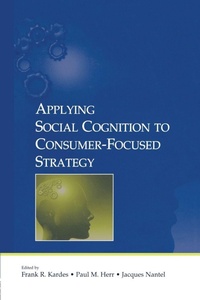
Applying Social Cognition to Consumer-Focused Strategy
1st Edition
Published on 7. May 2015
Book
Paperback/Softback
416 pages
978-1-138-87595-1 (ISBN)
Description
Applying Social Cognition to Consumer-Focused Strategy, a book in the Advertising and Consumer Psychology series sponsored by the Society for Consumer Psychology, focuses on the most important recent developments at the interface of social cognition and marketing, and develops integrative theoretical frameworks with rich practical implications. More specifically, the chapters offer a novel and thought-provoking perspective on consumer-focused strategy--or the effects of marketing stimuli and activities on an integrated system of consumer processes and responses.
Divided into four parts, this book:
*offers new perspectives on consumer information processing, selective or one sided information processing, and attribution theory;
*discusses how asking questions in focus groups, surveys, and experiments leads consumers to create opinions that would not have occurred to them otherwise;
*advances a new approach for modeling uncertainty and a new framework for thinking about uncertainty;
*summarizes recent developments concerning the Implicit Association Test and their implications for branding strategy;
*develops a new approach for analyzing the effects of intention on behavior and unplanned purchase behaviors;
*discusses the devaluation effect and shows both how implementation intentions can be used to increase new product consumption and also how promotion versus prevention regulatory focus influences consumer preferences; and
*focuses on consumer information processing and persuasion.
The text is intended for advanced graduate students, academics, and practitioners who embrace cutting-edge paradigms and methodologies in social-cognitive consumer research.
Divided into four parts, this book:
*offers new perspectives on consumer information processing, selective or one sided information processing, and attribution theory;
*discusses how asking questions in focus groups, surveys, and experiments leads consumers to create opinions that would not have occurred to them otherwise;
*advances a new approach for modeling uncertainty and a new framework for thinking about uncertainty;
*summarizes recent developments concerning the Implicit Association Test and their implications for branding strategy;
*develops a new approach for analyzing the effects of intention on behavior and unplanned purchase behaviors;
*discusses the devaluation effect and shows both how implementation intentions can be used to increase new product consumption and also how promotion versus prevention regulatory focus influences consumer preferences; and
*focuses on consumer information processing and persuasion.
The text is intended for advanced graduate students, academics, and practitioners who embrace cutting-edge paradigms and methodologies in social-cognitive consumer research.
More details
Series
Language
English
Place of publication
Hove
United Kingdom
Publishing group
Taylor & Francis Ltd
Target group
Professional and scholarly
Dimensions
Height: 229 mm
Width: 152 mm
Thickness: 22 mm
Weight
600 gr
ISBN-13
978-1-138-87595-1 (9781138875951)
Copyright in bibliographic data and cover images is held by Nielsen Book Services Limited or by the publishers or by their respective licensors: all rights reserved.
Schweitzer Classification
Other editions
Additional editions
Frank R. Kardes | Paul M. Herr | Jacques Nantel
Applying Social Cognition to Consumer-Focused Strategy
E-Book
04/2006
1st Edition
Psychology Press Ltd
€49.99
Available for download
Frank R. Kardes | Paul M. Herr | Jacques Nantel
Applying Social Cognition to Consumer-Focused Strategy
E-Book
04/2006
1st Edition
Psychology Press Ltd
€49.99
Available for download
Frank R. Kardes | Paul M. Herr | Jacques Nantel
Applying Social Cognition to Consumer-Focused Strategy
Book
07/2005
Psychology Press
€133.60
Shipment within 10-20 days
Persons
Frank R. Kardes, Paul M. Herr, Jacques Nantel
Content
Contents: Preface. Part I: New Perspectives on Consumer Information Processing. R.S. Wyer, Jr., The Role of Information Processing in Single-Alternative and Multiple-Alternative Judgments and Decisions. S.S. Posavac, G.J. Fitzsimons, F.R. Kardes, D.M. Sanbonmatsu, Implications of Selective Processing for Marketing Managers. D.H. Silvera, D. Laufer, Recent Developments in Attribution Research and Their Implications for Consumer Judgments and Behavior. Part II: New Perspectives on Consumer Information Processing and Research Methods. J.E. Machin, G.J. Fitzsimons, Marketing by Mistake: The Unintended Consequences of Consumer Research. M. Chandrashekaran, K. Rotte, R. Grewal, Knowledge in Error: Decoding Consumer Judgement With the JUMP Model. B.C. Tietje, F.F. Brunel, Toward a Unified Implicit Brand Theory. R. March, A.G. Woodside, Advancing Theory on Consumer Plans, Actions, and How Marketing Information Affects Both. Part III: New Perspectives on Motivation and Consumer Information Processing. A.B. Markman, C.M. Brendl, Goals, Policies, Preferences, and Actions. W.Y. Chun, A.W. Kruglanski, Consumption as a Multiple- Goal Pursuit Without Awareness. F.R. Kardes, M.L. Cronley, S.S. Posavac, Using Implementation Intentions to Increase New Product Consumption: A Field Experiment. A. Florack, M. Scarabis, S. Gosejohann, Regulatory Focus and Consumer Information Processing. Part IV: New Perspectives on Consumer Information Processing and Persuasion. E.J. Strahan, S.J. Spencer, M.P. Zanna, Subliminal Priming and Persuasion: How Motivation Affects the Activation of Goals and the Persuasiveness of Messages. C.V. Dimofte, R.F. Yalch, Consumer Responses to False Information: Is Believability Necessary for Persuasion? P.J. Mazzocco, D.D. Rucker, T.C. Brock, Implications for Advertising Effectiveness of Divergence Among Measured Advertising Effects. R.C. Goodstein, D.A. Cours, B.K. Jorgensen, J. Sengupta, The Positive Effects of Negative Advertising: It's a Matter of Time. S. Yoon, P.T. Vargas, When "What Might Have Been" Leads to What Isn't Best: Dysfunctional Counterfactual Thinking in Consumer Affect and Cognition. J. Eighmey, W. Siu, Complementary Roles of Dual-Process Models, Theory of Reasoned Action, Media Priming, and the Concept of Consideration in the Development of Advertising Message Strategies: A Case Study Concerning Youth Views of Military Service Amidst September 11, 2001. P.M. Herr, J. Nantel, F.R. Kardes, The Promise of Sociocognitive Consumer Psychology.