

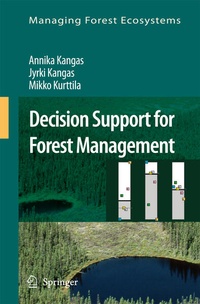
Decision Support for Forest Management
Published on 30. November 2010
Book
Paperback/Softback
XII, 224 pages
978-90-481-7727-1 (ISBN)
Description
This book has been developed as a textbook of decision support methods for s- dents and can also serve as a handbook for practical foresters. It is based on the research we have carried out and lectures we have given over the past years. We have set out to present all the methods in enough details and examples that they can be adopted from this book. For researchers who need more details, references are given to more advanced scienti c papers and books. In this book, theories of decision making and the methods used for forestry - cision support are presented. The book covers basics of classical utility theory and its fuzzy counterparts, exact and heuristic optimization method and modern mul- criteria decision support tools such as AHP or ELECTRE. Possibilities of analyzing and dealing with uncertainty are also brie y presented. The use of each method is illustrated with examples. In addition to decision aid methods, we present the basic theory of participatory planning. Both hard and soft methods suitable for partici- tory or group decision analysis are presented, such as problem structuring method and voting. The criticism towards decision theory is also covered.
Finally, some real-life examples of the methods are presented. Annika Kangas Department of Forest Resource Management University of Helsinki Jyrki Kangas Metsahallitus .. Mikko Kurttila University of Joensuu v Acknowledgements Manyresearchersandstudentshavehelpedusbyreviewingchapters,suggesting- provements and even checking our example calculations. We would like to ackno- edgethesereviewers,Ms.AnuHankala,M.Sc.TeppoHujala,M.Sc.AnnuKaila,Dr.
Finally, some real-life examples of the methods are presented. Annika Kangas Department of Forest Resource Management University of Helsinki Jyrki Kangas Metsahallitus .. Mikko Kurttila University of Joensuu v Acknowledgements Manyresearchersandstudentshavehelpedusbyreviewingchapters,suggesting- provements and even checking our example calculations. We would like to ackno- edgethesereviewers,Ms.AnuHankala,M.Sc.TeppoHujala,M.Sc.AnnuKaila,Dr.
Reviews / Votes
From the reviews:"It introduces many numerical techniques, and a fairly advanced level of knowledge . . If today's forest managers are to successfully manage the multiple values in a forest, they need to be aware of the decision support techniques that are available to them, and this book will certainly provide that information. Forestry students also need to know about these techniques if they wish to become successful forest managers . . It can therefore be recommended to all those involved in forest management." (John Innes, International Forestry Review, Vol. 10 (4), 2008)More details
Series
Edition
1st ed. Softcover of orig. ed. 2008
Language
English
Place of publication
Dordrecht
Netherlands
Target group
Professional and scholarly
Research
Illustrations
XII, 224 p.
Dimensions
Height: 235 mm
Width: 155 mm
Thickness: 13 mm
Weight
365 gr
ISBN-13
978-90-481-7727-1 (9789048177271)
DOI
10.1007/978-1-4020-6787-7
Schweitzer Classification
Other editions
New editions
Annika Kangas | Mikko Kurttila | Teppo Hujala
Decision Support for Forest Management
Book
11/2015
2nd Edition
Springer
€160.49
Shipment within 10-15 days
Additional editions
Annika Kangas | Jyrki Kangas | Mikko Kurttila
Decision Support for Forest Management
Book
04/2008
Springer
€106.95
Article exhausted; check for reprint
Annika Kangas | Jyrki Kangas | Mikko Kurttila
Decision Support for Forest Management
E-Book
03/2008
1st Edition
Springer
€88.80
Available for download
Content
Discrete Problems.- Unidimensional Problems.- Multi-Criteria Decision Problems.- Uncertainty in Multi-Criteria Decision Making.- Continuous Problems.- Optimization.- Heuristic Optimization.- Cases with Several Decision Makers.- Group Decision Making and Participatory Planning.- Voting Methods.- Application Viewpoints.- Behavioural Aspects.- Practical Examples of Using MCDS Methods.- Final Remarks.