

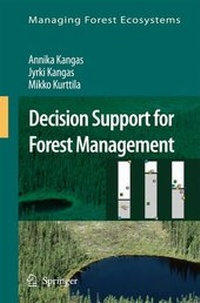
Decision Support for Forest Management
Published on 1. April 2008
Book
Hardback
XII, 224 pages
978-1-4020-6786-0 (ISBN)
Description
This book has been developed as a textbook of decision support methods for s- dents and can also serve as a handbook for practical foresters. It is based on the research we have carried out and lectures we have given over the past years. We have set out to present all the methods in enough details and examples that they can be adopted from this book. For researchers who need more details, references are given to more advanced scienti c papers and books. In this book, theories of decision making and the methods used for forestry - cision support are presented. The book covers basics of classical utility theory and its fuzzy counterparts, exact and heuristic optimization method and modern mul- criteria decision support tools such as AHP or ELECTRE. Possibilities of analyzing and dealing with uncertainty are also brie y presented. The use of each method is illustrated with examples. In addition to decision aid methods, we present the basic theory of participatory planning. Both hard and soft methods suitable for partici- tory or group decision analysis are presented, such as problem structuring method and voting. The criticism towards decision theory is also covered.
Finally, some real-life examples of the methods are presented. Annika Kangas Department of Forest Resource Management University of Helsinki Jyrki Kangas Metsahallitus .. Mikko Kurttila University of Joensuu v Acknowledgements Manyresearchersandstudentshavehelpedusbyreviewingchapters,suggesting- provements and even checking our example calculations. We would like to ackno- edgethesereviewers,Ms.AnuHankala,M.Sc.TeppoHujala,M.Sc.AnnuKaila,Dr.
Finally, some real-life examples of the methods are presented. Annika Kangas Department of Forest Resource Management University of Helsinki Jyrki Kangas Metsahallitus .. Mikko Kurttila University of Joensuu v Acknowledgements Manyresearchersandstudentshavehelpedusbyreviewingchapters,suggesting- provements and even checking our example calculations. We would like to ackno- edgethesereviewers,Ms.AnuHankala,M.Sc.TeppoHujala,M.Sc.AnnuKaila,Dr.
Reviews / Votes
From the reviews:"It introduces many numerical techniques, and a fairly advanced level of knowledge . . If today's forest managers are to successfully manage the multiple values in a forest, they need to be aware of the decision support techniques that are available to them, and this book will certainly provide that information. Forestry students also need to know about these techniques if they wish to become successful forest managers . . It can therefore be recommended to all those involved in forest management." (John Innes, International Forestry Review, Vol. 10 (4), 2008)More details
Series
Edition
2008
Language
English
Place of publication
Dordrecht
Netherlands
Target group
College/higher education
Professional and scholarly
Research
Product notice
Laminated cover
Illustrations
biography
Dimensions
Height: 23.5 cm
Width: 15.5 cm
Thickness: 14 mm
Weight
520 gr
ISBN-13
978-1-4020-6786-0 (9781402067860)
DOI
10.1007/978-1-4020-6787-7
Schweitzer Classification
Other editions
New editions
Annika Kangas | Mikko Kurttila | Teppo Hujala
Decision Support for Forest Management
Book
11/2015
2nd Edition
Springer
€160.49
Shipment within 10-15 days
Additional editions
Annika Kangas | Jyrki Kangas | Mikko Kurttila
Decision Support for Forest Management
Book
11/2010
Springer
€89.99
Shipment within 15-20 days
Annika Kangas | Jyrki Kangas | Mikko Kurttila
Decision Support for Forest Management
E-Book
03/2008
1st Edition
Springer
€88.80
Available for download
Content
Preface. Acknowledgements. 1. Introduction. 1.1 Planning and decision support. 1.2 Forest management planning. 1.3 History of forest planning.- Discrete problems. 2. Unidimensional problems. 2.1 Decisions under risk and uncertainty. 2.2 Measuring utility and value. 2.2.1 Estimating a utility function. 2.2.2 Estimating a value function.- 3. Multi-criteria decision problems. 3.1 Theoretical aspects. 3.2 Multi-attribute utility functions. 3.2.1 Function forms. 3.2.2 Basis for estimating the weights. 3.2.3 SMART. 3.3 Even Swaps. 3.4 Analytic hierarchy process. 3.4.1 Decision problem. 3.4.2 Phases of AHP. 3.4.3 Uncertainty in AHP. 3.4.4 ANP. 3.5 A'WOT.- 4. Uncertainty in multi-criteria decision making. 4.1 Nature of uncertainty. 4.2 Fuzzy set theory. 4.2.1 Membership functions and fuzzy numbers. 4.2.2 Fuzzy goals in decision making. 4.2.3 Fuzzy additive weighting. 4.3 Possibility theory in decision making. 4.4 Evidence theory. 4.5 Outranking methods. 4.5.1 Outline. 4.5.2 PROMETHEE method. 4.5.3 ELECTRE method. 4.5.4 Other outranking methods. 4.6 Probabilistic uncertainty in decision analysis. 4.6.1 Stochastic multicriteria acceptability analysis (SMAA). 4.6.2 SMAA-O. 4.6.3 Pairwise probabilities.- Continuous problems. 5. Optimization. 5.1 Linear programming. 5.1.1 Primal problem. 5.1.2 Dual problem. 5.1.3 Forest planning problem with several stands. 5.1.4 JLP software. 5.2 Goal programming. 5.3 Integer programming. 5.4 Uncertainty in optimization. 5.5 Robust portfolio modelling. 5.5.1 Principles of the method. 5.5.2 Use of RPM in forest planning.- 6. Heuristic optimization. 6.1 Principles. 6.2 Objective function forms. 6.3 HERO. 6.4 Simulated annealing and threshold accepting. 6.5 Tabu search. 6.6 Genetic algorithms. 6.7 Improving the heuristic search. 6.7.1 Parameters of heuristic optimisation techniques. 6.7.2 Expanding the neighbourhood. 6.7.3 Combining optimisation techniques.- Cases with several decision makers. 7. Group decision making and participatory planning. 7.1 Decision makers and stakeholders. 7.2 Public participation process. 7.2.1 Types of participation process. 7.2.2 Success of the participation process. 7.2.3 Defining the appropriate process. 7.3 Tools for eliciting the public preferences. 7.3.1 Surveys. 7.3.2 Public hearings. 7.4 Problem structuring methods. 7.4.1 Background. 7.4.2 Strategic options development and analysis (SODA). 7.4.3 Soft systems methodology (SSM). 7.5 Decision support for group decision making.- 8. Voting methods. 8.1 Social choice theory. 8.1.1 Outline. 8.1.2 Evaluation criteria for voting systems. 8.2 Positional voting schemes. 8.2.1 Plurality voting. 8.2.2 Approval voting. 8.2.3 Borda count. 8.3 Pairwise voting. 8.4 Fuzzy voting. 8.5 Probability voting. 8.6 Multicriteria approval. 8.6.1 Original method. 8.6.2 Fuzzy MA. 8.6.3 Multicriteria approval voting.- Application viewpoints. 9. Behavioural aspects. 9.1 Criticism towards decision theory. 9.1.1 Outline. 9.1.2 Satisficing or maximizing?. 9.1.3 Rules or rational behaviour?. 9.2 Image theory. 9.3 Prospect theory.- 10. Practical examples of using MCDS methods. 10.1 Landscape ecological planning. 10.2 Participatory planning. 10.3 Spatial objectives and heuristic optimisation in practical forest planning.- 11. Final remarks.-