

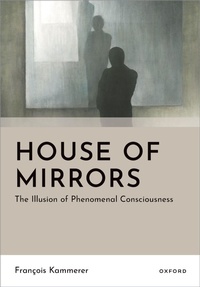
House of Mirrors
The Illusion of Phenomenal Consciousness
Will be published approx. on 17. October 2026
Book
Hardback
360 pages
978-0-19-784025-2 (ISBN)
Description
This is an open access title. It is available to read and download as a free PDF version on Oxford Academic and is made available under a Creative Commons Attribution-Non Commercial-No Derivatives 4.0 International licence.
Seeing a red spot, feeling back pain, imagining the sound of a harp: all these states seem to feel like something, in a distinctive sense of "feel." Philosophers categorize them as part of phenomenal consciousness. This form of consciousness seems mysterious, as it resists scientific explanation and seems irreducible to brain processes. Our phenomenally conscious experiences are presented to us intimately and directly when we have them, while remaining imperceptible to others.
House of Mirrors defends a radical view cutting through the mysteries and known as illusionism: the idea that phenomenal consciousness is not real and only seems real because we are under an introspective illusion generated by our brains. This illusion is unique: it is stronger and much harder to grasp than other illusions, such as perceptual illusions.
Francois Kammerer argues for illusionism and proposes a novel framework called Meta-Cartesianism, which explains why the illusion of phenomenal consciousness is unique and almost inextricable. Kammerer also maps the implications of the illusionist view in various domains: if phenomenal consciousness is illusory, what happens to the cognitive science of consciousness? What happens to ethics, given that phenomenal experiences seem crucial to well-being and moral status? What happens to epistemology, given that these experiences seem key to justification? House of Mirrors represents an important and bold new contribution to the study of consciousness.
Seeing a red spot, feeling back pain, imagining the sound of a harp: all these states seem to feel like something, in a distinctive sense of "feel." Philosophers categorize them as part of phenomenal consciousness. This form of consciousness seems mysterious, as it resists scientific explanation and seems irreducible to brain processes. Our phenomenally conscious experiences are presented to us intimately and directly when we have them, while remaining imperceptible to others.
House of Mirrors defends a radical view cutting through the mysteries and known as illusionism: the idea that phenomenal consciousness is not real and only seems real because we are under an introspective illusion generated by our brains. This illusion is unique: it is stronger and much harder to grasp than other illusions, such as perceptual illusions.
Francois Kammerer argues for illusionism and proposes a novel framework called Meta-Cartesianism, which explains why the illusion of phenomenal consciousness is unique and almost inextricable. Kammerer also maps the implications of the illusionist view in various domains: if phenomenal consciousness is illusory, what happens to the cognitive science of consciousness? What happens to ethics, given that phenomenal experiences seem crucial to well-being and moral status? What happens to epistemology, given that these experiences seem key to justification? House of Mirrors represents an important and bold new contribution to the study of consciousness.
More details
Series
Language
English
Place of publication
New York
United States
Product notice
sewn/stitched
Cloth over boards
Dimensions
Height: 235 mm
Width: 156 mm
ISBN-13
978-0-19-784025-2 (9780197840252)
Copyright in bibliographic data and cover images is held by Nielsen Book Services Limited or by the publishers or by their respective licensors: all rights reserved.
Schweitzer Classification
Person
Francois Kammerer is a CNRS Researcher at the Archives Henri-Poincare in Strasbourg, France. An analytic philosopher of mind, he has worked and published on the topics of consciousness and introspection.
Content
- Incoming