

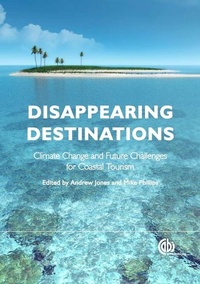
Disappearing Destinations
Climate Change and Future Challenges for Coastal Tourism
Published on 15. December 2010
Book
Hardback
296 pages
978-1-84593-548-1 (ISBN)
Description
Providing a thorough examination of the threats posed to destinations by tourism, this comprehensive text discusses how popular and fragile destinations such as the Great Barrier Reef could become severely damaged and forced to close to tourists if current tourism trends continue. The consequences of tourism growth, predicted changes, and management and policy responses are reviewed. The book will explore tourism in the context of climate change and vulnerable environments, exploring the situation at local level and in a wider perspective using international case studies throughout and providing future recommendations. It will be an essential text for researchers, policymakers and students in tourism, ecotourism, environmental conservation, planning, coastal management and engineering, climate change and marine conservation.
More details
Language
English
Place of publication
Wallingford
United Kingdom
Target group
Professional and scholarly
Product notice
sewn/stitched
Cloth over boards
Dimensions
Height: 251 mm
Width: 174 mm
Thickness: 22 mm
Weight
784 gr
ISBN-13
978-1-84593-548-1 (9781845935481)
Copyright in bibliographic data and cover images is held by Nielsen Book Services Limited or by the publishers or by their respective licensors: all rights reserved.
Schweitzer Classification
Other editions
Additional editions
Andrew Jones | Michael Phillips
Disappearing Destinations
Climate Change and Future Challenges for Coastal Tourism
E-Book
12/2010
CABI Publishing
€163.99
Available for download
Persons
Andrew is currently a resident professor and Head of Department for the Institute for Tourism Travel and Culture at The University of Malta. He has also held positions at The University of Wales, International Faculty Cardiff, Swansea Business School and the University of Brunei. In his early career he qualified in Urban and Regional Planning and Economic Development and initially worked within these fields both in the public and private sectors before taking up a position at the University of Wales where he taught planning , economic regeneration, environmental management and tourism development. He has professional experience in planning, environmental management and tourism management at international, regional and local levels and has been an enthusiastic contributor to the academic tourism community within the UK and internationally for over thirty years. In this respect he has been an active practitioner, researcher and teacher since 1981. In his positions with both the University of Wales and University of Malta he has been involved in the University's collaborative programmes and partnerships in Greece, China, and India, Hong Kong, Singapore, Uzbekistan, Malaysia, Japan, Germany and the UK.
He completed his Ph.D. on research investigating the relationship and tensions between cultural regeneration, the environment and the development of niche markets for tourism. Research associated with his academic experience over the last twenty years and the consequent research out puts have allowed him to develop a research profile based upon strategic/environmental planning, regeneration, economic and regional development, sustainable planning policy and the relationship between these dynamic processes and tourism development and in turn the development of sustainable/cultural (tourism) niche markets.
As such he has carried out numerous consultancy projects relating to economic regeneration, tourism planning, cultural regeneration and sustainability and has published a number of industry and academic articles, reports and conference papers. To this end he has travelled widely and has contributed to international conferences in Europe, North America, Asia and Australasia and spent two years as a visiting research fellow at the University of Brunei. Professor Mike Phillips has a BSc in Civil Engineering, an MSc in Environmental Management and a PhD in Coastal Processes and Geomorphology, which he has used in an interdisciplinary way to assess current challenges of living and working on the coast. He is Pro Vice-Chancellor (Research, Innovation, Enterprise and Commercialisation) at the University of Wales Trinity Saint David and also leads their Coastal and Marine Research Group. Professor Phillips' research expertise includes coastal processes, morphological change and adaptation to climate change and sea level rise, and this has informed his engagement in the policy arena. He has given many key note speeches, presented at many major international conferences and evaluated various international and national coastal research projects. Consultancy contracts include beach monitoring for the development of the Tidal Lagoon Swansea Bay, assessing beach processes and evolution at Fairbourne (one of the case studies in this book), beach replenishment issues, and techniques to monitor underwater sediment movement to inform beach management. Funded interdisciplinary research projects have included adaptation strategies in response to climate change and underwater sensor networks. He has published >100 academic articles and in 2010 organised a session on Coastal Tourism and Climate Change at UNESCO Headquarters in Paris in his role as a member of the Climate, Oceans and Security Working Group of the UNEP Global Forum on Oceans, Coasts, and Islands. He has successfully supervised many PhD students, and as well as research students in his own University, advises PhD students for overseas universities. These currently include the University of KwaZuluNatal, Durban, University of Technology, Mauritius and University of Aveiro, Portugal. Professor Phillips has been a Trustee/Director of the US Coastal Education and Research Foundation (CERF) since 2011 and he is on the Editorial Board of the Journal of Coastal Research. He is also an Adjunct Professor in the Department of Geography, University of Victoria, British Columbia and Visiting Professor at the University Centre of the Westfjords. He was an expert advisor for the Portuguese FCT Adaptaria (coastal adaptation to climate change) and Smartparks (planning marine conservation areas) projects and his contributions to coastal and ocean policies included: the Rio +20 World Summit, Global Forum on Oceans, Coasts and Islands; UNESCO; EU Maritime Spatial Planning; and Welsh Government Policy on Marine Aggregate Dredging. Past contributions to research agendas include the German Cluster of Excellence in Marine Environmental Sciences (MARUM) and the Portuguese Department of Science and Technology.
He completed his Ph.D. on research investigating the relationship and tensions between cultural regeneration, the environment and the development of niche markets for tourism. Research associated with his academic experience over the last twenty years and the consequent research out puts have allowed him to develop a research profile based upon strategic/environmental planning, regeneration, economic and regional development, sustainable planning policy and the relationship between these dynamic processes and tourism development and in turn the development of sustainable/cultural (tourism) niche markets.
As such he has carried out numerous consultancy projects relating to economic regeneration, tourism planning, cultural regeneration and sustainability and has published a number of industry and academic articles, reports and conference papers. To this end he has travelled widely and has contributed to international conferences in Europe, North America, Asia and Australasia and spent two years as a visiting research fellow at the University of Brunei. Professor Mike Phillips has a BSc in Civil Engineering, an MSc in Environmental Management and a PhD in Coastal Processes and Geomorphology, which he has used in an interdisciplinary way to assess current challenges of living and working on the coast. He is Pro Vice-Chancellor (Research, Innovation, Enterprise and Commercialisation) at the University of Wales Trinity Saint David and also leads their Coastal and Marine Research Group. Professor Phillips' research expertise includes coastal processes, morphological change and adaptation to climate change and sea level rise, and this has informed his engagement in the policy arena. He has given many key note speeches, presented at many major international conferences and evaluated various international and national coastal research projects. Consultancy contracts include beach monitoring for the development of the Tidal Lagoon Swansea Bay, assessing beach processes and evolution at Fairbourne (one of the case studies in this book), beach replenishment issues, and techniques to monitor underwater sediment movement to inform beach management. Funded interdisciplinary research projects have included adaptation strategies in response to climate change and underwater sensor networks. He has published >100 academic articles and in 2010 organised a session on Coastal Tourism and Climate Change at UNESCO Headquarters in Paris in his role as a member of the Climate, Oceans and Security Working Group of the UNEP Global Forum on Oceans, Coasts, and Islands. He has successfully supervised many PhD students, and as well as research students in his own University, advises PhD students for overseas universities. These currently include the University of KwaZuluNatal, Durban, University of Technology, Mauritius and University of Aveiro, Portugal. Professor Phillips has been a Trustee/Director of the US Coastal Education and Research Foundation (CERF) since 2011 and he is on the Editorial Board of the Journal of Coastal Research. He is also an Adjunct Professor in the Department of Geography, University of Victoria, British Columbia and Visiting Professor at the University Centre of the Westfjords. He was an expert advisor for the Portuguese FCT Adaptaria (coastal adaptation to climate change) and Smartparks (planning marine conservation areas) projects and his contributions to coastal and ocean policies included: the Rio +20 World Summit, Global Forum on Oceans, Coasts and Islands; UNESCO; EU Maritime Spatial Planning; and Welsh Government Policy on Marine Aggregate Dredging. Past contributions to research agendas include the German Cluster of Excellence in Marine Environmental Sciences (MARUM) and the Portuguese Department of Science and Technology.
Editor
Director: Institute for Tourism Travel and CultureL-Universita ta' Malta, Malta
University of Wales, UK
Contributions
Maastricht University, Netherlands
University of Cadiz, Spain
Formerly Oxford Brookes University, UK
DirectorInstitute for Tourism Research (INTOUR), UK
University of the Azores, Portugal
University of Delaware, USA
University of Ulster, Ireland
University of Victoria, Canada
Content
1: Introduction - Disappearing Destinations: Current issues Challenges and Polemics. 2: Climate Change and its Impacts on Tourism: Regional Assessments, Knowledge Gaps and Issues. 3: Managing the Coastal Zone. 4: Definitions and Typologies of Coastal Tourism Beach Destinations. 5: Climate Change: Risk Management Issues and Challenges. 6: Climate change and the Law. 7: Climate Change, Tourism and the Media: Developing a Research Agenda. 8: Climate Change and the Mediterranean Southern Coasts. 9: Climate Change and Coastal Tourism in the Azores Archipelago. 10: Climate Change and Coastal Tourism in Ireland. 11: Climate Change - Coral Reefs and Dive Tourism in Southeast Asia. 12: Tourism and Climate Impact on North American Eastern Seaboard. 13: Would you like Ice with that? Antarctic Tourism and Climate Change. 14: UK Coastal Tourism Destinations: Assessment of Perceived Climate Impacts: Issues for Destination management, Local Governance and Public Policy Making. 15: Grand Isle, Louisiana: A Historic U.S. Gulf Coast Resort Adapts to Hurricanes, Subsidence, and Sea Level Rise. 16: Impact of Climate Change on Island tourism - The Balearic Islands: Impacts, Vulnerability and Critical Management issues. 17: The impact of climate change on reef-based tourism in Cairns, Australia - adaptation and response strategies for a highly vulnerable destination. 18: Disappearing Destinations: Recognizing Problems - Meeting Expectations - Delivering Solutions.