

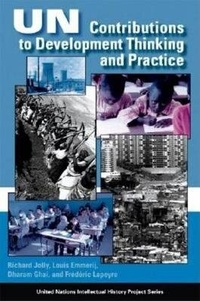
UN
Contributions to Development Thinking and Practice
Published on 18. June 2004
Book
Hardback
320 pages
978-0-253-34407-6 (ISBN)
Description
UN Contributions to Development Thinking and Practice is at once a history of the ideas and realities of international development, from the classical economists to the recent emphasis on human rights, and a history of the UN's role in shaping and implementing development paradigms over the last half century. The authors, all prominent in the field of development studies, argue that the UN's founding document, the UN Charter, is infused with the human values and human concerns that are at the centre of the UN's thinking on economic and human development today. In the intervening period, the authors show how the UN's approach to development evolved from mainstream areas of economic development to include issues of employment, poverty reduction, fairer distribution of the benefits of growth, equality of men and women, child development, social justice, and environmental sustainability.
More details
Series
Language
English
Place of publication
Bloomington, IN
United States
Target group
Professional and scholarly
Dimensions
Height: 240 mm
Width: 154 mm
Weight
680 gr
ISBN-13
978-0-253-34407-6 (9780253344076)
Copyright in bibliographic data and cover images is held by Nielsen Book Services Limited or by the publishers or by their respective licensors: all rights reserved.
Schweitzer Classification
Other editions
New editions
Richard Jolly | Louis Emmerij | Dharam Ghai
UN Contributions to Development Thinking and Practice
Book
06/2004
Indiana University Press
€41.50
Shipment within 10-20 days
Content
Part One: Values and History 1. Has There Been Progress? Values and Criteria for UN History; 2. The History of Development Thinking from Adam Smith to John Maynard Keynes Part Two: Ideas and Action 3. The 1940s & 1950s - the Foundations of UN Development Thinking and Practice; 4. The 1960s - The UN Development Decade: Mobilizing for Development; 5. The 1970s - Equity in Development; 6. The 1980s - Losing Control and Marginalizing the Poorest; 7. The 1990s - Rediscovering a Human Vision; 8. Building the Human Foundations; 9. Structural and Sector Change Part Three: Outcomes and the Future 10. The Record of Performance; 11. UN Contributions and Missed Opportunities; 12. Lessons for the Future: Development Thinking and the UN's Future