

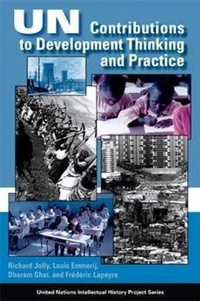
UN Contributions to Development Thinking and Practice
Published on 18. June 2004
Book
Paperback/Softback
400 pages
978-0-253-21684-7 (ISBN)
Description
UN Contributions to Development Thinking and Practice is at once a history of the ideas and realities of international development, from the classical economists to the recent emphasis on human rights, and a history of the UN's role in shaping and implementing development paradigms over the last half century. The authors, all prominent in the field of development studies, argue that the UN's founding document, the UN Charter, is infused with the human values and human concerns that are at the center of the UN's thinking on economic and human development today. In the intervening period, the authors show how the UN's approach to development evolved from mainstream areas of economic development to include issues of employment, poverty reduction, fairer distribution of the benefits of growth, equality of men and women, child development, social justice, and environmental sustainability.
Reviews / Votes
"One of the titles in a projected 14-volume series sponsored by the United Nations Intellectual History Project (see also Michael Ward's book in this series, Quantifying the World: UN Ideas and Statistics, CH, Oct'04), this institutional history of the UN is surprisingly readable. The product of four authors' collaboration, it tells an interesting story of UN work in development theory and practice. After a brief review of development literature, the authors break down the UN experience into five major periods. The 1940s and 1950s were foundational, with the work of Raul Prebisch and many others promulgated under UN auspices. The 1960s were the decade of development, first declared by John F. Kennedy in 1961. The 1970s saw a focus on equity in development, and the 1980s saw UN agencies being eclipsed by the International Monetary Fund and World Bank. By the 1990s, the UN Development Program restored a focus on human development that had been lost earlier. Concluding with a review of UN development ideas, the authors describe successes but do not hesitate to point out failures. Well organized and well written, this book will be essential reading in international organization or economic development courses. Summing Up: Highly recommended. Public, academic, upper-division undergraduate and up, and professional library collections."-S. Waalkes, Malone College , Choice, January 2005"Well organized and well written, this book will be essential reading in international organization or economic development courses. Summing Up: Highly recommended. Public, academic, upper-division undergraduate and up, and professional library collections.January 2005"-Choice
More details
Series
Language
English
Place of publication
Bloomington, IN
United States
Target group
Professional and scholarly
Product notice
Paperback (trade)
Illustrations
4 figures, 1 index
Dimensions
Height: 236 mm
Width: 154 mm
Thickness: 27 mm
Weight
567 gr
ISBN-13
978-0-253-21684-7 (9780253216847)
Copyright in bibliographic data and cover images is held by Nielsen Book Services Limited or by the publishers or by their respective licensors: all rights reserved.
Schweitzer Classification
Other editions
Previous edition
Book
06/2004
Indiana University Press
€60.66
Article exhausted; check for reprint
Persons
Richard Jolly is Senior Research Fellow at the CUNY Graduate Center, where he is co-director of the United Nations Intellectual History Project.
Louis Emmerij is Senior Research Fellow at the CUNY Graduate Center, where he is co-director of the United Nations Intellectual History Project.
Dharam Ghai is Advisor to the International Labour Organization.
Frederic Lapeyre is Professor at the Institute of Development Studies, Catholic University of Louvain, and a member of the United Nations Intellectual History Project.
Louis Emmerij is Senior Research Fellow at the CUNY Graduate Center, where he is co-director of the United Nations Intellectual History Project.
Dharam Ghai is Advisor to the International Labour Organization.
Frederic Lapeyre is Professor at the Institute of Development Studies, Catholic University of Louvain, and a member of the United Nations Intellectual History Project.
Content
List of Boxes, Tables, and Figures
Foreword by Louis Emmerij, Richard Jolly, and Thomas G. Weiss
Preface and Acknowledgments
List of Abbreviations
Part I. Values and History
1. Has There Been Progress? Values and Criteria for UN History
2. The History of Development Thinking from Adam Smith to John Maynard Keynes
Part II. Ideas and Action
3. The 1940s and 1950s: The Foundations of UN Development Thinking and Practice
4. The 1960s: The UN Development Decade-Mobilizing for Development
5. The 1970s: Equity in Development
6. The 1980s: Losing Control and Marginalizing the Poorest
7. The 1990s: Rediscovering a Human Vision
8. Building the Human Foundations
9. Structural and Sectoral Change
Part III. Outcomes and the Future
10. The Record of Performance
11. UN Contributions and Missed Opportunities
12. Lessons for the Future: Development Thinking and the UN's Future
Appendix: ILO Special Topics
Notes
Index
About the Authors
About the UN Intellectual History Project
Foreword by Louis Emmerij, Richard Jolly, and Thomas G. Weiss
Preface and Acknowledgments
List of Abbreviations
Part I. Values and History
1. Has There Been Progress? Values and Criteria for UN History
2. The History of Development Thinking from Adam Smith to John Maynard Keynes
Part II. Ideas and Action
3. The 1940s and 1950s: The Foundations of UN Development Thinking and Practice
4. The 1960s: The UN Development Decade-Mobilizing for Development
5. The 1970s: Equity in Development
6. The 1980s: Losing Control and Marginalizing the Poorest
7. The 1990s: Rediscovering a Human Vision
8. Building the Human Foundations
9. Structural and Sectoral Change
Part III. Outcomes and the Future
10. The Record of Performance
11. UN Contributions and Missed Opportunities
12. Lessons for the Future: Development Thinking and the UN's Future
Appendix: ILO Special Topics
Notes
Index
About the Authors
About the UN Intellectual History Project