

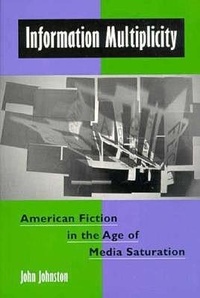
Information Multiplicity
American Fiction in the Age of Media Saturation
Published on 3. July 1998
Book
Paperback/Softback
320 pages
978-0-8018-5705-8 (ISBN)
Description
"With the birth of information theory and cybernetics in the late 1940s and early 1950s," writes John Johnston, "a decisive step was taken toward the immense techno-scientific transformation of the world into coded bits of 'information' and machinic assemblages." Beginning with Thomas Pynchon's The Crying of Lot 49, the novels that have reflected this transformation have similarly assembled disparate bits of information and narrative into fictions saturated with data and transcribed "clips" from media such as motion pictures, television, recordings, and computer files. Realism having thus fractilized into high-speed collage, thought itself is redefined from the High Modernist "stream of consciousness" into what the machine psychologist Daniel Dennett refers to as "multiple drafts" or "circuits" operating concurrently in the human brain. In a series of close readings, Johnston traces how this viral influx of information into human consciousness has been replicated in works by Thomas Pynchon ( Gravity's Rainbow and Vineland), Joseph McElroy ( Lookout Cartridge), William Gaddis ( J.R.), Don DeLillo ( Libra), and William Gibson ( Necromancer).
From John Johnston's Introduction: "Information multiplicities are profoundly corrosive of older cultural forms and identities, dissolving both subjects and objects alike into systems, processes and nodes in the circuits and flow of information exchange. But they also bring about new kinds of energy and even strange new forms of 'artificial life.'...Contemporary culture-or more specifically what is called postmordern techno- or cyberculture-is a restructuring process that can similarly be described: as an artifactual space created when information re-structures modern or traditional culture in order to make it a better habitat for information."
From John Johnston's Introduction: "Information multiplicities are profoundly corrosive of older cultural forms and identities, dissolving both subjects and objects alike into systems, processes and nodes in the circuits and flow of information exchange. But they also bring about new kinds of energy and even strange new forms of 'artificial life.'...Contemporary culture-or more specifically what is called postmordern techno- or cyberculture-is a restructuring process that can similarly be described: as an artifactual space created when information re-structures modern or traditional culture in order to make it a better habitat for information."
Reviews / Votes
Making thoughtful use of Deleuze, Guattari, and even Baudrillard, Johnston offers a learned yet clear analysis; this volume will become indispensable to college and university collections of literary criticism. ChoiceMore details
Language
English
Place of publication
Baltimore, MD
United States
Target group
Professional and scholarly
Product notice
Paperback (trade)
Dimensions
Height: 227 mm
Width: 152 mm
Thickness: 18 mm
Weight
440 gr
ISBN-13
978-0-8018-5705-8 (9780801857058)
DOI
10.56021/9780801857041
Copyright in bibliographic data and cover images is held by Nielsen Book Services Limited or by the publishers or by their respective licensors: all rights reserved.
Schweitzer Classification
Other editions
Additional editions

Book
07/1998
Johns Hopkins University Press
€72.71
Article not available for order
E-Book
07/1998
Johns Hopkins University Press
€23.49
Available for download
Person
John Johnston teaches in the department of English at Emory University.
Content
Acknowledgements
Introduction
Part I: Writing (in) the Machinic Universe
Chapter 1. The Literary Assemblage: Writing Machines and Late Capitalism
Chapter 2. Information and Mediality: The Novel as Psychic Apparatus
Part II: The Novel of Information Multiplicity
Chapter 3. Rocket-State Assemblage: Gravity's Rainbow
Chapter 4. Narration, Delirium, Machinic Consciousness: Lookout Cartridge
Chapter 5. Capitalism and Entropic Flow: JR
Part III: The Novel of Media Assemblages
Chapter 6. Fictions of the Culture Medium: The Novels of Don DeLillo
Chapter 7. An American Book of the Dead: Media and Spectral Life in Vineland
Chapter 8. The Disappearance of Media: Cyberspace in Neuromancer
Coda. "Change for the Machines": The Complexity of Bodies in Synners
Notes
Index
Introduction
Part I: Writing (in) the Machinic Universe
Chapter 1. The Literary Assemblage: Writing Machines and Late Capitalism
Chapter 2. Information and Mediality: The Novel as Psychic Apparatus
Part II: The Novel of Information Multiplicity
Chapter 3. Rocket-State Assemblage: Gravity's Rainbow
Chapter 4. Narration, Delirium, Machinic Consciousness: Lookout Cartridge
Chapter 5. Capitalism and Entropic Flow: JR
Part III: The Novel of Media Assemblages
Chapter 6. Fictions of the Culture Medium: The Novels of Don DeLillo
Chapter 7. An American Book of the Dead: Media and Spectral Life in Vineland
Chapter 8. The Disappearance of Media: Cyberspace in Neuromancer
Coda. "Change for the Machines": The Complexity of Bodies in Synners
Notes
Index