


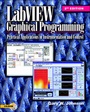
LabVIEW Graphical Programming
Practical Applications in Instrumentation and Control
3rd Edition
Published on 19. July 2001
Book
Mixed media product
400 pages
978-0-07-137001-1 (ISBN)
Description
This book is a basic programming primer, starting with LabVIEW basics and building up through some very powerful programming concepts. It is written in a breezy, light style, and has been frequently recommended for its accessibility and readability. These strengths remain in place in the new edition, but we've added Richard Jennings of Sandia National Laboratories, another well-known figure in the LabVIEW community, to bring his peerless knowledge of real time and embedded applications to the party. Combined with a CD featuring an entirely new smorgasbord of virtual instruments and a demo of 6.0, this is a one-of-a kind LabVIEW starter kit.
Reviews / Votes
"Best "Practical application of Labview book" "I am a user of both Gary's book and the other person's book and I find myself reaching for Gary's book far more often than the other one. He covers some very advanced topics that are practical to many of us. His writing style allows for easy reading. The CD that is included has so many VI's that you will not know where to start" Reader Review, Amazon.comMore details
Edition
3rd Revised edition
Language
English
Place of publication
New York
United States
Publishing group
McGraw-Hill Education - Europe
Target group
College/higher education
Edition type
Revised edition
Illustrations
200ill.
Dimensions
Height: 228 mm
Width: 180 mm
Thickness: 31 mm
Weight
1227 gr
ISBN-13
978-0-07-137001-1 (9780071370011)
Copyright in bibliographic data is held by Nielsen Book Services Limited or its licensors: all rights reserved.
Schweitzer Classification
Other editions
New editions
Richard Jennings | Fabiola De la Cueva
LabVIEW Graphical Programming, Fifth Edition
Book
11/2019
5th Edition
McGraw-Hill Education
€102.00
Shipment within 10-20 days
Gary Johnson | Richard Jennings
LabVIEW Graphical Programming
Book
08/2006
4th Edition
McGraw-Hill Professional
€85.41
Article exhausted; check for reprint
Previous edition
Book
07/1997
2nd Edition
McGraw-Hill Professional
€62.47
Article exhausted; check for reprint
Persons
GARY W. JOHNSON is known throughout the LabVIEW community as a programming guru extraordinaire. An instrumentation engineer at the Lawrence Livermore National Laboratory, he is one of the early adopters of LabVIEW and the author of all editions of this bestselling guide, the leading primary reference for general LabVIEW application development. He has previously edited LABVIEW POWER PROGRAMMING, a more advanced guide to the software, also available from McGraw-Hill. Gary has a BS degree in electrical engineering/ bioengineering from the University of Illinois and holds commercial radiotelephone and amateur radio licenses. His profesional interests include physics diagnostics, material xcharacterization, measurement and control systems, electro-optics, communications, transducers, analog circuit design, and, of course, LabVIEW programming. In his spare time, he enjoys woodworking, bicycling, and audio. He and his wife, Katherine, a scientific illustrator, live in Livermore, California, with their twin Afghan hounds, Chloe and Derby. RICHARD JENNINGS is a Senior Technologist and longtime LabVIEW programmer at Sandia National Laboratories in Livermore, California. He has been using LabVIEW for over 120 years and LabVIEW for Linux since its introduction. He has an AA degree in laser-electro optics from Texas State Technical College in Waco, Texas. He specializes in laboratory automation and finding new ways to use LabVIEW and Linux in Sandia's Combustion Research Facility. At home with his wife Patty and four children, Elizabeth, Danny, Chris, and David, Richard just enjoys being a dad.
Content
Chapter 1: Roots. Chapter 2: Getting Started. Chapter 3: Inputs and Outputs. Chapter 4: Sampling Signals. Chapter 5: Controlling Program Flow. Chapter 6: LabVIEW Data Types. Chapter 7: Timing. Chapter 8: Synchronization. Chapter 9: Files. Chapter 10: Gary's Approach to Building an Application. Chapter 11: Documentation. Chapter 12: Instrument Drivers. Chapter 13: Instrument Driver Development Techniques. Chapter 14: Using the DAQ Library. Chapter 15: Analog DAQ. Chapter 16: Digital DAQ. Chapter 17: Writing a Data Acquisition Program. Chapter 18: Process Control Applications. Chapter 19: Physics Applications. Chapter 20: Data Visualization, Imaging, and Sound. Chapter 21: LabVIEW RT Does Real Time. Chapter 22: Embedding LabVIEW for Linux in a Virtual Machine. Chapter 23: LabVIEW and Linux in Embedded Systems. Chapter 24: Interfacing LabVIEW to Real-Time Linux.