

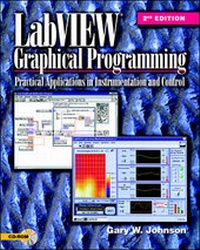
LabVIEW Graphical Programming: Practical Applications in Instrumentation and Control
2nd Edition
Published on 16. July 1997
Book
Paperback/Softback
400 pages
978-0-07-032915-7 (ISBN)
Description
The #1 guide to LabVIEW, updated for release 4.0! This is the only in-depth, engineering-level guide to the popular graphical programming language for virtual instrumentation. Using LabVIEW, engineers and scientists can create software-based instruments that can do the job of real-world hardwareNsaving thousands of dollars! Providing complete coverage of LabVIEW from a practical, engineering perspective, and including a CD-ROM with an extensive library of ready-to-use virtual instruments, this book will get you up to speed in no time.
More details
Edition
2nd edition
Language
English
Place of publication
United States
Publishing group
McGraw-Hill Education - Europe
Target group
Professional and scholarly
Illustrations
350 illustrations
Dimensions
Height: 234 mm
Width: 185 mm
Thickness: 28 mm
Weight
1021 gr
ISBN-13
978-0-07-032915-7 (9780070329157)
Copyright in bibliographic data and cover images is held by Nielsen Book Services Limited or by the publishers or by their respective licensors: all rights reserved.
Schweitzer Classification
Other editions
New editions

Book
07/2001
3rd Edition
McGraw-Hill Inc.,US
€61.97
Article exhausted; check for reprint
Previous edition
Book
07/1994
McGraw-Hill Inc.,US
€55.32
Article exhausted; check for reprint
Person
Gary W. Johnson (Livermore, CA) is a Electronics Engineer at the Lawrence Livermore National Laboratory. He is known throughout the LabVIEW community as a programming guru extraordinaire, and is the author of the previous two editions of LabVIEW Graphical Programming and the editor of the LabVIEW Power Programming.
Content
Roots.Inputs and Outputs.LabVIEW Programming Techniques.Building an Application.Instrument Drivers.using the DAW Library.Writing a Data Acquisition Program.Process Control Applications.Physics Applications.Data Visualization, Imaging and Sound.Automated Test Applications.Appendix A.Appendix B.