

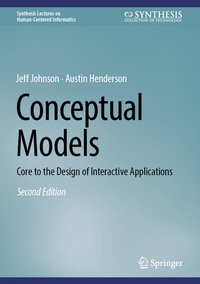
Conceptual Models
Core to the Design of Interactive Applications
2nd Edition
Published on 28. April 2024
Book
Hardback
XVI, 140 pages
978-3-031-50851-6 (ISBN)
Description
This book presents readers with an exploration of the concept of Conceptual Models and argues that they are core to achieving good design of interactive applications that are easy, effective, and enjoyable to use. The authors' years of experience helping companies create interactive software applications revealed that interactive applications built without Conceptual Models generally result in fraught production processes and designs that are confusing and difficult to learn, remember, and use. Instead, the book shows that Conceptual Models can be a central link between the elements involved in the use of interactive applications: people's tasks (domains), their plans for performing those tasks, the use of applications in the plans, the conceptual structure of applications, the presentation of the conceptual model (i.e., the user interface), the terms used to describe it, its implementation, and the learning that people must do to use the application. Readers will learn how putting a Conceptual Model at the core of the design and development process can pay rich dividends: designs are simpler, more coherent, and better aligned with users' tasks; unnecessary features are avoided; documentation is easier, development is faster and cheaper; customer uptake is improved; and the need for training and customer support is reduced.
To support its use in instruction, this second edition has been revised to explain the history and theoretical context of conceptual modeling using a consistent vocabulary, describe the structure of conceptual models, provide more current and more complete examples, explain how conceptual models fit into design and development, and further summarize the benefits of conceptual modeling.
To support its use in instruction, this second edition has been revised to explain the history and theoretical context of conceptual modeling using a consistent vocabulary, describe the structure of conceptual models, provide more current and more complete examples, explain how conceptual models fit into design and development, and further summarize the benefits of conceptual modeling.
More details
Series
Edition
Second Edition 2024
Language
English
Place of publication
Cham
Switzerland
Publishing group
Springer International Publishing
Target group
Professional and scholarly
Edition type
Revised edition
Illustrations
11 s/w Abbildungen, 21 farbige Abbildungen
XVI, 140 p. 32 illus., 21 illus. in color.
Dimensions
Height: 246 mm
Width: 173 mm
Thickness: 15 mm
Weight
450 gr
ISBN-13
978-3-031-50851-6 (9783031508516)
DOI
10.1007/978-3-031-50852-3
Schweitzer Classification
Other editions
Additional editions
Book
04/2025
2nd Edition
Springer
€48.14
Shipment within 15-20 days
E-Book
04/2024
2nd Edition
Springer
€48.14
Available for download
Previous edition
Book
12/2011
1st Edition
Springer
€32.09
Article exhausted; check for reprint
Persons
Jeff Johnson
is President and Principal Consultant at Wiser Usability, a consulting firm specializing in elder usability and accessibility. He has worked in the field of Human-Computer Interaction since 1978. After earning B.A. and Ph.D. degrees from Yale and Stanford Universities, he worked as a user-interface designer and implementer, engineer manager, usability tester, and researcher at Cromemco, Xerox, US West, Hewlett-Packard Labs, and Sun Microsystems. He has taught at Stanford University and Mills College,and in 2006 was an Erskine Teaching Fellow at the University of Canterbury in Christchurch New Zealand. He has published numerous articles and book chapters on a variety of topics in Human-Computer Interaction and the impact of technology on society. He frequently gives talks and tutorials at conferences and companies on usability and user-interface design. His previous books are: GUI Bloopers: Donâ?Tts and Dos for Software Developers and Web Designers (2000), Web Bloopers: 60 Common Design Mistakes and How to Avoid Them (2003), GUI Bloopers 2.0: Common User Interface Design Donâ?Tts and Dos(2007), and Designing with the Mind in Mind: Simple Guide to Understanding User Interface Design Rules(2010).
Austin Henderson 's 45-year career in Human-Computer Interaction includes user interface research and architecture at MIT's Lincoln Laboratory, Bolt Beranek and Newman, Xerox Research (both PARC and EuroPARC), Apple Computer, and Pitney Bowes, as well as strategic industrial design with Fitch and his own Rivendel Consulting & Design. Austin has built both commercial and research applications in many domains including manufacturing, programming languages, air traffic control, electronic mail (Hermes), user interface design tools (Trillium),workspace management (Rooms, Buttons), distributed collaboration (MediaSpace), and user-evolvable systems (Tailorable - ""design continued in use,"" Pliant - ""designing for the unanticipated"" and ""scalable conversations""). These applications, and their development with users, have grounded his analytical work, which has included the nature of computation-based socio-technical systems, the interaction of people with the technology in those systems, and the practices and tools of their development. The primary goal of his work has been to better meet user needs, both by improving system development to better anticipate those needs, and by broadening system capability to enable users themselves to better respond to unanticipated needs when they arise in a rich and changing world.
Austin Henderson 's 45-year career in Human-Computer Interaction includes user interface research and architecture at MIT's Lincoln Laboratory, Bolt Beranek and Newman, Xerox Research (both PARC and EuroPARC), Apple Computer, and Pitney Bowes, as well as strategic industrial design with Fitch and his own Rivendel Consulting & Design. Austin has built both commercial and research applications in many domains including manufacturing, programming languages, air traffic control, electronic mail (Hermes), user interface design tools (Trillium),workspace management (Rooms, Buttons), distributed collaboration (MediaSpace), and user-evolvable systems (Tailorable - ""design continued in use,"" Pliant - ""designing for the unanticipated"" and ""scalable conversations""). These applications, and their development with users, have grounded his analytical work, which has included the nature of computation-based socio-technical systems, the interaction of people with the technology in those systems, and the practices and tools of their development. The primary goal of his work has been to better meet user needs, both by improving system development to better anticipate those needs, and by broadening system capability to enable users themselves to better respond to unanticipated needs when they arise in a rich and changing world.
Content
Introduction.- Framework and Terminology.- What Conceptual Models Are and Are Not.- Components of a Conceptual Model.- Representing Conceptual Models.- Two Complete Examples.- Essential Conceptual Modeling.- Enhanced Conceptual Modeling.- Process of Designing with Conceptual Models.- Benefits of Designing with Conceptual Models.- Summing Up.