

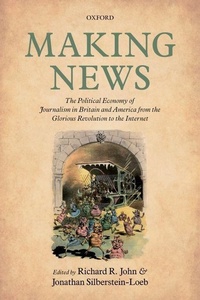
Making News
The Political Economy of Journalism in Britain and America from the Glorious Revolution to the Internet
Published on 31. May 2018
Book
Paperback/Softback
274 pages
978-0-19-882065-9 (ISBN)
Description
This book charts the rise and fall of the newspaper as the primary medium for the conveyance of news. The book focuses on two of the most influential media markets in the modern world-Great Britain and the United States between 1688 and 1995.
In 1688, Parliament created institutional arrangements that would hasten the rise of the newspaper as the dominant medium for the circulation of news. In 1995, the National Science Foundation commercialized the Internet, encouraging an astonishing proliferation of information on all manner of topics, including the news. Per capita newspaper circulation had been declining for decades, partly due to shifting social norms, and partly due to the rise of broadcast news. The Internet exacerbated this trend, partly because it provided a cheaper news source, and partly because it quickly became a superior vehicle for advertising, a major source of revenue for newspaper publishers for over two-hundred-years.
However, only rarely has advertising revenue and direct sales covered costs. Almost never has the demand for news generated the revenue necessary for its supply. Non-market institutional arrangements have ranged from direct government subsidies to organizational forms that enabled news organizations to cooperate. From a historical perspective, the large profits reaped by a handful of newspaper publishers in the post-Second World War era were anomalous, and in no sense a baseline for public policy. Never again will the newspaper be the dominant news medium. To guarantee an informed citizenry in the future, it is necessary to understand how the news business worked in the past.
This book is organized around eight essays-each written by a distinguished specialist, and each explicitly comparative. Its theme is the indispensability in both Great Britain and the United States of non-market institutional arrangements in the provisioning of news.
In 1688, Parliament created institutional arrangements that would hasten the rise of the newspaper as the dominant medium for the circulation of news. In 1995, the National Science Foundation commercialized the Internet, encouraging an astonishing proliferation of information on all manner of topics, including the news. Per capita newspaper circulation had been declining for decades, partly due to shifting social norms, and partly due to the rise of broadcast news. The Internet exacerbated this trend, partly because it provided a cheaper news source, and partly because it quickly became a superior vehicle for advertising, a major source of revenue for newspaper publishers for over two-hundred-years.
However, only rarely has advertising revenue and direct sales covered costs. Almost never has the demand for news generated the revenue necessary for its supply. Non-market institutional arrangements have ranged from direct government subsidies to organizational forms that enabled news organizations to cooperate. From a historical perspective, the large profits reaped by a handful of newspaper publishers in the post-Second World War era were anomalous, and in no sense a baseline for public policy. Never again will the newspaper be the dominant news medium. To guarantee an informed citizenry in the future, it is necessary to understand how the news business worked in the past.
This book is organized around eight essays-each written by a distinguished specialist, and each explicitly comparative. Its theme is the indispensability in both Great Britain and the United States of non-market institutional arrangements in the provisioning of news.
Reviews / Votes
Media history, business history and journalism studies scholars alike will enjoy these themed essays and their authors perspectives on where our journalism-driven political economy comes from, and where it may be going. * Will Mari, Journalism and Mass Communication Quarterly *More details
Language
English
Place of publication
Oxford
United Kingdom
Target group
College/higher education
Professional and scholarly
Product notice
Paperback (trade)
Unsewn / adhesive bound
Dimensions
Height: 231 mm
Width: 155 mm
Thickness: 15 mm
Weight
476 gr
ISBN-13
978-0-19-882065-9 (9780198820659)
Copyright in bibliographic data and cover images is held by Nielsen Book Services Limited or by the publishers or by their respective licensors: all rights reserved.
Schweitzer Classification
Other editions
Additional editions
Richard R. John | Jonathan Silberstein-Loeb
Making News
The Political Economy of Journalism in Britain and America from the Glorious Revolution to the Internet
Book
09/2015
Oxford University Press
€136.18
Shipment within 15-20 days
Persons
Richard R. John is a Professor of History and Communications at Columbia Journalism School, Columbia University. He is a historian who specializes in the history of business, technology, communications, and American political development. He teaches and advises graduate students in Columbia's Ph.D. program in communications, and is member of the core faculty of the Columbia history department, where he teaches courses on the history of capitalism and the history of communications.
Jonathan Silberstein-Loeb is sometime Senior Lecturer in History at Keble College and pupil barrister. After completing a PhD at the University of Cambridge, he became Senior Lecturer in History at the University of Oxford along with a research fellowship focused on the business of news at Oxford's Said Business School. Silberstein-Loeb's developing interest in law and business then led to an LLB at City University Law School in London and an LLM at NYU Law.
Jonathan Silberstein-Loeb is sometime Senior Lecturer in History at Keble College and pupil barrister. After completing a PhD at the University of Cambridge, he became Senior Lecturer in History at the University of Oxford along with a research fellowship focused on the business of news at Oxford's Said Business School. Silberstein-Loeb's developing interest in law and business then led to an LLB at City University Law School in London and an LLM at NYU Law.
Content
Richard R. John and Jonathan Silberstein-Loeb: Introduction: 'Making News'
1: Will Slauter: The Rise of the Newspaper
2: Joseph M. Adelman and Victoria E. M. Gardner: News in the Age of Revolution
3: David Paul Nord: The Urban Newspaper and the Victorian City
4: James R. Brennan: International News in the Age of Empire
5: Michael Stamm: Broadcast Journalism in the Interwar Period
6: James L. Baughman: Journalism since 1945
7: Heidi J. S. Tworek: Protecting News Before the Internet
8: Robert G. Picard: Protecting News Today
1: Will Slauter: The Rise of the Newspaper
2: Joseph M. Adelman and Victoria E. M. Gardner: News in the Age of Revolution
3: David Paul Nord: The Urban Newspaper and the Victorian City
4: James R. Brennan: International News in the Age of Empire
5: Michael Stamm: Broadcast Journalism in the Interwar Period
6: James L. Baughman: Journalism since 1945
7: Heidi J. S. Tworek: Protecting News Before the Internet
8: Robert G. Picard: Protecting News Today