

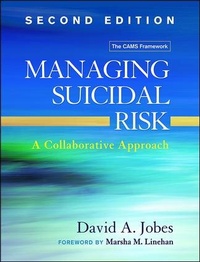
Managing Suicidal Risk, Second Edition
A Collaborative Approach
2nd Edition
Published on 28. September 2016
Book
Paperback/Softback
270 pages
978-1-4625-2690-1 (ISBN)
Description
*An in-demand approach to handling a critical issue: 70% new material reflects the greatly expanded evidence base plus patient and clinician feedback.
*The CAMS approach has grown in stature and recognition, is used by the VA, and is an adjunct to any type of therapy.
*Novice to experienced therapists appreciate this easy-to-use yet effective set of tools.
*Award-winning author actively consults with the U.S. Military and other institutions and maintains a busy speaking schedule.
*The CAMS approach has grown in stature and recognition, is used by the VA, and is an adjunct to any type of therapy.
*Novice to experienced therapists appreciate this easy-to-use yet effective set of tools.
*Award-winning author actively consults with the U.S. Military and other institutions and maintains a busy speaking schedule.
Reviews / Votes
. -Managing Suicidal Risk: A Collaborative Approach, Second Edition, provides a thorough introduction to the use of the Collaborative Assessment and Management of Suicide (CAMS) protocol. Experienced clinicians might easily incorporate the SSF-4 and associated CAMS materials into their practice with suicidal patients. Reproducible Suicide Status Forms and other CAMS materials are provided in the manual....A complete case example featuring one of Jobes's own former patients is interwoven throughout the manual....Provides a clear and flexible framework for the treatment of suicidal behavior in outpatient settings. Jobes offers an evidence-based treatment framework which was seemingly co-authored with his many patient-survivors of suicide over years of research and treatment. The manual provides important updates to the first edition which have resulted from rigorous evaluation of the CAMS model. With research support for CAMS growing, the second edition of Managing Suicidal Risk: A Collaborative Approach may become a relied-upon reference in the toolkit of clinicians and allied professionals who serve suicidal patients.--Journal of Contemporary Psychotherapy, 06/26/2017??This book is indubitably a masterpiece and ought to benefit providers and patients alike....Those of us who, due to the nature of our practice or preference, can see the patients along the continuum--from inpatient to outpatient care--will gain a lot from this book. (on the first edition)--Journal of Clinical Psychiatry, 05/01/2008??User-friendly....This manual packs quite a wallop for a book so deceptively easy to read. It is a genuine advance in the state of the art and science of suicide prevention. (on the first edition)--PsycCRITIQUES, 07/01/2007??An essential addition to any clinician's repertoire of books, especially for those interested in working with depressed clients. The success of the CAMS framework and what sets it apart from other treatment approaches is the emphasis placed on understanding the broader, underlying issues at the core of the suicidal patient. Jobes provides an alternative approach instead of the traditional focus on suicidal ideation as a symptom of a broader psychopathology. Moreover, it is clear that Jobes speaks from a scientist-practitioner perspective as evidenced by his extensive knowledge and activity in suicide research as well as by his personal case examples. Jobes successfully provides the clinician with the light needed to help those individuals who have been trapped by the darkness of suicide. (on the first edition)--Journal of Contemporary Psychotherapy, 12/01/2008??David Jobes, an expert in the field of suicidology, offers an innovative method of approaching...assessment, treating, and tracking outcomes with suicidal individuals....The text is likely to resonate with a wide variety of clinicians, from the novice to the expert with years of experience. (on the first edition)--Bulletin of the Menninger Clinic, 12/01/2008More details
Edition
2nd edition
Language
English
Place of publication
New York
United States
Publishing group
Guilford Publications
Target group
College/higher education
Professional and scholarly
Professional Practice & Development
Dimensions
Height: 267 mm
Width: 203 mm
Weight
620 gr
ISBN-13
978-1-4625-2690-1 (9781462526901)
Copyright in bibliographic data and cover images is held by Nielsen Book Services Limited or by the publishers or by their respective licensors: all rights reserved.
Schweitzer Classification
Other editions
New editions
Book
08/2023
3rd Edition
Guilford Press
€51.00
Available immediately
Additional editions
Book
03/2018
2nd Edition
Guilford Press
€88.08
Article exhausted; check for reprint
Previous edition
Book
09/2006
1st Edition
Guilford Publications
€54.65
Article exhausted; check for reprint
Person
David A. Jobes, PhD, ABPP, is Professor of Psychology and Associate Director of Clinical Training at The Catholic University of America. He is also Adjunct Professor of Psychiatry in the School of Medicine at the Uniformed Services University of the Health Sciences. With research interests in suicidology for over 30 years, he has published extensively in the field and routinely conducts professional training in clinical suicidology, professional ethics, and risk management. Dr. Jobes has served as a consultant to the Department of Defense, Veterans Affairs, the Centers for Disease Control and Prevention, and the Institute of Medicine of the National Academy of Sciences. A past president of the American Association of Suicidology (AAS), he serves on the Scientific Council and Public Policy Council of the American Foundation for Suicide Prevention. His work has been recognized with the Marsha Linehan Award for Outstanding Research in the Treatment of Suicidal Behavior and the Louis I. Dublin Award for Career Contribution to Suicide Prevention from the AAS, among other honors. Dr. Jobes is a Fellow of the American Psychological Association and is board certified in clinical psychology. He maintains a private clinical and forensic practice in Washington, DC.
Content
1. Collaborative Assessment and Management of Suicidality: A Suicide-Specific Intervention within Contemporary Health Care
2. The SSF and the Evolution of CAMS
3. Systems of Clinical Care and Optimizing the Use of CAMS
4. CAMS Risk Assessment: The Collaborative Use of the SSF
5. CAMS Treatment Planning: Coauthoring a Suicide-Specific Treatment Plan
6. CAMS Interim Sessions: Tracking Suicide Risk Assessments and Treatment Plan Updates
7. CAMS Clinical Outcomes and Disposition: Lessons in Living and Postsuicidal Life
8. CAMS as a Means of Decreasing Malpractice Liability
9. CAMS Adaptations and Future Developments
Epilogue
Appendix A. CAMS Suicide Status Form-4 (SSF-4): Initial Session, Tracking/Update Interim Session, Outcome/Disposition Final Session
Appendix B. Coding Manual for the SSF Core Assessment Scales: Qualitative Assessment
Appendix C. Coding Manual for SSF Reasons for Living versus Reasons for Dying
Appendix D. Coding Manual for the SSF One-Thing Response
Appendix E. CAMS Therapeutic Worksheet: Understanding Your Suicidality
Appendix F. CAMS Rating Scale (CRS.3)
Appendix G. Frequently Asked Questions about CAMS
Appendix H. Complete CAMS Case Example of Bill
2. The SSF and the Evolution of CAMS
3. Systems of Clinical Care and Optimizing the Use of CAMS
4. CAMS Risk Assessment: The Collaborative Use of the SSF
5. CAMS Treatment Planning: Coauthoring a Suicide-Specific Treatment Plan
6. CAMS Interim Sessions: Tracking Suicide Risk Assessments and Treatment Plan Updates
7. CAMS Clinical Outcomes and Disposition: Lessons in Living and Postsuicidal Life
8. CAMS as a Means of Decreasing Malpractice Liability
9. CAMS Adaptations and Future Developments
Epilogue
Appendix A. CAMS Suicide Status Form-4 (SSF-4): Initial Session, Tracking/Update Interim Session, Outcome/Disposition Final Session
Appendix B. Coding Manual for the SSF Core Assessment Scales: Qualitative Assessment
Appendix C. Coding Manual for SSF Reasons for Living versus Reasons for Dying
Appendix D. Coding Manual for the SSF One-Thing Response
Appendix E. CAMS Therapeutic Worksheet: Understanding Your Suicidality
Appendix F. CAMS Rating Scale (CRS.3)
Appendix G. Frequently Asked Questions about CAMS
Appendix H. Complete CAMS Case Example of Bill