

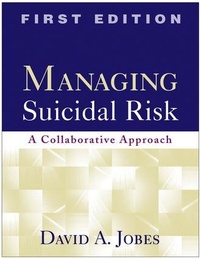
Managing Suicidal Risk, First Edition
A Collaborative Approach
1st Edition
Published on 4. September 2006
Book
Paperback/Softback
222 pages
978-1-59385-327-3 (ISBN)
Description
This clinical manual offers essential tools and guidance for therapists of any orientation faced with the complex challenges of assessing and treating a suicidal patient. In a large, ready-to-photocopy format, the book provides step-by-step instructions and reproducible forms for evaluating suicidal risk, developing a suicide-specific outpatient treatment plan, and tracking clinical progress and outcomes using documentation that can help to reduce the risk of malpractice liability. In addition to providing a flexible structure for assessment and intervention, The Collaborative Assessment and Management of Suicidality (CAMS) approach is designed to strengthen the therapeutic alliance and increase patient motivation. Highly readable and user friendly, the volume builds on 15 years of empirically oriented clinical research.
Reviews / Votes
"There is essential clinical wisdom here, informed by empirical data, experience, theory, and pragmatism. Simply stated, this book is an important tool for any clinician who aspires to engage the suicidal mind and clinically venture forth into the world of 'psychache.' This book is good news for the clinician and even better news for the lives of patients this approach will save."--from the Foreword by Edwin S. Shneidman, PhD, University of California, Los Angeles"An exemplary treatment guide must combine science, clinical wisdom, and relevant personal experience, and must attend to the sometimes vexing everyday realities of clinicians seeing patients. Who is up to such a daunting task? David A. Jobes, for one. His model, The Collaborative Assessment and Management of Suicidality (CAMS), is the epitome of a science-based, clinician-friendly approach, and his book does CAMS due justice. Readers of this book will be better positioned to understand, assess, and treat suicidal behavior."--Thomas Joiner, PhD, Florida State University
"It is rare to find a book that is firmly grounded in science and that also offers a flexible, commonsense model for clinical practice. Jobes has given us just such a gem. He provides essential tools for clinicians of every persuasion and level of expertise. This book is ideal for training graduate students or providing an infrastructure to supervision for psychologists, counselors, psychiatrists, social workers, or nurses who have contact with suicidal patients. The book will leave the reader with a newfound sense of confidence that his or her approach is embedded in 'best practices,' has a wealth of empirical support, and is one that patients will respond to in a positive fashion."--M. David Rudd, PhD, Texas Tech University
"Managing Suicidal Risk effectively meets the critical need for clear guidelines for assessing and treating the suicidal person. In the belief that most suicidal people want to end their pain, not their life, Jobes offers the clinician a comprehensive, multifaceted handbook tailored to present-day treatment realities. This book can serve to guide the clinician in providing the suicide-prone patient with hope and help through a life-threatening crisis. It is well suited for specialized courses in suicide prevention and crisis intervention, and for more general graduate-level courses in mental health counseling and assessment."--Katherine van Wormer, PhD, MSSW, University of Northern Iowa
"For the last decade, Jobes and his colleagues have been researching and refining their novel therapeutic approach. Jobes offers an antidote to haphazard and personalized views of working with suicidal patients, integrating the theoretical constructs of Edwin Shneidman, Aaron Beck, and Roy Baumeister into a comprehensive and evidence-based treatment strategy. The Collaborative Assessment and Management of Suicidality (CAMS) gives clients leverage to fight for their lives. Every graduate student and clinician working with suicidal patients needs to read this manual and learn this approach."--Morton M. Silverman, MD, Editor-in-Chief, Suicide and Life-Threatening Behavior
"The CAMS approach has quickly achieved best-practice status and, as more clinical trials are completed, is destined to be sufficiently evidence-based to become a 'must' in every clinicianaEUR (TM)s repertoire. This accessible guide teaches clinicians to listen to and align with their patients, to consistently target suicide risk, and to effectively reduce that risk. Jobes is a master teacher, and readers of this book are lucky to be among his students."--Alan L. Berman, PhD, Executive Director, American Association of Suicidology
More details
Language
English
Place of publication
New York
United States
Target group
College/higher education
Professional and scholarly
Weight
524 gr
ISBN-13
978-1-59385-327-3 (9781593853273)
Copyright in bibliographic data and cover images is held by Nielsen Book Services Limited or by the publishers or by their respective licensors: all rights reserved.
Schweitzer Classification
Other editions
New editions
Book
09/2016
2nd Edition
Guilford Press
€64.56
Article exhausted; check for reprint
Person
David A. Jobes, PhD, Department of Psychology, The Catholic University of America, Washington, DC, USA
Content
Shneidman, Foreword. Contemporary Clinical Challenges and the Need for the Collaborative Assessment and Management of Suicidality (CAMS). A Review of the Suicide Status Form and the Origin of CAMS. The Early Identification of Suicide Risk. CAMS Risk Assessment: The Collaborative Use of the SSF. CAMS Treatment Planning: Coauthoring the Outpatient Treatment Plan. CAMS Suicide Status Tracking: Assessment and Treatment Plan Updates. Suicide Status Outcomes: The Completion of CAMS. CAMS as Means of Decreasing Malpractice Liability. Future Developments: Using CAMS Across Settings and Future Research. Epilogue. Appendixes: A: The Suicide Status Form-III (SSF-III): Assessment, Treatment Planning, Tracking, and Outcome Forms. B: Coding Manual for the SSF Likert Scales: Qualitative Assessment. C: Coding Manual for SSF Reasons for Living versus Reasons for Dying. D: Coding Manual for the SSF One-Thing Response. E: Frequently Asked Questions About CAMS. F: Complete CAMS Case Example.