

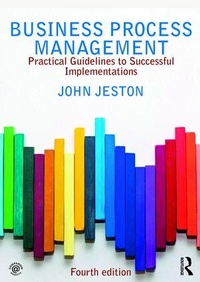
Business Process Management
Practical Guidelines to Successful Implementations
4th Edition
Published on 8. January 2018
Book
Paperback/Softback
654 pages
978-1-138-73840-9 (ISBN)
Description
Business Process Management, a huge bestseller, has helped thousands of leaders and BPM practitioners successfully implement BPM projects, enabling them to add measurable value to their organizations. The book's runaway success can be attributed partly to its overview of all major useful frameworks (such as LEAN and Six Sigma) without over-investment in one over another, and a unique emphasis on BPM's interrelationship with organizational management, culture and leadership. Its common-sense approach teaches how BPM must be well-integrated across an entire business if it's to be successful: augmented and aligned with other management disciplines.
This highly anticipated fourth edition brings Jeston's practicable frameworks and solutions up to date with the latest developments in BPM, including the robotics process automation, digital strategies and the changes necessary as a result of the impact of the quad generations in the workforce.
This thoroughly revised and updated new edition includes:
Enhanced BPM House noting the importance of traceability from strategy to execution activities
New and revised case studies
An analysis of the risks and benefits of robotic automation and cognitive computing.
The book highlights that millennials will be 50% of the global workforce in 2020 and 67% by 2025-Jeston warns managers to ignore them at your peril. Business processes and the way work is performed must evolve!
This book will prove to be an indispensable guide to any senior business executive or chief financial officer while providing practical BPM examples to undergraduate and postgraduate students alike.
This highly anticipated fourth edition brings Jeston's practicable frameworks and solutions up to date with the latest developments in BPM, including the robotics process automation, digital strategies and the changes necessary as a result of the impact of the quad generations in the workforce.
This thoroughly revised and updated new edition includes:
Enhanced BPM House noting the importance of traceability from strategy to execution activities
New and revised case studies
An analysis of the risks and benefits of robotic automation and cognitive computing.
The book highlights that millennials will be 50% of the global workforce in 2020 and 67% by 2025-Jeston warns managers to ignore them at your peril. Business processes and the way work is performed must evolve!
This book will prove to be an indispensable guide to any senior business executive or chief financial officer while providing practical BPM examples to undergraduate and postgraduate students alike.
More details
Edition
4th edition
Language
English
Place of publication
London
United Kingdom
Publishing group
Taylor & Francis Ltd
Target group
College/higher education
Illustrations
155 color images, 104 color tables and 1 color halftone
Dimensions
Height: 246 mm
Width: 174 mm
Weight
1280 gr
ISBN-13
978-1-138-73840-9 (9781138738409)
Copyright in bibliographic data and cover images is held by Nielsen Book Services Limited or by the publishers or by their respective licensors: all rights reserved.
Schweitzer Classification
Other editions
New editions
Book
05/2022
5th Edition
Routledge
€76.00
Shipment within 15-20 days
Additional editions

Book
01/2018
4th Edition
Routledge
€222.84
Article exhausted; check for reprint
Previous edition
John Jeston
Business Process Management
Book
01/2014
3rd Edition
Routledge
€70.75
Article exhausted; check for reprint
Person
John Jeston has over 40 years' experience in senior executive and consulting positions. He runs an international consultancy, Management By Process Pty Ltd.
Content
Contributors
Foreword
Preface
Introduction
Introduction to the fourth edition
Layout of this book
Acknowledgements
Training Services
Part I Frequently asked questions
Chapter 1What is business process management?
Chapter 2 How can we demystify business process management?
Chapter 3 Who should be involved in BPM and what are the critical success factors?
Chapter 4 When should you do BPM - what are the main drivers and triggers?
Chapter 5 How should we start BPM - bottom-up or top-down?
Chapter 6 Why is it important to improve business processes before automating them?
Chapter 7 What are the technology components of BPM?
Chapter 8 Should you be customer-centric?
Chapter 9 Why is determining BPM foundations a critical first step?
Chapter 10 Why do you need a structured approach to implementing BPM?
Chapter 11 Typical common approach pitfalls
Part II BPM - how do you do it?
Chapter 117FE Framework overview
Chapter 12 Guidelines on how to use the 7FE Framework
Chapter 13 Foundations phase
Chapter 14 Enablement phase
Chapter 15 Launch pad phase
Chapter 16 Understand phase
Chapter 17 Innovate phase
Chapter 18 People phase
Chapter 19 Develop phase
Chapter 20 Implement phase
Chapter 21 Realize value phase
Chapter 22 Sustainable performance phase
Chapter 23 Essentials Introduction
Chapter 24 Project management
Chapter 25 People change management
Chapter 26 Leadership
Chapter 27 Embedding BPM in the organization
Part III Case studies and BPM maturity
Chapter 28 Case studies from the USA, Asia and Europe
Chapter 29 BPMM model
Glossary
References and bibliography
Index
Foreword
Preface
Introduction
Introduction to the fourth edition
Layout of this book
Acknowledgements
Training Services
Part I Frequently asked questions
Chapter 1What is business process management?
Chapter 2 How can we demystify business process management?
Chapter 3 Who should be involved in BPM and what are the critical success factors?
Chapter 4 When should you do BPM - what are the main drivers and triggers?
Chapter 5 How should we start BPM - bottom-up or top-down?
Chapter 6 Why is it important to improve business processes before automating them?
Chapter 7 What are the technology components of BPM?
Chapter 8 Should you be customer-centric?
Chapter 9 Why is determining BPM foundations a critical first step?
Chapter 10 Why do you need a structured approach to implementing BPM?
Chapter 11 Typical common approach pitfalls
Part II BPM - how do you do it?
Chapter 117FE Framework overview
Chapter 12 Guidelines on how to use the 7FE Framework
Chapter 13 Foundations phase
Chapter 14 Enablement phase
Chapter 15 Launch pad phase
Chapter 16 Understand phase
Chapter 17 Innovate phase
Chapter 18 People phase
Chapter 19 Develop phase
Chapter 20 Implement phase
Chapter 21 Realize value phase
Chapter 22 Sustainable performance phase
Chapter 23 Essentials Introduction
Chapter 24 Project management
Chapter 25 People change management
Chapter 26 Leadership
Chapter 27 Embedding BPM in the organization
Part III Case studies and BPM maturity
Chapter 28 Case studies from the USA, Asia and Europe
Chapter 29 BPMM model
Glossary
References and bibliography
Index