

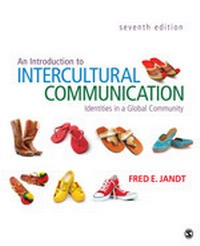
An Introduction to Intercultural Communication
Identities in a Global Community
7th Edition
Published on 2. February 2012
Book
Paperback/Softback
448 pages
978-1-4129-9287-9 (ISBN)
Description
Filled with thought-provoking examples, photos, quotes, cases, and stories that spark studentsE interest and challenge them to reconsider existing viewpoints, the Seventh Edition of An Introduction to Intercultural Communication prepares todayEs readers to successfully navigate our increasingly global community. Using a historical framework that places current topics in context, author Fred E. Jandt integrates media as a variable in advancing issues and ideas, offers a full chapter on women, and family, , and retains his non-biased presentation of all cultures and ethnic groups. Extremely relevant, this Seventh Edition includes social media as well as new challenges evident in ethnic and religious conflict, the role of women, and technology.
More details
Edition
7th Revised edition
Language
English
Place of publication
Thousand Oaks
United States
Target group
College/higher education
Edition type
Revised edition
Illustrations
Illustrations
Dimensions
Height: 229 mm
Width: 178 mm
ISBN-13
978-1-4129-9287-9 (9781412992879)
Copyright in bibliographic data and cover images is held by Nielsen Book Services Limited or by the publishers or by their respective licensors: all rights reserved.
Schweitzer Classification
Other editions
Previous edition
Book
06/2009
6th Edition
SAGE Publications Inc
€85.72
Article exhausted; check for reprint
Person
Fred E. Jandt was born of second-generation German immigrants in the multicultural south-central region of Texas. After graduating from Texas Lutheran University and Stephen F. Austin State University, he received his doctorate in communication from Bowling Green State University. He has taught and been a student of intercultural communication for more than 40 years, developing his experience through travel and international training and research projects. While Professor of Communication at The College at Brockport, State University of New York, his reputation as a teacher led to his appointment as SUNY's first director of faculty development. He has retired as Dean of the Palm Desert Campus and Professor of Communication at California State University, San Bernardino, where he was named Outstanding Professor. He has also been a visiting professor at Victoria University of Wellington in New Zealand. He has extensive experience in the areas of intercultural and international communication, negotiation mediation, and conflict management. He was one of the first scholars to introduce the study of conflict to the communication discipline with his text Conflict Resolution Through Communication (Harper & Row, 1973). He has subsequently published many other titles in this area, including the successful trade books Win-Win Negotiating: Turning Conflict Into Agreement (Wiley, 1985), which has been translated into eight languages, and a casebook on international conflict management, Constructive Conflict Management: Asia-Pacific Cases (SAGE, 1996) with Paul B. Pedersen. For several years, he conducted the training workshop "Managing Conflict Productively" for major corporations and government agencies throughout the United States. Jandt continues to train volunteers who are learning to become mediators in the California justice system.
Content
Part I. CULTURE AS CONTEXT FOR COMMUNICATION 1. Defining Culture and Identities 2. Understanding Face-to-Face and Mediated Communication 3. Culture's Influence on Perception Part II. COMMUNICATION VARIABLES 4. Barriers to Intercultural Communication 5. Nonverbal Communication 6. Language as a Barrier Part III. CULTURAL VALUES 7. Dimensions of Culture 8. Dominant U.S. Cultural Patterns: Using Value Orientation Theory 9. Comparative Cultural Patterns: Arab Culture 10. Culture and Gender 11. Contact Between Cultures PART IV: CULTURES WITHIN CULTURES 12. Immigration and Acculturation 13. Cultures Within Cultures 14. Identity and Subgroups