

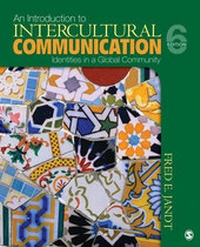
An Introduction to Intercultural Communication
Identities in a Global Community
6th Edition
Published on 30. June 2009
Book
Paperback/Softback
440 pages
978-1-4129-7010-5 (ISBN)
Description
Now in its 6th edition, Fred Jandt's international bestseller continues to offer students an accessible and exciting introduction to the art of effectively communicating across group barriers. Packed with thought-provoking examples, photos, vignettes, quotes, cases, and stories that spark students' interest and challenge them to reassess existing viewpoints, "An Introduction to Intercultural Communication" remains an invaluable text and a leader in its field. New and continuing features include: an environment-focused box in each chapter discusses how the environment relates to each topic; 'Focus on Theory' boxes ground practical material in communication and social theory; expanded coverage of immigration; global examples updated throughout; new and expanded photo essays; new companion website featuring test questions, student activities, sample syllabi, and PowerPoint presentations; and, student site featuring web activities and resources, study quizzes, e-Flashcards, and SAGE journal articles. An accompanying reader, "Intercultural Communication: A Global Reader", is also available and can be used alone or in conjunction with this text.
Reviews / Votes
"I chose this book because for me it covers the issues pertaining to intercultural communication that are relevant to today's society." -- Rosemary O'Donnell 20110209More details
Edition
6th Revised edition
Language
English
Place of publication
Thousand Oaks
United States
Target group
College/higher education
Edition type
Revised edition
Illustrations
Illustrations, map
Dimensions
Height: 229 mm
Width: 178 mm
ISBN-13
978-1-4129-7010-5 (9781412970105)
Copyright in bibliographic data and cover images is held by Nielsen Book Services Limited or by the publishers or by their respective licensors: all rights reserved.
Schweitzer Classification
Other editions
New editions
Book
04/2018
7th Edition
SAGE Publications (USA)
€103.08
The article will not be published
Book
02/2012
7th Edition
SAGE Publications Inc
€95.64
Article is exhausted; no reprint
Previous edition
Book
10/2006
5th Edition
SAGE Publications Inc
€57.19
Article exhausted; check for reprint
Person
Fred E. Jandt (Ph.D., Bowling Green State University) is Professor of Communication at CSU San Bernardino. He was a visiting professor at Victoria University of Wellington, New Zealand and has also taught at SUNY-Brockport (where he became SUNY's first director of faculty development). For SAGE, he is the author of a best-selling introductory textbook, An Introduction to Intercultural Communication: Identities in a Global Community, 4/e (2004), and the editor of Intercultural Communication: A Global Reader (2004); in addition, he's also the author of Win-Win Negotiating (1985, Wiley; translated into 7 languages), Effective Interviewing for Paralegals, 2/e (1994, Anderson), Straight Answers to People Problems (1993, McGraw-Hill), Conflict Resolution through Communication (1975, Harper Collins) and co-editor of Constructive Conflict Management: Asia-Pacific Cases (1996). He attends and presents at major national and international conferences.
Content
Part I: Culture as Context for Communication Chapter 1: The Dispute over Defining Culture Chapter 2: Defining Communication as an Element of Culture Chapter 3: Culture's Influence on Perception Part II: Communication Variables Chapter 4: Barriers to Intercultural Communication Chapter 5: Nonverbal Communication Chapter 6: Language as a Barrier Part III: Cultural Values Chapter 7: Dimensions of Culture Chapter 8: Dominant U.S. Cultural Patterns Chapter 9: Comparative Cultural Patterns Chapter 10: Women, Families, and Children Chapter 11: Contact Between Cultures Part IV: Cultures within Cultures Chapter 12: Immigration and Acculturation Chapter 13: Cultures within Cultures Chapter 14: Identity and Subgroups