


Methods for Teaching
Promoting Student Learning
6th Edition
Published on 13. May 2002
Book
Paperback/Softback
352 pages
978-0-13-030898-6 (ISBN)
Description
Methods for Teaching uses a three-phase model of teaching--planning, implementing, and assessing--as a framework for fostering a success-oriented K-12 environment by promoting student learning. Features new to the sixth edition include: *An increased focus on constructivist learning theory *Significant new coverage of technology and technology delivery systems *Discussions of -- National standards and professional development -- Applications of NCATE and INTASC -- English proficiency and ESL -- Rubrics *A companion Website, www.prenhall.com/jacobsen, that is integrated into the text through the use of projects and activities that encourage Internet research
More details
Edition
6th edition
Language
English
Place of publication
United States
Publishing group
Pearson Education (US)
Target group
Professional and scholarly
Dimensions
Height: 234 mm
Width: 191 mm
Thickness: 60 mm
Weight
600 gr
ISBN-13
978-0-13-030898-6 (9780130308986)
Copyright in bibliographic data is held by Nielsen Book Services Limited or its licensors: all rights reserved.
Schweitzer Classification
Other editions
New editions
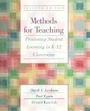
David A. Jacobsen | Paul Eggen | Don Kauchak
Methods for Teaching
Promoting Student Learning in K-12 Classrooms
Book
07/2005
7th Edition
Pearson
€60.65
Article exhausted; check for reprint
Previous edition
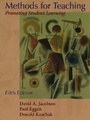
Book
09/1998
5th Edition
Pearson
€44.56
Article exhausted; check for reprint
Content
1. Introduction: A Model for Teaching.
2. The Goals of Instruction.
3. Formulating Goals and Objectives.
4. Planning for Learning.
5. The Affective, Psychomotor, and Cognitive Domains.
6. Questioning Strategies.
7. Teaching Strategies.
8. Utilizing and Building Upon Learning Differences: Instructional Strategies.
9. Classroom Management: Prevention.
10. Classroom Management: Intervention.
11. Assessing Student Learning.
2. The Goals of Instruction.
3. Formulating Goals and Objectives.
4. Planning for Learning.
5. The Affective, Psychomotor, and Cognitive Domains.
6. Questioning Strategies.
7. Teaching Strategies.
8. Utilizing and Building Upon Learning Differences: Instructional Strategies.
9. Classroom Management: Prevention.
10. Classroom Management: Intervention.
11. Assessing Student Learning.