

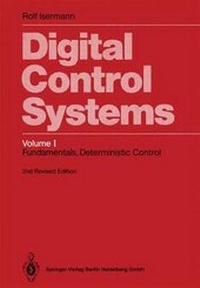
Digital Control Systems
Volume 1: Fundamentals, Deterministic Control
2nd Edition
Published on 21. July 1989
Book
Hardback
XIX, 336 pages
978-3-540-50266-1 (ISBN)
Description
This well-known book is an introduction to the field of digital, sampled-data control. It treats the field in depth and can be used for courses and for self study. The second edition has been completely revised and expanded with new results. The work now appears in two volumes, with Volume 2 to be published in 1989. The volumes form a unit and take the reader systematically from fundamentals to problems of real applications. The work is directed towards students of electrical and mechanical engineering, computer science (especially with a specialization on automation and control engineering), and other fields like biology, economics, space mathematics and physics. It is also directed to engineers and scientists concerned with solving concrete problems.
More details
Edition
2nd rev. ed.
Language
English
Place of publication
Heidelberg
Germany
Publishing group
Springer Berlin
Target group
College/higher education
Professional and scholarly
Illustrations
64
64 s/w Abbildungen
88 figures
Weight
750 gr
ISBN-13
978-3-540-50266-1 (9783540502661)
DOI
10.1007/978-3-642-86417-9
Schweitzer Classification
Other editions
Additional editions
E-Book
11/2013
2nd Edition
Springer
€53.49
Available for download
Book
11/2012
2nd Edition
Springer
€53.49
Shipment within 7-9 days
Previous edition
Content
1 Introduction.- A Fundamentals.- 2 Control with Digital Computers (Process Computers, Microcomputers).- 3 Fundamentals of Linear Sampled-data Systems (Discrete-time Systems).- 3.1 Discrete-time Signals.- 3.1.1 Discrete Functions, Difference Equations.- 3.1.2 Impulse Trains.- 3.1.3 Fourier-Transform of the Impulse Train.- 3.2 Laplace-transformation of Discrete-time Functions and Shannon's Sampling Theorem.- 3.2.1 Laplace-transformation.- 3.2.2 Shannon's Sampling Theorem.- 3.2.3 Holding Element.- 3.2.4 Frequency Response of Sampled Systems.- 3.3 z-Transform.- 3.3.1 Introduction of z-Transform.- 3.3.2 z-Transform Theorems.- 3.3.3 Inverse z-Transform.- 3.4 Convolution Sum and z-Transfer Function.- 3.4.1 Convolution Sum.- 3.4.2 Pulse Transfer Function and z-Transfer-Function.- 3.4.3 Properties of the z-Transfer Functions and Difference Equations.- 3.5 Poles and Zeros, Stability.- 3.5.1 Location of Poles in the z-Plane.- 3.5.2 Stability Condition.- 3.5.3 Stability Analysis through Bilinear Transformation.- 3.5.4 Schur-Cohn-Jury Criterion.- 3.5.5 Location of Zeros in the z-Plane.- 3.6 State Variable Representation.- 3.6.1 The Vector Difference Equation Based on Vector Differential Equation.- 3.6.2 The Vector Difference Equation Based on Difference Equation.- 3.6.3 Canonical Forms.- 3.6.4 Processes with Deadtime.- 3.6.5 Solution of Vector Difference Equation.- 3.6.6 Determination of the z-Transfer Function.- 3.6.7 Determination of the Impulse Response.- 3.6.8 Controllability and Observability.- 3.7 Mathematical Models of Processes.- 3.7.1 Basic Types of Technical Processes.- 3.7.2 Determination of the Process Model-Modelling and Identification.- 3.7.3 Calculation of z-Transfer Functions from s-Transfer Functions.- 3.7.4 Simplification of Process Models for Discrete-time Signals.- B Control-Systems for Deterministic Disturbances.- 4 Deterministic Control Systems.- 5 Parameter-optimized Controllers.- 5.1 Discretizing the Differential Equations of Continuous PID-Controllers.- 5.2 Parameter-optimized Discrete Control Algorithms of Low-Order.- 5.2.1 Control Algorithms of First and Second Order.- 5.2.2 Control Algorithms with Prescribed Initial Manipulated Variable.- 5.2.3 PID-Control Algorithm through z-Transformation.- 5.3 Modifications to Discrete PID-Control Algorithms.- 5.3.1 Different Evaluation of Control Variable and Reference Variable.- 5.3.2 Different Discretizations of the Derivative Term.- 5.3.3 Delayed Differential Term.- 5.4 Design Through Numerical Parameter Optimization.- 5.4.1 Numerical Parameter Optimization.- 5.4.2 Simulation Results for PID-Control Algorithms.- 5.5 PID-Controller Design Through Pole-Assignment, Compensation and Approximation.- 5.5.1 Pole-assignment Design.- 5.5.2 Design as a Cancellation Controller.- 5.5.3 Design of PID-Controllers Through Approximation of other Controllers.- 5.6 Tuning Rules for Parameter-optimized Control Algorithms.- 5.6.1 Tuning Rules for Modified PID-controllers.- 5.6.2 Tuning Rules Based on Measured Step Functions.- 5.6.3 Tuning Rules with Oscillation Tests.- 5.7 Choice of Sample Time for Parameter-optimized Control Algorithms.- 5.8 Supplementary Functions of Digital PID-Controllers.- 6 General Linear Controllers and Cancellation Controllers.- 6.1 General Linear Controllers.- 6.1.1 General Linear Controller Design for Specified Poles.- 6.1.2 General Linear Controller Design Through Parameter Optimization.- 6.2 Cancellation Controllers.- 7 Controllers for Finite Settling Time.- 7.1 Deadbeat Controller Without Prescribed Manipulated Variable.- 7.2 Deadbeat Controller with Prescribed Manipulated Variable.- 7.3 Choice of the Sample Time for Deadbeat Controllers.- 7.4 Approximation Through PID-Controllers.- 8 State Controller and State Observers.- 8.1 Optimal State Controllers for Initial Values.- 8.2 Optimal State Controllers for External Disturbances.- 8.3 State Controllers with a Given Characteristic Equation.- 8.4 Modal State Control.- 8.5 State Controllers for Finite Settling Time (Deadbeat).- 8.6 State Observers.- 8.7 State Controllers with Observers.- 8.7.1 An Observer for Initial Values.- 8.7.2 Observer for External Disturbances.- 8.7.3 Introduction of Integral Action Elements into the State Controller.- 8.7.4, Measures to Minimize Observer Delays.- 8.8 State Observer of Reduced-Order.- 8.9 State Variable Reconstruction.- 8.10 Choice of Weighting Matrices and Sample Time.- 8.10.1 Weighting Matrices for State Controllers and Observers.- 8.10.2 Choice of the Sample Time.- 9 Controllers for Processes with Large Deadtime.- 9.1 Models for Processes with Deadtime.- 9.2 Deterministic Controllers for Deadtime Processes.- 9.2.1 Processes with Large Deadtime and Additional Dynamics.- 9.2.2 Pure Deadtime Processes.- 9.3 Comparison of the Control Performance and the Sensitivity of Different Controllers for Deadtime Processes.- 10 Sensitivity and Robustness with Constant Controllers.- 10.1 On the Sensitivity of Closed-loop Systems.- 10.2 Insensitive Control Systems.- 10.2.1 Insensitivity through Additional Dynamic Feedback.- 10.2.2 Insensitivity through Variation of the Design of General Controllers.- 10.3 On the Robustness of Control Systems.- 10.4 Robust Control Systems.- 11 Comparison of Different Controllers for Deterministic Disturbances.- 11.1 Comparison of Controller Structures, Poles and Zeros.- 11.1.1 General Linear Controller for Specified Poles.- 11.1.2 Low Order Parameter-optimized Controllers.- 11.1.3 General Cancellation Controller.- 11.1.4 Deadbeat Controller.- 11.1.5 Predictor Controller.- 11.1.6 State Controller.- 11.2 Characteristic Values for Performance Comparison.- 11.3 Comparison of the Performance of the Control Algorithms.- 11.4 Comparison of the Dynamic Control Factor.- 11.5 Conclusions for the Application of Control Algorithms.- Appendix A.- A1 Tables of z-Transforms and Laplace-Transforms.- A2 Table of Some Transfer Elements with Continuous and Sampled Systems.- A3 Test Processes for Simulation.- A4 On the Differentiation of Vectors and Matrices.- Appendix B.- Problems.- Appendix C.- Results of the Problems.- References.