

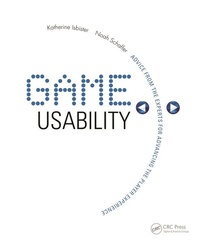
Game Usability
Advancing the Player Experience
1st Edition
Published on 12. August 2008
Book
Paperback/Softback
398 pages
978-0-12-374447-0 (ISBN)
Description
Computers used to be for geeks. And geeks were fine with dealing with a difficult and finicky interface--they liked this--it was even a sort of badge of honor (e.g. the Unix geeks). But making the interface really intuitive and useful--think about the first Macintosh computers--took computers far far beyond the geek crowd. The Mac made HCI (human computer interaction) and usability very popular topics in the productivity software industry. Suddenly a new kind of experience was crucial to the success of software - the user experience. Now, 20 years later, developers are applying and extending these ideas to games.
Game companies are now trying to take games beyond the 'hardcore' gamer market--the people who love challenge and are happy to master a complicated or highly genre-constrained interface. Right about now (with the growth of interest in casual games) game companies are truly realizing that usability matters, particularly to mainstream audiences. If it's not seamless and easy to use and engaging, players will just not stay to get to the 'good stuff'.
By definition, usability is the ease with which people can emplo a particular tool in order to achieve a particular goal. Usability refers to a computer program's efficiency or elegance. This book gives game designers a better understanding of how player characteristics impact usability strategy, and offers specific methods and measures to employ in game usability practice. The book also includes practical advice on how to include usability in already tight development timelines, and how to advocate for usability and communicate results to higher-ups effectively.
Game companies are now trying to take games beyond the 'hardcore' gamer market--the people who love challenge and are happy to master a complicated or highly genre-constrained interface. Right about now (with the growth of interest in casual games) game companies are truly realizing that usability matters, particularly to mainstream audiences. If it's not seamless and easy to use and engaging, players will just not stay to get to the 'good stuff'.
By definition, usability is the ease with which people can emplo a particular tool in order to achieve a particular goal. Usability refers to a computer program's efficiency or elegance. This book gives game designers a better understanding of how player characteristics impact usability strategy, and offers specific methods and measures to employ in game usability practice. The book also includes practical advice on how to include usability in already tight development timelines, and how to advocate for usability and communicate results to higher-ups effectively.
Reviews / Votes
Isbister's Better Game Characters by Design MK book was mentioned in a New York Times article, July 2007, called "Hey Man, Let's Play Video Game Dress Up". "Playtesting is the most challenging, and most mysterious part of game development, and this book is by far, the most thorough and practical collection of writings on the subject. I plan to return to it again and again -- there is just so much to draw from! Anyone who reads it will be able to playtest their games well, and with confidence."Jesse Schell, Professor of Entertainment Technology, Carnegie Mellon University
".Games user research has taken leaps and bounds over the past 10 years, as evidenced by the content of this book.We encourage the readers to use this resource as a great starting point for strengthening the discipline while taking us into the future.
Randy Pagulayan, Microsoft Game Studios & Dennis Wixon, Microsoft Surfaces
"Katherine Isbister's "Game Usability is a multi-faceted look at a critical component of modern game design, full of excellent case studies by usability experts, industry leaders and cutting edge researchers. The methods found here will be useful to anyone interested in honing the player experience of their commercial, independent or academic games."
Tracy Fullerton, Associate Professor USC School of Cinematic Arts; Director, EA Game Innovation Lab
"On first blush, usability and game design look like oil and water: they don't seem to mix. One appears scientific, the other creative; one dispassionate, the other sentimental. This book offers a variety of promising ways to put the two together, ways that suggest general lessons in how design can learn from a measure of impartiality, and usability from a measure of passion."
Ian Bogost, Associate Professor in the School of Literature Communication and Culture, The Georgia Institute of Technology, and Founding Partner, Persuasive Games
More details
Language
English
Place of publication
Burlington
United States
Publishing group
Taylor & Francis Inc
Target group
Professional and scholarly
Game designers and developers.Secondary: students of game design and HCI (Human/Computer Interaction).Level: All levels of game designers/developers.
Dimensions
Height: 235 mm
Width: 191 mm
Weight
953 gr
ISBN-13
978-0-12-374447-0 (9780123744470)
Copyright in bibliographic data and cover images is held by Nielsen Book Services Limited or by the publishers or by their respective licensors: all rights reserved.
Schweitzer Classification
Other editions
New editions

Katherine Isbister | Celia Hodent
Game Usability
Advice from the Experts for Advancing UX Strategy and Practice in Videogames
Book
03/2022
2nd Edition
CRC Press
€68.00
Shipment within 15-20 days
Additional editions
Book
07/2017
1st Edition
CRC Press
€237.70
Article exhausted; check for reprint
Persons
Associate Professor, Department of Language, Literature and Communication, RPI; Director of the Games Research Lab, RPI; Chair of the MS in HCI Program, RPI. Katherine is Director of the Games Research Lab at Rensselaer (RPI), where she has worked to build an undergraduate major in game design, as well as a robust program of games-related research. She is also the Chair of the MS in HCI at RPI, which she helped to redesign to address current challenges facing HCI practitioners, such as the design of games and other social and leisure applications. Katherine is a former MK Game author, having written: Better Game Characters by Design: A Psychological Approach, which was nominated for a Game Developer Magazine Front Line award in 2006. She has published work in a wide variety of venues, and has given invited talks at research and academic venues including Sony research labs in Japan, Banff Centre in Canada, IBM, the Royal Institute of Technology in Stockholm, and others. The Games Research Lab at RPI has cutting-edge facilities for user studies, and Isbister has used the lab to research innovative methods in user testing (e.g. the Sensual Evaluation Instrument - a project nominated for Best Paper award at the CHI conference in 2006).
Isbister has worked in both research and commercial settings on HCI and usability aspects of games and other products. This background, combined with strong connections to game industry practitioners, makes her well suited to put together an edited volume on games usability that is both rigorous and useful to developers in their everyday work.
Isbister has worked in both research and commercial settings on HCI and usability aspects of games and other products. This background, combined with strong connections to game industry practitioners, makes her well suited to put together an edited volume on games usability that is both rigorous and useful to developers in their everyday work.
Content
Knowing the User; Methods; Measures; Special Contexts; Pulling it all Together