

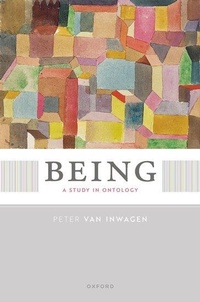
Being
A Study in Ontology
Published on 22. December 2022
Book
Hardback
314 pages
978-0-19-288396-4 (ISBN)
Description
For millennia, philosophers have debated about the existence of things - not only the existence of things like God, demons and the soul, but things like mathematical objects, qualities and attributes, or merely possible states of affairs and people. Ontology is the present-day name for the part of philosophy that addresses such questions. Being attempts to answer these old questions-and the question of how one should go about attempting to answer them.
This book presents and defends a meta-ontology and an ontology. Quine has taught us to use the word 'ontology' as a label for the part of philosophy that addresses "the ontological question" - 'What is there?' Meta-ontology, then, is the part of philosophy that addresses two questions, 'What is it to be (or to exist)?' and 'How should one attempt to answer the ontological question?' Chapters 1 and 5 are devoted to meta-ontology - Chapter 1 to a defense of the "neo-Quinean" meta-ontology, Chapter 5 to an examination of various alternative meta-ontologies. The essence of neo-Quineanism is that 'x exists' and 'Something is x' and 'The number of things that are x is not 0' mean more or less the same thing'. Neo-Quineanism obviously entails that there are no non-existent things, for nothing is such that nothing is it and everything is such that the number of things identical with it is 1. Chapter 2 is an examination of various positions that imply that there are non-existent things. The topic of Chapter 3 is the ancient "problem of universals," or the problem of the existence and nature of abstract objects. Chapter 4 is devoted to questions concerning possible worlds and other objects belonging to the ontology of modality.
This book presents and defends a meta-ontology and an ontology. Quine has taught us to use the word 'ontology' as a label for the part of philosophy that addresses "the ontological question" - 'What is there?' Meta-ontology, then, is the part of philosophy that addresses two questions, 'What is it to be (or to exist)?' and 'How should one attempt to answer the ontological question?' Chapters 1 and 5 are devoted to meta-ontology - Chapter 1 to a defense of the "neo-Quinean" meta-ontology, Chapter 5 to an examination of various alternative meta-ontologies. The essence of neo-Quineanism is that 'x exists' and 'Something is x' and 'The number of things that are x is not 0' mean more or less the same thing'. Neo-Quineanism obviously entails that there are no non-existent things, for nothing is such that nothing is it and everything is such that the number of things identical with it is 1. Chapter 2 is an examination of various positions that imply that there are non-existent things. The topic of Chapter 3 is the ancient "problem of universals," or the problem of the existence and nature of abstract objects. Chapter 4 is devoted to questions concerning possible worlds and other objects belonging to the ontology of modality.
Reviews / Votes
The book is something of a historical document... this book will be very welcome to those working in the resurgence of analytic meta-ontology because it uncovers the roots of contemporary thinking about being. * Choice *More details
Language
English
Place of publication
Oxford
United Kingdom
Target group
Professional and scholarly
Product notice
sewn/stitched
Cloth over boards
Dimensions
Height: 238 mm
Width: 161 mm
Thickness: 25 mm
Weight
640 gr
ISBN-13
978-0-19-288396-4 (9780192883964)
Copyright in bibliographic data and cover images is held by Nielsen Book Services Limited or by the publishers or by their respective licensors: all rights reserved.
Schweitzer Classification
Other editions
Person
Peter van Inwagen is the John Cardinal O'Hara Professor Emeritus of Philosophy at the University of Notre Dame and a member of the American Academy of Arts and Sciences. He has delivered the Maurice Lectures at King's College, London, the Wilde Lectures on Natural Religion at Oxford University, the Stewart Lectures at Princeton University, and the Gifford Lectures at the University of St Andrews, where he received an honorary doctorate. He is the author of eight books and over two hundred essays and critical studies, and has had three books and four international conferences devoted to his work.
Content
Preface
Introduction
Summary
I: Being and Existence
II: Being and Non-Being
III: Being and Abstraction
IV: Being and Possibility
V: Being and Generality
VI: Lightweight Platonism: An Ontological Framework
Bibliography
Index
Introduction
Summary
I: Being and Existence
II: Being and Non-Being
III: Being and Abstraction
IV: Being and Possibility
V: Being and Generality
VI: Lightweight Platonism: An Ontological Framework
Bibliography
Index