

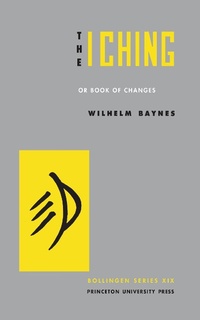
The I Ching or Book of Changes
The I Ching or Book of Changes
Princeton University Press
3rd Edition
Published on 21. October 1967
Book
Hardback
808 pages
978-0-691-09750-3 (ISBN)
Description
The bestselling English translation of the ancient classic of Chinese divination that has inspired millions with its timeless insights into the changing nature of existence
The I Ching, or Book of Changes, has exerted a living influence in China for thousands of years. Today, it continues to enrich the lives of readers around the world. First set down in the dawn of history as a book of oracles, it grew into a book of wisdom with the inclusion of commentaries on its oracular pronouncements, eventually becoming one of the Five Classics of Confucianism and providing a common source for both Confucianist and Taoist philosophy. This edition of the I Ching is the most authoritative and complete translation available, preserving the spirit of the ancient text while providing a vital key for anyone who seeks to live harmoniously with the immutable law of change.
The book presents the sixty-four hexagrams of the I Ching along with their texts and interpretations in a format especially designed for easy reference. Unlike many editions of the I Ching, it also features the Ten Wings, supplemental writings traditionally ascribed to Confucius that provide indispensable insights into the symbolic structure of the hexagrams and their place in a cosmology where change is the only constant.
With an illuminating foreword by C. G. Jung and an informative introduction by Richard Wilhelm, this beautiful edition of the I Ching shares the essence of wisdom and a true understanding of life.
The I Ching, or Book of Changes, has exerted a living influence in China for thousands of years. Today, it continues to enrich the lives of readers around the world. First set down in the dawn of history as a book of oracles, it grew into a book of wisdom with the inclusion of commentaries on its oracular pronouncements, eventually becoming one of the Five Classics of Confucianism and providing a common source for both Confucianist and Taoist philosophy. This edition of the I Ching is the most authoritative and complete translation available, preserving the spirit of the ancient text while providing a vital key for anyone who seeks to live harmoniously with the immutable law of change.
The book presents the sixty-four hexagrams of the I Ching along with their texts and interpretations in a format especially designed for easy reference. Unlike many editions of the I Ching, it also features the Ten Wings, supplemental writings traditionally ascribed to Confucius that provide indispensable insights into the symbolic structure of the hexagrams and their place in a cosmology where change is the only constant.
With an illuminating foreword by C. G. Jung and an informative introduction by Richard Wilhelm, this beautiful edition of the I Ching shares the essence of wisdom and a true understanding of life.
Reviews / Votes
"Princeton's Bollingen edition--still regarded as the best and most authentic by I Ching aficionados." * The New York Times Book Review *More details
Series
Edition
3rd Reformatted edition
Language
English
Place of publication
New Jersey
United States
Product notice
Trade binding
Illustrations
5 b/w illus.
Dimensions
Height: 213 mm
Width: 137 mm
Thickness: 43 mm
Weight
748 gr
ISBN-13
978-0-691-09750-3 (9780691097503)
Copyright in bibliographic data and cover images is held by Nielsen Book Services Limited or by the publishers or by their respective licensors: all rights reserved.
Schweitzer Classification
Other editions
Additional editions
Hellmut Wilhelm
I Ching or Book of Changes
E-Book
01/2011
1st Edition
Princeton University Press
€24.49
Available for download
Persons
C. G. Jung (1875-1961) was the founder of analytical psychology and one of the great intellectual figures of the twentieth century. Richard Wilhelm (1873-1930) was a sinologist, theologian, and missionary who translated many ancient Chinese works and wrote several books on Chinese philosophy and civilization. His acclaimed German translation of the I Ching from Chinese served as the basis for this Bollingen edition. Hellmut Wilhelm (1905-1990) was a scholar of Chinese literature and history and a world-renowned expert on the I Ching. He was the son of Richard Wilhelm. Cary F. Baynes (1883-1977) was a translator and Jungian psychologist.