

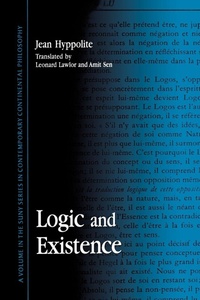
Logic and Existence
Published on 31. July 1997
Book
Paperback/Softback
212 pages
978-0-7914-3232-7 (ISBN)
Description
This first English translation illuminates Hegelianism's most obscure dialectical synthesis: the relation between the phenomenology and the logic. This book is essential for understanding the development of French thought in this century.
Logic and Existence, which originally appeared in 1952, completes the project Hyppolite began with Genesis and Structure of Hegel's Phenomenology of Spirit. Taking up successively the role of language, reflection, and categories in Hegel's Science of Logic, Hyppolite illuminates Hegelianism's most obscure dialectical synthesis: the relation between the phenomenology and the logic.
His interpretation of the relation between the phenomenology and the logic has the result of marking a rupture in French thought. Not only does Logic and Existence effectively end the humanistic reading of Hegel popularized by Kojeve in France before World War II, but also it initiates the great anti-Hegelianism of French philosophy in the sixties. Hyppolite's work displays the originality of Hegel's thought in a new way, and sets up the means by which to escape from it. If the phrase "the philosophy of difference" defines French anti-Hegelianism, then we have to say that there would be no philosophy of difference without Logic and Existence. Derrida's notion of differance, Deleuze's logic of sense, and Foucault's reconception of history all stem from this book. This first English translation of the virtually unknown Logic and Existence is essential for the understanding of the development of French thought in this century.
Logic and Existence, which originally appeared in 1952, completes the project Hyppolite began with Genesis and Structure of Hegel's Phenomenology of Spirit. Taking up successively the role of language, reflection, and categories in Hegel's Science of Logic, Hyppolite illuminates Hegelianism's most obscure dialectical synthesis: the relation between the phenomenology and the logic.
His interpretation of the relation between the phenomenology and the logic has the result of marking a rupture in French thought. Not only does Logic and Existence effectively end the humanistic reading of Hegel popularized by Kojeve in France before World War II, but also it initiates the great anti-Hegelianism of French philosophy in the sixties. Hyppolite's work displays the originality of Hegel's thought in a new way, and sets up the means by which to escape from it. If the phrase "the philosophy of difference" defines French anti-Hegelianism, then we have to say that there would be no philosophy of difference without Logic and Existence. Derrida's notion of differance, Deleuze's logic of sense, and Foucault's reconception of history all stem from this book. This first English translation of the virtually unknown Logic and Existence is essential for the understanding of the development of French thought in this century.
Reviews / Votes
His interpretation of the relation between the phenomenology and the logic has the result of marking a rupture in French thought. Not only does Logic and Existence effectively end the humanistic reading of Hegel popularized by Koje've in France before World War II, but also it initiates the great anti-Hegelianism of French philosophy in the sixties. Hyppolite's work displays the originality of Hegel's thought in a new way, and sets up the means by which to escape from it. If the phrase "the philosophy of difference" defines French anti-Hegelianism, then we have to say that there would be no philosophy of difference without Logic and Existence. Derrida's notion of differance, Deleuze's logic of sense, and Foucault's reconception of history all stem from this book. This first English translation of the virtually unknown Logic and Existence is essential for the understanding of the development of French thought in this century.More details
Series
Language
English
Place of publication
Albany, NY
United States
Target group
Professional and scholarly
US School Grade: College Graduate Student and over
Product notice
Paperback (trade)
Dimensions
Height: 229 mm
Width: 152 mm
Thickness: 15 mm
Weight
390 gr
ISBN-13
978-0-7914-3232-7 (9780791432327)
Copyright in bibliographic data and cover images is held by Nielsen Book Services Limited or by the publishers or by their respective licensors: all rights reserved.
Schweitzer Classification
Other editions
Additional editions
Jean Hyppolite
Logic and Existence
E-Book
07/1997
1st Edition
State University of New York Press
€35.99
Available for download
Persons
Jean Hyppolite (1907-1968) was a professor at Strasbourg and then the Sorbonne as well as serving as Director of the Ecole Normale Superieure. He is the author of Genesis and Structure of Hegel's Phenomenology of Spirit; Introduction to Hegel's Philosophy of History; and Studies on Marx and Hegel. Leonard Lawlor is Associate Professor in the Department of Philosophy at the University of Memphis and is the author of Imagination and Chance: The Difference Between the Thought of Ricoeur and Derrida also published by SUNY Press. Amit Sen is a doctoral student at the University of Memphis.
Content
Translator's Preface
Translator's Note
List of Abbreviations
PART 1. LANGUAGE AND LOGIC
Introduction
1. The Ineffable
2. Sense and Sensible
3. Philosophical Dialectic, Poetry and Mathematical Symbolism
PART 2. SPECULATIVE THOUGHT AND REFLECTION
1. The Transformation of Metaphysics into Logic
2. Reflection and Reflections
3. Absolute Knowledge as Identity and Contradiction: Logos, Nature, Spirit
4. Empirical Negation and Speculative Negation
PART 3. THE CATEGORIES OF THE ABSOLUTE
1. Empirical Proposition and Speculative Proposition
2. The Categories as Catagories of the Absolute
3. The Organization of the Logic: Being, Essence, Concept
Conclusion. Logic and Existence
Appendix. Review of Jean Hyppolite, Logique et existence, by Gilles Deleuze
Index
Translator's Note
List of Abbreviations
PART 1. LANGUAGE AND LOGIC
Introduction
1. The Ineffable
2. Sense and Sensible
3. Philosophical Dialectic, Poetry and Mathematical Symbolism
PART 2. SPECULATIVE THOUGHT AND REFLECTION
1. The Transformation of Metaphysics into Logic
2. Reflection and Reflections
3. Absolute Knowledge as Identity and Contradiction: Logos, Nature, Spirit
4. Empirical Negation and Speculative Negation
PART 3. THE CATEGORIES OF THE ABSOLUTE
1. Empirical Proposition and Speculative Proposition
2. The Categories as Catagories of the Absolute
3. The Organization of the Logic: Being, Essence, Concept
Conclusion. Logic and Existence
Appendix. Review of Jean Hyppolite, Logique et existence, by Gilles Deleuze
Index