

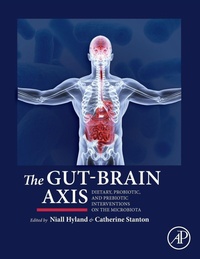
The Gut-Brain Axis
Dietary, Probiotic, and Prebiotic Interventions on the Microbiota
Published on 7. June 2016
Book
Hardback
508 pages
978-0-12-802304-4 (ISBN)
Description
The Gut-Brain Axis: Dietary, Probiotic, and Prebiotic Interventions on the Microbiota examines the potential for microbial manipulation as a therapeutic avenue in central nervous system disorders in which an altered microbiota has been implicated, and explores the mechanisms, sometimes common, by which the microbiota may contribute to such disorders.
More details
Language
English
Place of publication
San Diego
United States
Publishing group
Elsevier Science Publishing Co Inc
Target group
Professional and scholarly
Product notice
Laminated cover
Dimensions
Height: 241 mm
Width: 195 mm
Thickness: 32 mm
Weight
1218 gr
ISBN-13
978-0-12-802304-4 (9780128023044)
Copyright in bibliographic data and cover images is held by Nielsen Book Services Limited or by the publishers or by their respective licensors: all rights reserved.
Schweitzer Classification
Other editions
New editions
Niall Hyland | Catherine Stanton
The Gut-Brain Axis
Dietary, Probiotic, and Prebiotic Interventions on the Microbiota
Book
12/2023
2nd Edition
Academic Press
€204.61
Shipment within 15-20 days
Additional editions
Niall Hyland | Catherine Stanton
The Gut-Brain Axis
Dietary, Probiotic, and Prebiotic Interventions on the Microbiota
E-Book
05/2016
1st Edition
Academic Press
€136.00
Available for download
Persons
Niall Hyland is a Senior Lecturer in the Department of Physiology at University College Cork in Ireland and a Funded Investigator at APC Microbiome Ireland. Dr Hyland has over 20 years' experience in gastrointestinal physiology and enteric neuroscience and his fields of interest include enteric physiology and pharmacology, the brain-gut axis, and microbiota-host interactions. He received a BSc (Hons) in Biomedical Sciences from the University of Ulster and PhD in Pharmacology from King's College London. Dr. Hyland was a visiting fellow at the Department of Pharmacology and Experimental Therapeutics, Louisiana State University Medical Center, USA and completed postdoctoral training at the University of Calgary, Canada. He returned to Ireland in 2007. He has represented Ireland on the Steering Committee of the European Society of Neurogastroenterology and Motilty and is an Honorary Fellow of the British Pharmacological Society.
Catherine Stanton is a Senior Principal Research Officer at Teagasc Moorepark Food Research Centre, Moorepark, Fermoy, Ireland, a Research Professor at University College Cork, College of Medicine and Health, and one of the original PI of APC Microbiome Ireland. Her research program addresses development of innovative dairy foods and probiotics that influence human health and the developing gut microbiota in early life. She has led numerous national and international grants, including the coordination of a number EU projects on various aspects of probiotics for human and animal applications.
Catherine Stanton is a Senior Principal Research Officer at Teagasc Moorepark Food Research Centre, Moorepark, Fermoy, Ireland, a Research Professor at University College Cork, College of Medicine and Health, and one of the original PI of APC Microbiome Ireland. Her research program addresses development of innovative dairy foods and probiotics that influence human health and the developing gut microbiota in early life. She has led numerous national and international grants, including the coordination of a number EU projects on various aspects of probiotics for human and animal applications.
Content
1. Global and Epidemiological Perspectives on Diet and Mood
2. Targeting the microbiota: Considerations for developing probiotics as functional foods
3. Food- and non-food based strategies for effective delivery of probiotics
4. Bioactive- and non-bioactive food constituents and their influence on the microbiome
5. Correlating the gut microbiome to health and disease
6. The microbiome and aging: Impact on health and wellbeing
7. Importance of the microbiota in early life and influence on future health
8. Utility of microbial genome sequencing in probiotic strain identification: Promises and pitfalls
9. Germ-Free Animals: A Key Tool in Unravelling How the Microbiota Affects Brain and Behavior
10. Sensitivity of the hypothalamic-pituitary-adrenal axis to the gut microbiota: Opportunities for dietary intervention
11. A neuroactive microbiome
12. The influence of diet and the gut microbiota in schizophrenia
13. Influence of the microbiota on the development and function of "the second brain" - the enteric nervous system
14. Dietary inventions and brain-gut disorders
15. Altering the gut microbiome for cognitive benefit?
16. The role of the microbiota in neurodevelopmental disorders
17. The role of the microbiota and potential for dietary intervention in chronic fatigue syndrome
18. Potential for pre - and probiotics in managing psychological symptoms associated with alcohol-dependence
19. Where next for dietary intetventions and the brain-gut axis?
20. Perspectives on targeting the microbiome in developing global populations
21. Regulatory considerations for the use and marketing of probiotics and functional foods
22. Microbiota and Metabolism
2. Targeting the microbiota: Considerations for developing probiotics as functional foods
3. Food- and non-food based strategies for effective delivery of probiotics
4. Bioactive- and non-bioactive food constituents and their influence on the microbiome
5. Correlating the gut microbiome to health and disease
6. The microbiome and aging: Impact on health and wellbeing
7. Importance of the microbiota in early life and influence on future health
8. Utility of microbial genome sequencing in probiotic strain identification: Promises and pitfalls
9. Germ-Free Animals: A Key Tool in Unravelling How the Microbiota Affects Brain and Behavior
10. Sensitivity of the hypothalamic-pituitary-adrenal axis to the gut microbiota: Opportunities for dietary intervention
11. A neuroactive microbiome
12. The influence of diet and the gut microbiota in schizophrenia
13. Influence of the microbiota on the development and function of "the second brain" - the enteric nervous system
14. Dietary inventions and brain-gut disorders
15. Altering the gut microbiome for cognitive benefit?
16. The role of the microbiota in neurodevelopmental disorders
17. The role of the microbiota and potential for dietary intervention in chronic fatigue syndrome
18. Potential for pre - and probiotics in managing psychological symptoms associated with alcohol-dependence
19. Where next for dietary intetventions and the brain-gut axis?
20. Perspectives on targeting the microbiome in developing global populations
21. Regulatory considerations for the use and marketing of probiotics and functional foods
22. Microbiota and Metabolism