

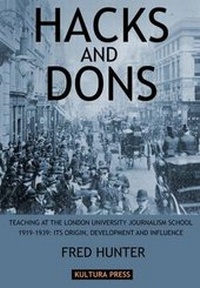
Hacks And Dons
Teaching at the London University Journalism School, 1919-1939, Its Origins, Development and Influence
Published on 1. December 2012
Book
Paperback/Softback
345 pages
978-0-9542899-4-2 (ISBN)
Description
A history of the first university journalism course in Britain between 1919 and 1939, that gave groundings to some of the leading journalists and national newspaper editors from the 1920s until the millennium. The two year Diploma for Journalism course was run by the University of London and by the 1930s was situated at King's College within a stone's throw of Fleet Street. Many course graduates, guided by teaching pioneers Dr George Harrison, Joan Skipsey and Tom Clarke, became successful authors, including Leila Berg, Elizabeth Bowen, Elizabeth Ferrars, Stella Gibbons, Yvonne Kapp, Betty Miller, Penelope Mortimer, and Ruth Tomalin. HACKS: 'A COMMON DRUDGE ESPECIALLY A LITERARY DRUDGE; HENCE A POOR WRITER, A MERE SCRIBBLER (1700)' DONS: 'TUTOR OR FELLOW OF A COLLEGE AT OXFORD OR CAMBRIDGE.' 'SOMETHING WITH A LOUD, AFFECTED VOICE, AIRING ITS KNOWLEDGE' - JOHN CAREY
More details
Language
English
Place of publication
Colchester
United Kingdom
Illustrations
34 black and white illustrations
Dimensions
Height: 234 mm
Width: 150 mm
ISBN-13
978-0-9542899-4-2 (9780954289942)
Copyright in bibliographic data and cover images is held by Nielsen Book Services Limited or by the publishers or by their respective licensors: all rights reserved.
Schweitzer Classification
Person
Dr. Fred Hunter completed the first PhD in journalism at City University under the supervision of Lord Asa Briggs and the legendary editor of the Sunday Times Sir Harry Evans. Dr. Hunter was educated at Cambridge University and after a career in the Central Office of Information became the founder editor of the UK's Independent Radio News. He originated and developed broadcast journalism teaching at the London College of Printing.
Content
Chapter 1 Tom Clarke - Pioneer of Teaching British Journalists; Chapter 2 The Evolution of the Modern Journalist 1880-1930; Chapter 3 Some Aspects of Education and Training; Chapter 4 The Emergence and Development of Education for Journalism in Britain: John Churton Collins and the Birmingham University Scheme for Educating Journalists; Chapter 5 The Introduction of Government Education Grants for Students on Further and Higher Education Courses; Chapter 6 The University of London Diploma for Journalism: The Educational Background and Aims of the Course; Illustrations; Chapter 7 Editorial Attitudes Towards News Reporting Revealed in Clarke's Lecture Notes; Chapter 8 Developments in the Practical Journalism Component of the Diploma for Journalism 1935-1939 including a Termly Examination from 1937 onwards; Chapter 9 The influence of the Diploma for Journalism on the National Union of Journalists and future journalism training and education; Chapter 10; The importance and meaning of the London University Diploma for Journalism course; Chapter 11 Young Women Learning Journalism at London University, 1919-1939; Appendices; Bibliography; Index.