

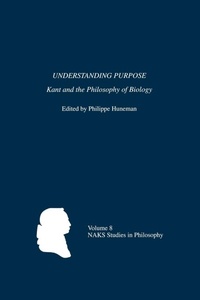
Understanding Purpose
Kant and the Philosophy of Biology
Published on 15. July 2007
Book
Paperback/Softback
202 pages
978-1-58046-265-5 (ISBN)
Description
A collection of essays investigating key historical and scientific questions relating to the concept of natural purpose in Kant's philosophy of biology.
Understanding Purpose is an exploration of the central concept of natural purpose [Naturzweck] in Kant's philosophy of biology. Kant's work in this area is marked by a strong teleological concern: living organisms, in his view, are qualitatively different from mechanistic devices, and as a result they cannot be understood by means of the same principles. At the same time, Kant's own use of the concept of purpose does not presuppose any theological commitments, and is merely "regulative"; that is, it is employed as a heuristic device. The contributors to this volume also investigate the following key historical questions relating to Kant's philosophy of biology: How does it relate to European work in the life sciences that was done before Kant arrived on the scene? How did Kant's unique approach to the philosophy of biology in turn influence later work in this area?
The issues explored in this volume are as pertinent to the history of philosophy as they are to the history of science -- it is precisely the blurred boundaries between these two disciplines that allows for new perspectives on Kantianism and early nineteenth-century German biology to emerge.
Contributors: Jean-Claude Dupont, Mark Fisher, Philippe Huneman, Robert J. Richards, Phillip R. Sloan, Stephane Schmitt, and John Zammito.
Philippe Huneman is researcher at the Centre National de la Recherche Scientifique Unit of the Universite Paris.
Understanding Purpose is an exploration of the central concept of natural purpose [Naturzweck] in Kant's philosophy of biology. Kant's work in this area is marked by a strong teleological concern: living organisms, in his view, are qualitatively different from mechanistic devices, and as a result they cannot be understood by means of the same principles. At the same time, Kant's own use of the concept of purpose does not presuppose any theological commitments, and is merely "regulative"; that is, it is employed as a heuristic device. The contributors to this volume also investigate the following key historical questions relating to Kant's philosophy of biology: How does it relate to European work in the life sciences that was done before Kant arrived on the scene? How did Kant's unique approach to the philosophy of biology in turn influence later work in this area?
The issues explored in this volume are as pertinent to the history of philosophy as they are to the history of science -- it is precisely the blurred boundaries between these two disciplines that allows for new perspectives on Kantianism and early nineteenth-century German biology to emerge.
Contributors: Jean-Claude Dupont, Mark Fisher, Philippe Huneman, Robert J. Richards, Phillip R. Sloan, Stephane Schmitt, and John Zammito.
Philippe Huneman is researcher at the Centre National de la Recherche Scientifique Unit of the Universite Paris.
More details
Series
Language
English
Place of publication
Rochester
United States
Publishing group
Boydell & Brewer Ltd
Target group
Professional and scholarly
Product notice
Paperback (trade)
Illustrations
1 s/w Zeichnung
1 line illus.
Dimensions
Height: 229 mm
Width: 152 mm
Thickness: 12 mm
Weight
336 gr
ISBN-13
978-1-58046-265-5 (9781580462655)
Copyright in bibliographic data and cover images is held by Nielsen Book Services Limited or by the publishers or by their respective licensors: all rights reserved.
Schweitzer Classification
Other editions
Additional editions
E-Book
07/2007
1st Edition
De Gruyter
€14.99
Available for download
Persons
Content
Pre-Kantian Revival of Epigenesis: Caspar Friedrich Wolff's De formatione intestinorum (1768-69) - Jean-Claude Dupont
Kant's Persistent Ambivalence toward Epigenesis, 1764-90 - John H. Zammito
Reflexive Judgment and Wolffian Embryology: Kant's Shift between the First and the Third Critiques - Philippe Huneman
Kant's Explanatory Natural History: Generation and Classification of Organisms in Kant's Natural Philosophy - Mark Fisher
Succession of Functions and Classifications in Post-Kantian Naturphilosophie around 1800 - Stephane Schmitt
Goethe's Use of Kant in the Erotics of Nature - Robert J. Richards
Kant and British Bioscience - Phillip R. Sloan
Kant's Persistent Ambivalence toward Epigenesis, 1764-90 - John H. Zammito
Reflexive Judgment and Wolffian Embryology: Kant's Shift between the First and the Third Critiques - Philippe Huneman
Kant's Explanatory Natural History: Generation and Classification of Organisms in Kant's Natural Philosophy - Mark Fisher
Succession of Functions and Classifications in Post-Kantian Naturphilosophie around 1800 - Stephane Schmitt
Goethe's Use of Kant in the Erotics of Nature - Robert J. Richards
Kant and British Bioscience - Phillip R. Sloan