

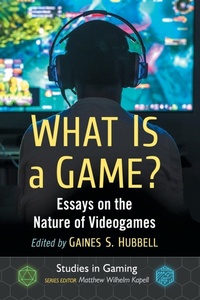
What Is a Game?
Essays on the Nature of Videogames
Published on 28. February 2020
Book
Paperback/Softback
291 pages
978-1-4766-6837-6 (ISBN)
Description
What is a videogame? What makes a videogame "good"? If a game is supposed to be fun, can it be fun without a good story? If another is supposed to be an accurate simulation, does it still need to be entertaining? With the ever-expanding explosion of new videogames and new developments in the gaming world, questions about videogame criticism are becoming more complex. The differing definitions that players and critics use to decide what a game is and what makes a game successful, often lead to different ideas of how games succeed or fail.
This collection of new essays puts on display the variety and ambiguity of videogames. Each essay is a work of game criticism that takes a different approach to defining the game and analyzing it. Through analysis and critical methods, these essays discuss whether a game is defined by its rules, its narrative, its technology, or by the activity of playing it, and the tensions between these definitions. With essays on Overwatch, Dark Souls 3, Far Cry 4, Farmville and more, this collection attempts to show the complex changes, challenges and advances to game criticism in the era of videogames.
This collection of new essays puts on display the variety and ambiguity of videogames. Each essay is a work of game criticism that takes a different approach to defining the game and analyzing it. Through analysis and critical methods, these essays discuss whether a game is defined by its rules, its narrative, its technology, or by the activity of playing it, and the tensions between these definitions. With essays on Overwatch, Dark Souls 3, Far Cry 4, Farmville and more, this collection attempts to show the complex changes, challenges and advances to game criticism in the era of videogames.
More details
Series
Language
English
Place of publication
Jefferson, NC
United States
Target group
Professional and scholarly
Interest Age: From 18 years
Product notice
Paperback (trade)
Illustrations
4 photos, notes, bibliographies, index
Dimensions
Height: 229 mm
Width: 152 mm
Thickness: 17 mm
Weight
478 gr
ISBN-13
978-1-4766-6837-6 (9781476668376)
Copyright in bibliographic data and cover images is held by Nielsen Book Services Limited or by the publishers or by their respective licensors: all rights reserved.
Schweitzer Classification
Persons
Gaines S. Hubbell is an assistant professor of English and writing program administrator at the University of Alabama in Huntsville. His work focuses on the history of rhetoric and methods of game criticism. Series editor Matthew Wilhelm Kapell teaches American studies, anthropology, and writing at Pace University in New York.
Content
Table of Contents
Introduction: Defining Games in the Process of Criticism (Gaines S. Hubbell)
Games as Text
Experiential Rhetoric: Game Design as Persuasion (Jason Hawreliak)
Post-Procedural Composition(s): Writing Gameplay Criticism
(Kyle M. Bohunicky)
An Educational Critique of Blizzard's Overwatch (Joseph R. Fanfarelli)
Using Procedural Rhetoric to Analyze a Persuasive
Health Game: Re-Mission (Emily Kuzneski Johnson and Rudy McDaniel)
Texts and Turnabouts: Analyzing the Words of Ace Attorney (Robyn Hope)
Imagining the World Differently: Hohokum and the Evolution of Digital Games (Raven A. Pfister)
Games as Activity
Lighting the Bonfire: The Role of Online Fan Community Discourse and Collaboration in Dark Souls 3 (Alexander Jenkins)
(Re)framing Public Performativity: The Expanding Social Game
of Photos, Sharing and Queer Identity via Gone Home (Jordan Youngblood)
Exploring Literary Merit of Mainstream Videogames Through -Gaming Literacy Theory (April M. Sanders)
Games as Technology
Playing Like a Girl: The Ludic Representation of Gender
in Videogames (Bryan J. Carr)
Cultivating Play: Analyzing the Neoliberal Sub(ob)jects
in FarmVille 2 (Alexis Pulos)
Wii Play the Game Like U: -Gameplay-Oriented Analysis
and Games Criticism On/Off the Screen (Sky LaRell Anderson)
Blockbusters and -Button-Mashers: Analyzing Cinematic
References in Game Reviews as a Means of Convergence (Theo Plothe)
"Choices have consequences," Except When They Don't:
The Illusion of Player Agency in Far Cry 4 (Matthew Wysocki)
Conclusion: Exploring the Ambiguity of Games (Gaines S. Hubbell)
About the Contributors
Index
Introduction: Defining Games in the Process of Criticism (Gaines S. Hubbell)
Games as Text
Experiential Rhetoric: Game Design as Persuasion (Jason Hawreliak)
Post-Procedural Composition(s): Writing Gameplay Criticism
(Kyle M. Bohunicky)
An Educational Critique of Blizzard's Overwatch (Joseph R. Fanfarelli)
Using Procedural Rhetoric to Analyze a Persuasive
Health Game: Re-Mission (Emily Kuzneski Johnson and Rudy McDaniel)
Texts and Turnabouts: Analyzing the Words of Ace Attorney (Robyn Hope)
Imagining the World Differently: Hohokum and the Evolution of Digital Games (Raven A. Pfister)
Games as Activity
Lighting the Bonfire: The Role of Online Fan Community Discourse and Collaboration in Dark Souls 3 (Alexander Jenkins)
(Re)framing Public Performativity: The Expanding Social Game
of Photos, Sharing and Queer Identity via Gone Home (Jordan Youngblood)
Exploring Literary Merit of Mainstream Videogames Through -Gaming Literacy Theory (April M. Sanders)
Games as Technology
Playing Like a Girl: The Ludic Representation of Gender
in Videogames (Bryan J. Carr)
Cultivating Play: Analyzing the Neoliberal Sub(ob)jects
in FarmVille 2 (Alexis Pulos)
Wii Play the Game Like U: -Gameplay-Oriented Analysis
and Games Criticism On/Off the Screen (Sky LaRell Anderson)
Blockbusters and -Button-Mashers: Analyzing Cinematic
References in Game Reviews as a Means of Convergence (Theo Plothe)
"Choices have consequences," Except When They Don't:
The Illusion of Player Agency in Far Cry 4 (Matthew Wysocki)
Conclusion: Exploring the Ambiguity of Games (Gaines S. Hubbell)
About the Contributors
Index