

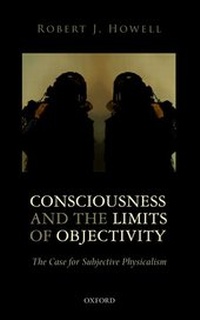
Consciousness and the Limits of Objectivity
The Case for Subjective Physicalism
Published on 13. June 2013
Book
Hardback
202 pages
978-0-19-965466-6 (ISBN)
Description
In Consciousness and the Limits of Objectivity Robert J. Howell argues that the options in the debates about consciousness and the mind-body problem are more limited than many philosophers have appreciated. Unless one takes a hard-line stance, which either denies the data provided by consciousness or makes a leap of faith about future discoveries, one must admit that no objective picture of our world can be complete. Howell argues, however, that this is consistent with physicalism, contrary to received wisdom. After developing a novel, neo-Cartesian notion of the physical, followed by a careful consideration of the three major anti-materialist arguments--Black's 'Presentation Problem', Jackson's Knowledge Argument, and Chalmers' Conceivability Argument--Howell proposes a 'subjective physicalism' which gives the data of consciousness their due, while retaining the advantages of a monistic, physical ontology.
Reviews / Votes
... let me end by emphasizing how clear, imaginative and straightforward this book is. Subjective physicalism has been defended before, but Howell makes a good case that existing versions are incomplete. * Daniel Stoljar, Mind * A clear account of how consciousness could be physical even if we can't fully know it from an objective standpoint. Howell shows that there is still much to be discussed in what might look like well-worn territory, and his book is deserving of attention. . . . I think this is the best version of the supervenience approach currently on the market * Richard Brown, Notre Dame Philosophical Reviews * The book is aimed at professional philosophers ... and its breezy, informal (by academic standards) tone make the book a pleasant read. * Derek Ball, TPM * Consciousness and the Limits of Objectivity is carefully argued, clear, full of creative insights, and advances a number of debates. It should be read by anyone with an interest in physicalism, consciousness, and the limits of objective understanding. * Kevin Morris, Philosophical Quarterly * Short, sharply-focused, and well-written, this volume develops an improved version of supervenience-based physicalism . . . an excellent addition to the literature on the hard problem of consciousness . . . Highly recommended. * W. Seager, Choice *More details
Language
English
Place of publication
Oxford
United Kingdom
Target group
College/higher education
Professional and scholarly
Dimensions
Height: 223 mm
Width: 147 mm
Thickness: 19 mm
Weight
390 gr
ISBN-13
978-0-19-965466-6 (9780199654666)
Copyright in bibliographic data and cover images is held by Nielsen Book Services Limited or by the publishers or by their respective licensors: all rights reserved.
Schweitzer Classification
Other editions
Additional editions
Book
02/2017
Oxford University Press
€31.60
Shipment within 15-20 days
E-Book
06/2013
1st Edition
OUP eBook
€13.49
Available for download
Person
Robert J. Howell received his Ph.D. In philosophy from Brown University in 2002. He is an Associate Professor at Southern Methodist University, and has published numerous articles on the mind-body problem, self-knowledge, and issues in epistemology. He is the co-author, with Torin Alter, of A Dialogue on Consciousness (OUP, 2009) and The God Dialogues (OUP 2011), and has co-edited with Alter Consciousness and the Mind Body Problem: A Reader (OUP, 2011).
Content
PART I: DEFINING PHYSICALISM; PART II: THE THREAT OF THE SUBJECTIVE; PART III: SAVING PHYSICALISM