

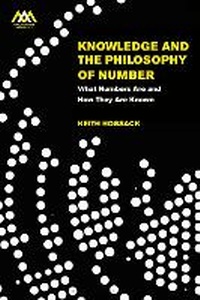
Knowledge and the Philosophy of Number
What Numbers Are and How They Are Known
Published on 26. August 2021
Book
Paperback/Softback
216 pages
978-1-350-27796-0 (ISBN)
Description
If numbers were objects, how could there be human knowledge of number? Numbers are not physical objects: must we conclude that we have a mysterious power of perceiving the abstract realm? Or should we instead conclude that numbers are fictions?
This book argues that numbers are not objects: they are magnitude properties. Properties are not fictions and we certainly have scientific knowledge of them. Much is already known about magnitude properties such as inertial mass and electric charge, and much continues to be discovered. The book says the same is true of numbers.
In the theory of magnitudes, the categorial distinction between quantity and individual is of central importance, for magnitudes are properties of quantities, not properties of individuals. Quantity entails divisibility, so the logic of quantity needs mereology, the a priori logic of part and whole. The three species of quantity are pluralities, continua and series, and the book presents three variants of mereology, one for each species of quantity.
Given Euclid's axioms of equality, it is possible without the use of set theory to deduce the axioms of the natural, real and ordinal numbers from the respective mereologies of pluralities, continua and series. Knowledge and the Philosophy of Number carries out these deductions, arriving at a metaphysics of number that makes room for our a priori knowledge of mathematical reality.
This book argues that numbers are not objects: they are magnitude properties. Properties are not fictions and we certainly have scientific knowledge of them. Much is already known about magnitude properties such as inertial mass and electric charge, and much continues to be discovered. The book says the same is true of numbers.
In the theory of magnitudes, the categorial distinction between quantity and individual is of central importance, for magnitudes are properties of quantities, not properties of individuals. Quantity entails divisibility, so the logic of quantity needs mereology, the a priori logic of part and whole. The three species of quantity are pluralities, continua and series, and the book presents three variants of mereology, one for each species of quantity.
Given Euclid's axioms of equality, it is possible without the use of set theory to deduce the axioms of the natural, real and ordinal numbers from the respective mereologies of pluralities, continua and series. Knowledge and the Philosophy of Number carries out these deductions, arriving at a metaphysics of number that makes room for our a priori knowledge of mathematical reality.
Reviews / Votes
Recommended. Upper-division undergraduates, graduate students, and faculty. * CHOICE * Hossack's book revives the ancient view that numbers are magnitudes and thus a special kind of property, which are instantiated in the physical world. This view receives a powerful mathematical and philosophical development and defense. The book is highly recommended to anyone with an interest in metaphysics or the philosophy of mathematics. * Oystein Linnebo, Professor of Philosophy, University of Oslo, Norway *More details
Series
Language
English
Place of publication
London
United Kingdom
Publishing group
Bloomsbury Publishing PLC
Target group
College/higher education
Dimensions
Height: 232 mm
Width: 152 mm
Thickness: 14 mm
Weight
680 gr
ISBN-13
978-1-350-27796-0 (9781350277960)
Copyright in bibliographic data and cover images is held by Nielsen Book Services Limited or by the publishers or by their respective licensors: all rights reserved.
Schweitzer Classification
Other editions
Additional editions
E-Book
02/2020
1st Edition
Bloomsbury Academic
€36.49
Available for download
E-Book
02/2020
1st Edition
Bloomsbury Academic
€36.49
Available for download
Person
Keith Hossack is Reader in Philosophy, Birkbeck College, University of London, UK.
Content
Preface
Introduction
1. Properties
2. Frege's Theory of Concepts
3. The Logic of Quantity
4. Mereology
5. The Homomorphism Theorem
6. The Natural Numbers
7. Multiplication
8. Ratio
9. Geometry
10. The Ordinals
Notes
References
Index
Introduction
1. Properties
2. Frege's Theory of Concepts
3. The Logic of Quantity
4. Mereology
5. The Homomorphism Theorem
6. The Natural Numbers
7. Multiplication
8. Ratio
9. Geometry
10. The Ordinals
Notes
References
Index