

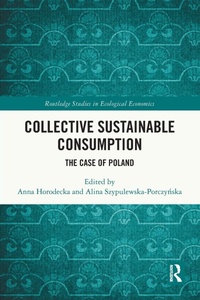
Collective Sustainable Consumption
The Case of Poland
1st Edition
Published on 22. May 2026
Book
Paperback/Softback
270 pages
978-1-032-53826-6 (ISBN)
Description
In the face of climate change and resulting environmental and social crises, sustainable consumption has become a widely discussed issue and a key plank of the UN's Sustainable Development Goals (SDGs). The majority of the sustainable consumption research uses the SDG framework, but this only serves to reinforce an individualistic, efficiency-based approach and it does not sufficiently cover the specific situation of transition economies. In contrast, this volume promotes a collective approach to sustainable consumption, and combines general theoretical issues with empirical examples from the Polish economy.
The first part of the book presents a theoretical approach to collective consumption which has the core concepts of justice and human nature at its heart. This approach emphasises the role of collective rationality and categorises aspects of sustainable consumption as a common and public good. The second part investigates diversified aspects of sustainability, including socio-economic inequalities as barriers to sustainable consumption, consumer sovereignty in the context of current legal regulations, and the impact on employees of changes to the types and conditions of work. It also examines the sharing economy and the legal conditions of its development. The third part adopts a political perspective focusing on the state policies enhancing the role of investment in public goods, analyses photovoltaic programmes which promote prosumption and indicates challenges to sustainability faced by many countries such as the energy crisis, sustainable finance, and cooperative platforms.
This book will be of great interest to researchers and scholars interested in sustainability and consumption issues in economics, management, law, public administration, and political science.
The first part of the book presents a theoretical approach to collective consumption which has the core concepts of justice and human nature at its heart. This approach emphasises the role of collective rationality and categorises aspects of sustainable consumption as a common and public good. The second part investigates diversified aspects of sustainability, including socio-economic inequalities as barriers to sustainable consumption, consumer sovereignty in the context of current legal regulations, and the impact on employees of changes to the types and conditions of work. It also examines the sharing economy and the legal conditions of its development. The third part adopts a political perspective focusing on the state policies enhancing the role of investment in public goods, analyses photovoltaic programmes which promote prosumption and indicates challenges to sustainability faced by many countries such as the energy crisis, sustainable finance, and cooperative platforms.
This book will be of great interest to researchers and scholars interested in sustainability and consumption issues in economics, management, law, public administration, and political science.
More details
Series
Language
English
Place of publication
London
United Kingdom
Publishing group
Taylor & Francis Ltd
Target group
College/higher education
Postgraduate
Product notice
Paperback (trade)
Illustrations
26 s/w Tabellen, 7 s/w Zeichnungen, 7 s/w Abbildungen
26 Tables, black and white; 7 Line drawings, black and white; 7 Illustrations, black and white
Dimensions
Height: 234 mm
Width: 156 mm
Thickness: 15 mm
Weight
397 gr
ISBN-13
978-1-032-53826-6 (9781032538266)
Copyright in bibliographic data and cover images is held by Nielsen Book Services Limited or by the publishers or by their respective licensors: all rights reserved.
Schweitzer Classification
Other editions
Additional editions
E-Book
06/2024
1st Edition
Routledge
€60.49
Available for download
E-Book
06/2024
1st Edition
Routledge
€60.49
Available for download
Book
06/2024
1st Edition
Routledge
€207.90
Shipment within 10-20 days
Persons
Anna Horodecka is Associate Professor at SGH Warsaw School of Economics, Poland.
Alina Szypulewska-Porczynska is Associate Professor at SGH Warsaw School of Economics, Poland.
Alina Szypulewska-Porczynska is Associate Professor at SGH Warsaw School of Economics, Poland.
Content
1. Introduction: Setting the Stage by Exploring Different Perspectives on Sustainable Consumption Alina Szypulewska-Porczynska & Aleksandra Burgiel-Szewc & Marta Grybs-Kabocik & Anna Horodecka & Agnieszka Kacprowicz & Tadeusz Makulski & Ewa Radomska & Tomasz Szewc & Magdalena Sliwinska & Liudmyla Vozna & Agnieszka Ziomek & Jacek Zralek & Jolanta Zralek 2. Exploring the Collective Perspective on Sustainable Consumption: A Study of Justice and Human Nature Anna Horodecka 3. The Role of Collective Rationality in Explaining the Sustainable Consumption: The Rational Choice Theory Revisited Liudmyla Vozna and Anna Horodecka 4. Sustainable Consumption as a Common Good: The Citizen-Consumer Approach Challenged Anna Horodecka 5. Sustainable Consumption as a Public Good Alina Szypulewska-Porczynska 6. The Interplay Between Inequalities and Sustainability: The Case of Poland Anna Horodecka, Alina Szypulewska-Porczynska and Agnieszka Ziomek 7. Revision of the Consumer Sovereignty Concept in the Light of the Sustainable Consumption Policy in Poland Jacek Zralek and Jolanta Zralek 8. The Sustainable Consumption of Employees in the Context of Changing Work Models in Poland Agnieszka Ziomek and Anna Horodecka 9. Legal Perspective on the Development of Sharing Economy in Poland Tomasz Szewc and Aleksandra Burgiel-Szewc 10. Fair Trade as a Driver for Sustainable Consumption: The Polish Perspective Magdalena Sliwinska, Ewa Radomska and Tadeusz Makulski 11. Investments in Public Goods in Poland Alina Szypulewska-Porczynska and Anna Horodecka 12. Prosumption-based Solutions for Achieving SDG 12: The Case of Solar Photovoltaics Programmes in Poland Jolanta Zralek and Jacek Zralek 13. Sustainable Finance as a Driver for Changes Towards Sustainability Alina Szypulewska-Porczynska and Agnieszka Kacprowicz 14. Pro-Ecological Implications of Developing Collaborative Platforms in Poland Marta Grybs-Kabocik 15. Conclusions: Navigating the Landscape of Collective Sustainable Consumption Anna Horodecka, Aleksandra Burgiel-Szewc, Marta Grybs-Kabocik, Agnieszka Kacprowicz, Tadeusz Makulski, Ewa Radomska, Tomasz Szewc, Alina Szypulewska-Porczynska, Magdalena Sliwinska, Liudmyla Vozna, Agnieszka Ziomek, Jacek Zralek and Jolanta Zralek