

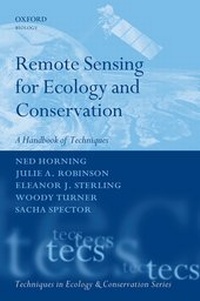
Remote Sensing for Ecology
A Handbook of Techniques
Published on 28. August 2010
Book
Hardback
496 pages
978-0-19-921994-0 (ISBN)
Description
The work of conservation biology has grown from local studies of single species into a discipline concerned with mapping and managing biodiversity on a global scale. Remote sensing, using satellite and aerial imaging to measure and map the environment, increasingly provides a vital tool for effective collection of the information needed to research and set policy for conservation priorities. The perceived complexities of remotely sensed data and analyses have tended to discourage scientists and managers from using this valuable resource. This text focuses on making remote sensing tools accessible to a larger audience of non-specialists, highlighting strengths and limitations while emphasizing the ways that remotely sensed data can be captured and used, especially for evaluating human impacts on ecological systems.
Reviews / Votes
Horning et al successfully achieve their main goal of making the technical discipline of remote sensing accessible to a new audience. The text is supported by invaluable colour diagrams and images to bring the more technical aspects to life. This contribution to the 'Techniques in Ecology and Conservation' series will be of great use to advanced undergraduates, postgraduates, researchers and practitioners. Sarah Taylor, Bulletin of the British Ecological SocietyMore details
Language
English
Place of publication
Oxford
United Kingdom
Target group
College/higher education
Professional and scholarly
This accessible text is primarily aimed at postgraduate and advanced undergraduate students taking courses in ecology, conservation biology and environmental management. It will also serve as a valuable reference work for established researchers, nature conservation practitioners, policy makers and land managers.
Illustrations
150 illustrations in full colour
Dimensions
Height: 239 mm
Width: 162 mm
Thickness: 28.7 mm
Weight
977 gr
ISBN-13
978-0-19-921994-0 (9780199219940)
Copyright in bibliographic data and cover images is held by Nielsen Book Services Limited or by the publishers or by their respective licensors: all rights reserved.
Schweitzer Classification
Other editions
Additional editions
Ned Horning | Julie A. Robinson | Eleanor J. Sterling
Remote Sensing for Ecology and Conservation
A Handbook of Techniques
Book
07/2010
Oxford University Press
€141.30
Shipment within 15-20 days
Persons
Ned Horning, Center for Biodiversity and Conservation, American Museum of Natural History, New York, USA, Julie A. Robinson, NASA Johnson Space Center, USA, Eleanor J. Sterling, Center for Biodiversity and Conservation, American Museum of Natural History, New York, USA, Woody Turner, NASA Headquarters, USA, and Sacha Spector, Center for Biodiversity and Conservation, American Museum of Natural History, New York, USA
Author
Center for Biodiversity and Conservation, American Museum of Natural History, New York, USA
NASA Johnson Space Center, USA
Center for Biodiversity and Conservation, American Museum of Natural History, New York, USA
NASA Headquarters, USA
Center for Biodiversity and Conservation, American Museum of Natural History, New York, USA
Content
Preface; Acronyms List; 1. Introduction: Why Ecologists and Conservation Biologists Use Remote Sensing; 2. When to Use Remote Sensing; 3. Working with Images; 4. Measuring and Monitoring Land Cover, Land Use, and Vegetation Characteristics; 5. Terrain and Soils; 6. Marine and Coastal Environments; 7. Wetlands-Estuaries, Inland Wetlands, and Freshwater Lakes; 8. Atmosphere and Climate; 9. Disturbances: Fires and Floods; 10. Landscape Fragmentation; 11. Human Interfaces and Urban Change; 12. Protected Area Design and Monitoring; 13. Integrating Field Data; 14. Linking Remote Sensing with Modeling; 15. Global Conservation; Appendix 1 The Electromagnetic Spectrum; Appendix 2 Image Processing Software; Appendix 3 Open Source Software; Appendix 4 Satellites and Sensors; Appendix 5 Visual Interpretation; Appendix 6 Systems for Observing Climate and Atmospheric Phenomena; References; Index