

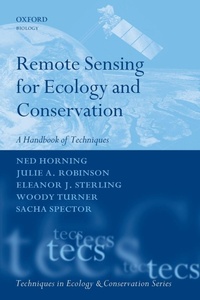
Remote Sensing for Ecology and Conservation
A Handbook of Techniques
Published on 1. July 2010
Book
Paperback/Softback
496 pages
978-0-19-921995-7 (ISBN)
Description
The work of conservation biology has grown from local studies of single species into a discipline concerned with mapping and managing biodiversity on a global scale. Remote sensing, using satellite and aerial imaging to measure and map the environment, increasingly provides a vital tool for effective collection of the information needed to research and set policy for conservation priorities. The perceived complexities of remotely sensed data and analyses have tended to discourage scientists and managers from using this valuable resource. This text focuses on making remote sensing tools accessible to a larger audience of non-specialists, highlighting strengths and limitations while emphasizing the ways that remotely sensed data can be captured and used, especially for evaluating human impacts on ecological systems.
Reviews / Votes
If you are either contemplating the use of remote sensing approaches or requiring guidance in the interpretation of data obtained by this suite of methods, this book, well-illustrated in colour, is likely to be what you need ... [This] is an authoritative and pragmatic text, produced with potential and actual users in mind. * Biodiversity and Conservation * Horning et al successfully achieve their main goal of making the technical discipline of remote sensing accessible to a new audience. The text is supported by invaluable colour diagrams and images to bring the more technical aspects to life. This contribution to the 'Techniques in Ecology and Conservation' series will be of great use to advanced undergraduates, postgraduates, researchers and practitioners. * Sarah Taylor, Bulletin of the British Ecological Society *More details
Series
Language
English
Place of publication
Oxford
United Kingdom
Target group
College/higher education
Professional and scholarly
This accessible text is primarily aimed at postgraduate and advanced undergraduate students taking courses in ecology, conservation biology and environmental management. It will also serve as a valuable reference work for established researchers, nature conservation practitioners, policy makers and land managers.
Illustrations
150 illustrations in full colour
Dimensions
Height: 234 mm
Width: 156 mm
Thickness: 26 mm
Weight
743 gr
ISBN-13
978-0-19-921995-7 (9780199219957)
Copyright in bibliographic data and cover images is held by Nielsen Book Services Limited or by the publishers or by their respective licensors: all rights reserved.
Schweitzer Classification
Other editions
Additional editions
Ned Horning | Julie A. Robinson | Eleanor J. Sterling
Remote Sensing for Ecology
A Handbook of Techniques
Book
08/2010
Oxford University Press
€80.60
Article exhausted; check different version
Persons
Ned Horning started his 20-year career at NASA's Goddard Space Flight Center. For nine years he was involved in remote sensing applications research with spatial scales ranging from individual leaves to continents. This was followed by nine years working as an independent consultant where he worked on NASA-based education outreach to promote the use of satellite imagery in teaching and assorted conservation remote sensing projects. For the last two years Mr. Horning has been the Remote Sensing / GIS Program Manager for the American Museum of Natural History's Center for Biodiversity Conservation where he is actively involved in promoting and applying remote sensing tools for conservation.
Dr. Julie A. Robinson joined the International Space Station Program at NASA Johnson Space Center in 2004, was named the Deputy Program Scientist in 2006, and Program Scientist in 2007. As Program Scientist, she serves as the chief scientist within the ISS Program, representing all research on the ISS, and providing recommendations to NASA Headquarters. She also continues interdisciplinary scientific work in ecology and remote sensing. Her most recent major collaboration was in developing a distribution network for global maps of coral reefs to make them accessible to natural resource managers in developing countries. She was assistant editor on the book: Dynamic Earth Environments: Remote Sensing Observations from Shuttle-Mir Missions (Wiley, 2000). She earned her Ph.D. in Ecology, Evolution and Conservation Biology from the University of Nevada, Reno in 1996.
Dr. Eleanor Sterling is the director of the American Museum of Natural History's Center for Biodiversity and Conservation (CBC), where she oversees strategic planning and project development, leads fundraising efforts, and manages a multidisciplinary staff of over 30. Under Dr. Sterling's direction, the CBC established the Remote Sensing and Geographical Information Systems Facility. The GIS lab supports existing CBC research, and drives independent research projects by identifying potential survey sites, analyzing deforestation rates in focal study areas, developing and implementing spatial and non-spatial databases, advancing predictive modeling, and creating persuasive visual aids to enhance conservation strategies. Dr. Sterling has extensive expertise developing environmental education programs and professional development workshops, having trained teachers, students, and U.S. Peace Corps volunteers in a variety of subjects related to biodiversity conservation.
Woody Turner has worked at NASA Headquarters in Washington, DC for over 20 years. Currently, he is the Program Scientist for Biological Diversity and Program Manager for Ecological Forecasting activities in the NASA Science Mission Directorate. As such, he supports and oversees research activities using NASA remote sensing systems to understand the environmental underpinnings of biological diversity at scales ranging from landscape to global. In addition, Woody has started a NASA ecological forecasting program, which brings together observations and associated models to understand the impacts of human activities on biological diversity. His graduate degrees are in international relations and conservation biology.
Dr. Sacha Spector, Invertebrate Conservation Program Manager at the Center for Biodiversity and Conservation, oversees a number of projects related to developing scientific resources and practical approaches for invertebrate conservation. He also directs the CBC's Invertebrate Biodiversity Laboratory. Dr. Spector's research focuses on understanding and modeling patterns of insect communities' distributions across landscapes and their relationships with plant communities in order to define large-scale conservation plans that benefit insect species. Dr. Spector also serves as an adjunct assistant professor at Columbia University, where he teaches conservation biology and insect conservation, and as Chair of the Terrestrial Invertebrate Red List Authority for the IUCN Species Programme. He received his Ph.D. in Ecology and Evolutionary Biology from the University of Connecticut in 2001, where he held a NASA Graduate Student Researchers Program Fellowship.
Dr. Julie A. Robinson joined the International Space Station Program at NASA Johnson Space Center in 2004, was named the Deputy Program Scientist in 2006, and Program Scientist in 2007. As Program Scientist, she serves as the chief scientist within the ISS Program, representing all research on the ISS, and providing recommendations to NASA Headquarters. She also continues interdisciplinary scientific work in ecology and remote sensing. Her most recent major collaboration was in developing a distribution network for global maps of coral reefs to make them accessible to natural resource managers in developing countries. She was assistant editor on the book: Dynamic Earth Environments: Remote Sensing Observations from Shuttle-Mir Missions (Wiley, 2000). She earned her Ph.D. in Ecology, Evolution and Conservation Biology from the University of Nevada, Reno in 1996.
Dr. Eleanor Sterling is the director of the American Museum of Natural History's Center for Biodiversity and Conservation (CBC), where she oversees strategic planning and project development, leads fundraising efforts, and manages a multidisciplinary staff of over 30. Under Dr. Sterling's direction, the CBC established the Remote Sensing and Geographical Information Systems Facility. The GIS lab supports existing CBC research, and drives independent research projects by identifying potential survey sites, analyzing deforestation rates in focal study areas, developing and implementing spatial and non-spatial databases, advancing predictive modeling, and creating persuasive visual aids to enhance conservation strategies. Dr. Sterling has extensive expertise developing environmental education programs and professional development workshops, having trained teachers, students, and U.S. Peace Corps volunteers in a variety of subjects related to biodiversity conservation.
Woody Turner has worked at NASA Headquarters in Washington, DC for over 20 years. Currently, he is the Program Scientist for Biological Diversity and Program Manager for Ecological Forecasting activities in the NASA Science Mission Directorate. As such, he supports and oversees research activities using NASA remote sensing systems to understand the environmental underpinnings of biological diversity at scales ranging from landscape to global. In addition, Woody has started a NASA ecological forecasting program, which brings together observations and associated models to understand the impacts of human activities on biological diversity. His graduate degrees are in international relations and conservation biology.
Dr. Sacha Spector, Invertebrate Conservation Program Manager at the Center for Biodiversity and Conservation, oversees a number of projects related to developing scientific resources and practical approaches for invertebrate conservation. He also directs the CBC's Invertebrate Biodiversity Laboratory. Dr. Spector's research focuses on understanding and modeling patterns of insect communities' distributions across landscapes and their relationships with plant communities in order to define large-scale conservation plans that benefit insect species. Dr. Spector also serves as an adjunct assistant professor at Columbia University, where he teaches conservation biology and insect conservation, and as Chair of the Terrestrial Invertebrate Red List Authority for the IUCN Species Programme. He received his Ph.D. in Ecology and Evolutionary Biology from the University of Connecticut in 2001, where he held a NASA Graduate Student Researchers Program Fellowship.
Author
Center for Biodiversity and Conservation, American Museum of Natural History, New York, USA
NASA Johnson Space Center, USA
Center for Biodiversity and Conservation, American Museum of Natural History, New York, USA
NASA Headquarters, USA
Center for Biodiversity and Conservation, American Museum of Natural History, New York, USA
Content
Preface ; Acronyms List ; 1. Introduction: Why Ecologists and Conservation Biologists Use Remote Sensing ; 2. When to Use Remote Sensing ; 3. Working with Images ; 4. Measuring and Monitoring Land Cover, Land Use, and Vegetation Characteristics ; 5. Terrain and Soils ; 6. Marine and Coastal Environments ; 7. Wetlands-Estuaries, Inland Wetlands, and Freshwater Lakes ; 8. Atmosphere and Climate ; 9. Disturbances: Fires and Floods ; 10. Landscape Fragmentation ; 11. Human Interfaces and Urban Change ; 12. Protected Area Design and Monitoring ; 13. Integrating Field Data ; 14. Linking Remote Sensing with Modeling ; 15. Global Conservation ; Appendix 1 The Electromagnetic Spectrum ; Appendix 2 Image Processing Software ; Appendix 3 Open Source Software ; Appendix 4 Satellites and Sensors ; Appendix 5 Visual Interpretation ; Appendix 6 Systems for Observing Climate and Atmospheric Phenomena ; References ; Index