

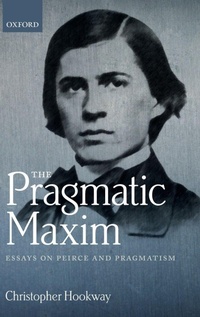
The Pragmatic Maxim
Essays on Peirce and pragmatism
Published on 8. November 2012
Book
Hardback
256 pages
978-0-19-958838-1 (ISBN)
Description
Christopher Hookway presents a series of essays on the philosophy of Charles Sanders Peirce (1839-1913), the 'founder of pragmatism' and one of the most important and original American philosophers. Peirce made significant contributions to the development of formal logic and to the study of the normative standards we should follow in carrying out inquiries and enhancing our knowledge in science and mathematics. In The Pragmatic Maxim, Hookway explores Peirce's writings on truth, science, and the nature of meaning, which have become steadily more influential over recent decades. He demonstrates how Peirce's ideas can contribute to and inform philosophical understanding in debates that continue today.
The first seven chapters explore the framework of Peirce's thought, especially his fallibilism and his rejection of scepticism, and his contributions to the pragmatist understanding of truth and reality. Like Frege and Husserl, among others, Peirce rejected psychologism and used phenomenological foundations to defend the system of categories. The final three chapters are concerned with 'the pragmatic maxim', a rule for clarifying the contents of concepts and ideas. Hookway explores the different strategies Peirce employed to demonstrate the correctness of the maxim, and thus of pragmatism. As well as studying and evaluating Peirce's views, The Pragmatic Maxim discusses the relations between the views of Peirce and other pragmatist philosophers such as William James, C. I. Lewis, and Richard Rorty.
The first seven chapters explore the framework of Peirce's thought, especially his fallibilism and his rejection of scepticism, and his contributions to the pragmatist understanding of truth and reality. Like Frege and Husserl, among others, Peirce rejected psychologism and used phenomenological foundations to defend the system of categories. The final three chapters are concerned with 'the pragmatic maxim', a rule for clarifying the contents of concepts and ideas. Hookway explores the different strategies Peirce employed to demonstrate the correctness of the maxim, and thus of pragmatism. As well as studying and evaluating Peirce's views, The Pragmatic Maxim discusses the relations between the views of Peirce and other pragmatist philosophers such as William James, C. I. Lewis, and Richard Rorty.
Reviews / Votes
we should be grateful for HookwayAcs deeply illuminating analyses * Philip Kitcher, MIND * an excellent collection of eleven historical-philosophical studies of the philosophy of Charles Saunders Peirce... Hookways writing is clear and exact, and his thinking rigorous... in these essays [he] exemplifies enviable standards of historical and critical philosophical exposition... For anyone interested in the concept of knowledge, Hookway makes Peirces epistemology, philosophy of science and methodology of inquiry come alive. * Dale Jacquette, Journal for the History of Analytical Philosophy * Christopher Hookway is one of the very finest scholars of C. S. Peirce and the tradition he founded -- American pragmatism . . . These essays are required reading for anyone interested in Peirce or pragmatism . . . We are also treated to a magnificent introduction, which will serve as a primer for those who want to know the essentials . . . [an] excellent volume * Cheryl Misak, Notre Dame Philosophical Reviews *More details
Language
English
Place of publication
Oxford
United Kingdom
Target group
College/higher education
Professional and scholarly
Dimensions
Height: 240 mm
Width: 161 mm
Thickness: 18 mm
Weight
552 gr
ISBN-13
978-0-19-958838-1 (9780199588381)
Copyright in bibliographic data and cover images is held by Nielsen Book Services Limited or by the publishers or by their respective licensors: all rights reserved.
Schweitzer Classification
Other editions
Additional editions
E-Book
11/2012
1st Edition
OUP Oxford
€100.99
Available for download
Person
Christopher Hookway has been Professor of Philosophy at the University of Sheffield since 1995, having previously taught at the University of Birmingham. In 1995 he was President of the Charles S. Peirce Society. He is the editor of The European Journal of Philosophy.
Content
Preface ; Acknowledgements ; Texts and abbreviations ; Introduction: The pragmatist maxim, the method of science, and representation ; 1. Peirce and scepticism ; 2. Fallibilism and the aim of inquiry ; 3. Truth, reality, and convergence ; 4. Normative logic and psychology: Peirce's rejection of psychologism ; 5. Interrogatives and uncontrollable abductions ; 6. 'The form of a relation': Peirce and mathematical structuralism ; 7. 'A sort of composite photograph': pragmatism, ideas, and schematism ; 8. Pragmatism and the given: C.I. Lewis, Quine, and Peirce ; 9. The principle of pragmatism: Peirce's formulations and illustrations ; 10. Logical principles and philosophical attitudes: Peirce's response to James's pragmatism ; 11. How Peirce argued for his pragmatist maxim ; Bibliography ; Index