

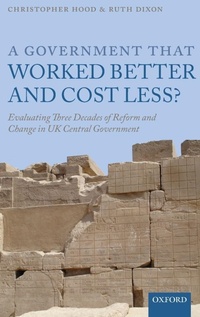
A Government that Worked Better and Cost Less?
Evaluating Three Decades of Reform and Change in UK Central Government
Published on 2. April 2015
Book
Hardback
244 pages
978-0-19-968702-2 (ISBN)
Description
The UK is said to have been one of the most prolific reformers of its public administration. Successive reforms have been accompanied by claims that the changes would make the world a better place by transforming the way government worked. Despite much discussion and debate over government makeovers and reforms, however, there has been remarkably little systematic evaluation of what happened to cost and performance in UK government during the last thirty years.
A Government that Worked Better and Cost Less? aims to address that gap, offering a unique evaluation of UK government modernization programmes from 1980 to the present day. The book provides a distinctive framework for evaluating long-term performance in government, bringing together the 'working better' and 'costing less' dimensions, and presents detailed primary evidence within that framework.
This book explores the implications of their findings for widely held ideas about public management, the questions they present, and their policy implications for a period in which pressures to make government 'work better and cost less' are unlikely to go away.
A Government that Worked Better and Cost Less? aims to address that gap, offering a unique evaluation of UK government modernization programmes from 1980 to the present day. The book provides a distinctive framework for evaluating long-term performance in government, bringing together the 'working better' and 'costing less' dimensions, and presents detailed primary evidence within that framework.
This book explores the implications of their findings for widely held ideas about public management, the questions they present, and their policy implications for a period in which pressures to make government 'work better and cost less' are unlikely to go away.
Reviews / Votes
A Government That Worked Better And Cost Less? should be required reading for students of New Public Management. It provides a model of the often frustrating empirical outcomes which result from great theoretical promise. * Tom Thatcher, LSE Review of Books * it [the book] has accomplished a truly Herculean labor...Rich in statistics and graphs, the book sets out to prove that, contrary to myth, NPM has not produced a government that costs less and works better, quite the opposite, in fact. To back their argument up, the authors of the book have taken pains to explain their methods and approach and how conclusions are reached. * Demetrios Argyriades, City University of New York and Pan Suk Kim, Yonsei University. Governance * This is an important book. At a time when there is a great need for evidence-based policy,A Government that Worked Better and Cost Less? makes a major contribution to our knowledge about the effects of New Public Management (NPM) reforms. * Per Laegrid, University of Bergen, Governance * This study is notable for the important question it addresses, the methods it devises for dealing with data breaks and discontinuities, the data series it constructs, and the results it produces. * Nancy Roberts, Naval Post-Graduate School, Governance *More details
Language
English
Place of publication
Oxford
United Kingdom
Target group
College/higher education
Professional and scholarly
Dimensions
Height: 240 mm
Width: 161 mm
Thickness: 18 mm
Weight
534 gr
ISBN-13
978-0-19-968702-2 (9780199687022)
Copyright in bibliographic data and cover images is held by Nielsen Book Services Limited or by the publishers or by their respective licensors: all rights reserved.
Schweitzer Classification
Other editions
Additional editions
Christopher Hood | Ruth Dixon
A Government that Worked Better and Cost Less?
Evaluating Three Decades of Reform and Change in UK Central Government
E-Book
04/2015
1st Edition
OUP eBook
€36.99
Available for download
Persons
Christopher Hood, is a Fellow of All Souls College, Oxford, and was the Gladstone Professor of Government from 2001 to 2014, and Director of the ESRC Public Services research programme from 2004 to 2010. With Andrew Dunsire, he pioneered the development of 'bureaumetrics' from the late 1970s and was a leading commentator on the emergence of 'New Public Management' in the 1990s.
Dr Ruth Dixon, who comes from a natural science background, has worked at the Department of Politics and International Relations, University of Oxford since 2006, playing a key role in the ESRC Public Services Research Programme before becoming a Research Fellow working on this project since 2010.
Dr Ruth Dixon, who comes from a natural science background, has worked at the Department of Politics and International Relations, University of Oxford since 2006, playing a key role in the ESRC Public Services Research Programme before becoming a Research Fellow working on this project since 2010.
Author
Gladstone Professor of Government Emeritus and Fellow EmeritusGladstone Professor of Government Emeritus and Fellow Emeritus, All Souls College, Oxford
Leverhulme Trust Postdoctoral ResearcherLeverhulme Trust Postdoctoral Researcher, Department of Politics and International Relations, University of Oxford
Content
1. Yesterday's Tomorrows Revisited - the Route to Better and Cheaper Public Services ; 2. The General Background: What Changed and What Didn't in the UK Central Governance Landscape ; 3. Performance Data Breaks: Breaking the Mould and Burying the Evidence ; 4. Did Government Cost Less? Running Costs and Paybill ; 5. Collecting Taxes: Central and Local Government Taxation Compared ; 6. Consistency and Fairness in Administration: Formal Complaints and Legal Challenges ; 7. Comparative Perspectives on Performance ; 8. Government Processes: More Focused and Business-like or Heading into Chaos? ; 9. Not What it Said on the Tin: Assessing Three Decades of Change ; Select Bibliography ; Official Sources Bibliography ; Appendix 1. Anonymised List of Interviewees and Focus Group Members ; Appendix 2. Index of Volatility: Classification of Discontinuities for Chapter Three ; Appendix 3. Dealing with Discontinuities: Methodology for Chapter Four ; Appendix 4. Analysis of Legislative Amendments: Methodology for Chapter Eight