

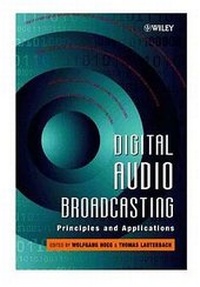
Digital Audio Broadcasting
Principles and Applications
Published on 30. January 2001
Book
Hardback
XVIII, 266 pages
978-0-471-85894-2 (ISBN)
Description
The new Digital Radio system DAB (Digital Audio Broadcasting) is a highly innovative and universal multimedia broadcast system that will replace the existing AM and FM audio broadcast services in many parts of the world in the immediate future. It is designed for excellent mobile reception, is highly robust against multipath reception and allows the use of single frequency networks (SFN) for high frequency efficiency. In addition to several high-quality digital audio services, DAB is able to transmit programme associated data and a host of other data services including travel and traffic information and still and moving pictures. Dynamic multiplex management on the network side opens up new possibilities for flexible programming. Written in an accessible style, "Digital Audio Broadcasting" provides an excellent guide for developers in industry, planning engineers together with broadcasters, network providers and service and content providers. For students and those wishing to get to grips with the new concepts of digital broadcasting it will serve as a comprehensive introduction to the field.
It explains the basic concepts of DAB including audio processing, data transmission and modulation schemes and how the system can be implemented and operated, and features new broadcasting components such as perceptual audio coding (MPEG-1 and MPEG-2), OFDM channel coding and modulation, multiplex management (STI) and data transmission protocols (MOT). It focuses on the practical implications for service provision and coverage planning and the new infrastructure required in studios and broadcasting houses for multiplex and network management, and provides an insight into current receiver development strategies.
It explains the basic concepts of DAB including audio processing, data transmission and modulation schemes and how the system can be implemented and operated, and features new broadcasting components such as perceptual audio coding (MPEG-1 and MPEG-2), OFDM channel coding and modulation, multiplex management (STI) and data transmission protocols (MOT). It focuses on the practical implications for service provision and coverage planning and the new infrastructure required in studios and broadcasting houses for multiplex and network management, and provides an insight into current receiver development strategies.
Reviews / Votes
"The whole DAB community has been waiting for this. It really is a very useful 'one--stop' handbook". (EBU Technical Review, June 2001) "...provides a technical review of digital radio system DAB...Written for broadcasting engineers and technical operators, content providers and programmers, and broadcast students." (SciTech Book News, Vol. 25, No. 3, September 2001) "A well written book by people who know what they are talking about." (M2 Communications, 24 May 2001) "...I am sure I will be poring over this book for months... I encourage you to do the same. It will serve you well..." (Radio World, 14 October 2002)More details
Language
English
Place of publication
Chichester
United Kingdom
Publishing group
John Wiley and Sons Ltd
Target group
College/higher education
Professional and scholarly
Illustrations
Ill.
Dimensions
Height: 25.2 cm
Width: 17.5 cm
Weight
621 gr
ISBN-13
978-0-471-85894-2 (9780471858942)
Schweitzer Classification
Other editions
New editions
Wolfgang Hoeg | Thomas Lauterbach
Digital Audio Broadcasting
Principles and Applications of Digital Radio
Book
08/2003
2nd Edition
Wiley
€99.90
Article exhausted; check for reprint
Persons
Wolfgang Hoeg Berlin, Germany (formerly head of division at Deutsche Telekom Berkom) Thomas Lauterbach University of Applied Sciences, Nurnberg, Germany
Content
Introduction. System Concept. Audio Services and Applications. Data Services and Applications. Provision of Services. Collection and Distribution Networks. The Broadcast Side. The Receiving Side. Appendices. Bibliography. Index.