

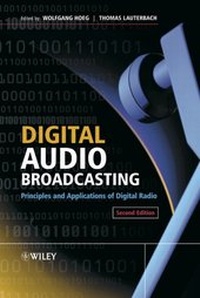
Digital Audio Broadcasting
Principles and Applications of Digital Radio
2nd Edition
Published on 28. August 2003
Book
Hardback
360 pages
978-0-470-85013-8 (ISBN)
Description
This second edition to a successful book will provide an overview and guidance to the technically oriented reader, based on the various international standards and other publications. It will include contributions from a team of expert authors involved in the development and standardisation process of DAB for many years.
Reviews / Votes
"This updated edition introduces the recent international standards, applications, and the technical issues of the Eureka-147 DAB System." (Radio, September 1, 2004) "I had great pleasure reading this book...I highly recommend it..." (Journal of Audio Engineers Society, Vol.52, June 2004) "...second edition is even more complete and comprehensive...straightforward, down-to-earth language...very understandable to the non-initiated..." (EBU Technical Review, April 2004) "...this fully updated new edition introduces the recent international standards, applications, and technical issues of the Eureka 147 DAB system." (IEEE Solid-State Circuits Society Newsletter, January 2004)More details
Edition
2., Auflage
Language
English
Place of publication
Chichester
United Kingdom
Publishing group
John Wiley and Sons Ltd
Target group
Professional and scholarly
Edition type
Revised edition
Illustrations
Illustrations
Dimensions
Height: 25.5 cm
Width: 18.6 cm
Weight
806 gr
ISBN-13
978-0-470-85013-8 (9780470850138)
Schweitzer Classification
Other editions
New editions
Wolfgang Hoeg | Thomas Lauterbach
Digital Audio Broadcasting
Principles and Applications of DAB, DAB + and DMB
Book
05/2009
3rd Edition
Wiley
€147.50
Shipment within 10-20 days
Previous edition
Book
01/2001
Wiley
€92.90
Article exhausted; check for reprint
Persons
Wolfgang Hoeg, Dipl.-Ing., AES Fellow, Berlin, Germany, graduated from the University of Technology, Dresden, in electrical engineering and joined the RFZ (Research and Development Centre of Deutsche Post) in 1959. Since 1991 he has been with Deutsche Telekom, and became head of the division "Audiosystems" with Deutsche Telekom Berkom, Berlin. He has worked in various fields of audio engineering, such as two-channel and multi-channel audio, DAB and other new broadcast technologies. As a member of the standardisation bodies of OIRT, ITU-R and EBU, he was acting as a chairman of several project groups. He also contributed to the Eureka 147/DAB Working Groups and chaired the Task group DRC. After retiring from Deutsche telekom in 1999, he has become an audio consultant.
Thomas Lauterbach, Prof. Dr. rer. nat., Nürnberg, Germany, received his Diplom-Physiker degree and PhD from Erlangen University. In 1992 he joined Robert Bosch GambH, where he became involved with the development of DAB. In 1997 head became head of a multimedia systems development department. He was with several Eureka 147/DAB Working Groups, the German DAB platform and Euro-DAB/WorldDAB and contributed to ETSI. He also co-ordinated the MEMO (ACTS) project. Since 1997 he has been with the Georg-Simon-Ohm-Fachhochschule Nürnberg - University of Applied Sciences as a Professor of Physics. He is currently involved in the Digital Radio Mondiale (DRM) project. In 1996 he edited one of the first books on DAB in German.
Thomas Lauterbach, Prof. Dr. rer. nat., Nürnberg, Germany, received his Diplom-Physiker degree and PhD from Erlangen University. In 1992 he joined Robert Bosch GambH, where he became involved with the development of DAB. In 1997 head became head of a multimedia systems development department. He was with several Eureka 147/DAB Working Groups, the German DAB platform and Euro-DAB/WorldDAB and contributed to ETSI. He also co-ordinated the MEMO (ACTS) project. Since 1997 he has been with the Georg-Simon-Ohm-Fachhochschule Nürnberg - University of Applied Sciences as a Professor of Physics. He is currently involved in the Digital Radio Mondiale (DRM) project. In 1996 he edited one of the first books on DAB in German.
Content
Foreword.
Preface.
List of contributors.
Abbreviations.
1. Introduction.
General.
Radio in the Digital Age.
Benefits of the Eureka 147 DAB System.
History of the Origins of DAB.
International Standardisation.
Relations to Other Digital Broadcasting Systems.
2. System Concept.
The Physical Channel.
The DAB Transmission System.
The DAB Multiplex.
Conditional Access.
Service Information.
3. Audio Services and Applications.
General.
Audio Coding.
Characteristics and Features of MPEG-1 Layer II for DAB.
Programme-associated Data.
Advanced Audio Applications Using MPEG-2 Features.
Quality of Service.
Error Protection and Concealment.
A Typical DAB Ensemble.
Audio Levels.
4. Data Services and Applications.
General.
Data Service Signalling.
Multimedia Applications with MOT.
Standardisation MOT User Application.
"Mobil-Info" as an Example of a Proprietary MOT User Application.
Textual PAD Services.
Traffic Information Services and Navigation Aids.
Moving Picture Services.
Other Data Transmission Mechanism.
5. Provision of Services.
The DAB Service Landscape.
Use of Existing Infrastructures.
Need for New Infrastructure.
Relationship between DAB Data Services and RDS.
Electronic Programme Guide EPG.
Possible New Audio Services.
6. Collection and Distribution Networks.
General.
The Collection Network.
The Distribution Network.
Example of Implementation.
7. The Broadcast Side.
General.
Radio Frequency Propagation Aspects.
Introduction of DAB Networks.
Particularities of Single frequency networks (SFN).
DAB Transmitters.
Coverage Planning.
Coverage Evaluation and Monitoring of SFNs.
Frequency Management.
8. The Receiving Side.
General.
FR Front-End.
Digital Baseband Processing.
Audio Decoder.
Interfaces.
Integrated Circuits for DAB.
Receiver Overview.
Operating a DAB Receiver - the Human Machine Interface.
Appendices.
Bibliography.
Index.
Preface.
List of contributors.
Abbreviations.
1. Introduction.
General.
Radio in the Digital Age.
Benefits of the Eureka 147 DAB System.
History of the Origins of DAB.
International Standardisation.
Relations to Other Digital Broadcasting Systems.
2. System Concept.
The Physical Channel.
The DAB Transmission System.
The DAB Multiplex.
Conditional Access.
Service Information.
3. Audio Services and Applications.
General.
Audio Coding.
Characteristics and Features of MPEG-1 Layer II for DAB.
Programme-associated Data.
Advanced Audio Applications Using MPEG-2 Features.
Quality of Service.
Error Protection and Concealment.
A Typical DAB Ensemble.
Audio Levels.
4. Data Services and Applications.
General.
Data Service Signalling.
Multimedia Applications with MOT.
Standardisation MOT User Application.
"Mobil-Info" as an Example of a Proprietary MOT User Application.
Textual PAD Services.
Traffic Information Services and Navigation Aids.
Moving Picture Services.
Other Data Transmission Mechanism.
5. Provision of Services.
The DAB Service Landscape.
Use of Existing Infrastructures.
Need for New Infrastructure.
Relationship between DAB Data Services and RDS.
Electronic Programme Guide EPG.
Possible New Audio Services.
6. Collection and Distribution Networks.
General.
The Collection Network.
The Distribution Network.
Example of Implementation.
7. The Broadcast Side.
General.
Radio Frequency Propagation Aspects.
Introduction of DAB Networks.
Particularities of Single frequency networks (SFN).
DAB Transmitters.
Coverage Planning.
Coverage Evaluation and Monitoring of SFNs.
Frequency Management.
8. The Receiving Side.
General.
FR Front-End.
Digital Baseband Processing.
Audio Decoder.
Interfaces.
Integrated Circuits for DAB.
Receiver Overview.
Operating a DAB Receiver - the Human Machine Interface.
Appendices.
Bibliography.
Index.