

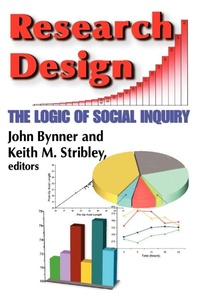
Research Design
The Logic of Social Inquiry
1st Edition
Published on 30. March 2010
Book
Paperback/Softback
366 pages
978-0-202-36370-7 (ISBN)
Description
Research Design: The Logic of Social Inquiry is a collection of critical writings on different aspects of social research. They have been carefully selected for the variety of approaches they display in relation to three broad styles of research: experimental, survey, and ethnographic. All are classic contributions to the development of methodology and excellent expositions of particular procedures.
The book is organized in sections that detail the methods of a typical experimental research program design, data collection, and data analysis. These five sections include The Language of Social Research, Research Design, Data Collection, Measurement, and Data Analysis and Report. Each is preceded by an introduction stressing the unique strengths of the different viewpoints represented and reconciling them in one coherent approach to research.
The volume includes displays of philosophical underpinnings of different methodological styles and important issues in research design. Data collection methods, particularly the problem of systematic bias in the data collected, and ways in which researchers may attempt to reduce it, are discussed. There is also a discussion on measurement in which the central issues of reliability, validity, and scale construction are detailed. This kind of synthesis, between such diverse schools of research as the experimentalists and the ethnographers, is of particular concern to social researchers. The book will be of great value to planners and researchers in local government and education departments and to all others engaged in social science or educational research.
The book is organized in sections that detail the methods of a typical experimental research program design, data collection, and data analysis. These five sections include The Language of Social Research, Research Design, Data Collection, Measurement, and Data Analysis and Report. Each is preceded by an introduction stressing the unique strengths of the different viewpoints represented and reconciling them in one coherent approach to research.
The volume includes displays of philosophical underpinnings of different methodological styles and important issues in research design. Data collection methods, particularly the problem of systematic bias in the data collected, and ways in which researchers may attempt to reduce it, are discussed. There is also a discussion on measurement in which the central issues of reliability, validity, and scale construction are detailed. This kind of synthesis, between such diverse schools of research as the experimentalists and the ethnographers, is of particular concern to social researchers. The book will be of great value to planners and researchers in local government and education departments and to all others engaged in social science or educational research.
More details
Language
English
Place of publication
Somerset
United States
Publishing group
Taylor & Francis Inc
Target group
College/higher education
Professional and scholarly
Dimensions
Height: 229 mm
Width: 152 mm
Thickness: 20 mm
Weight
533 gr
ISBN-13
978-0-202-36370-7 (9780202363707)
Copyright in bibliographic data and cover images is held by Nielsen Book Services Limited or by the publishers or by their respective licensors: all rights reserved.
Schweitzer Classification
Other editions
Additional editions
Book
10/2017
1st Edition
Routledge
€232.60
Shipment within 10-20 days
E-Book
09/2017
1st Edition
Routledge
€69.99
Available for download
E-Book
09/2017
Routledge
€69.99
Available for download
Person
John Bynner is professor emeritus of policy and society at the National Research and Development Centre for Adult Literacy and Numeracy, University of London. He is the author of Modeling and Measuring the Wider Benefits of Learning and The Benefits of Learning. Keith M. Stribley is Course Manager in the Faculty of Social Sciences at Open University where he works in the area of research methodology
Content
Acknowledgments General Introduction Section 1: The language of social research -- includes Walter Wallace, G.H. Von Wright, K.R. Popper, Alfred Schutz, and Norman K. DenzinSection 2: Research design -- includes Scott Greer, John I. Kitsuse, Aaron V. Cicourel, Leslie Kish, Donald T. Campbell, Jacqueline P. Wiseman, and Morris Zelditch Jr.Section 3: Data collection -- includes C. A. Moser,G. Kalton, William Belson, Judith A. Duncan, Harper W. Boyd Jr., RalphWestfall, John P. Dean, William Foote Whyte, and Herbert C. KelmanSection 4: Measurement -- includes A. N. Oppenheim, Lee J. Cronbach, Paul E. Meehl, and Aubrey McKennellSection 5: Data analysis and report -- includes Morris Rosenberg, Hanan C. Selvin, Alan Stuart, Andrew Ahlgren, Herbert J. Walberg, and Howard S. Becker Index