

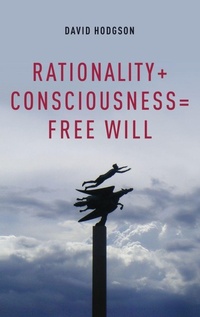
Rationality + Consciousness = Free Will
Published on 19. January 2012
Book
Hardback
288 pages
978-0-19-984530-9 (ISBN)
Description
In recent years, philosophical discussions of free will have focused largely on whether or not free will is compatible with determinism. In this challenging book, David Hodgson takes a fresh approach to the question of free will, contending that close consideration of human rationality and human consciousness shows that together they give us free will, in a robust and indeterministic sense. In particular, they give us the capacity to respond appositely to feature-rich gestalts of conscious experiences, in ways that are not wholly determined by laws of nature or computational rules. The author contends that this approach is consistent with what science tells us about the world; and he considers its implications for our responsibility for our own conduct, for the role of retribution in criminal punishment, and for the place of human beings in the wider scheme of things.
Praise for David Hodgson's previous work, The Mind Matters
"magisterial...It is balanced, extraordinarily thorough and scrupulously fair-minded; and it is written in clear, straightforward, accessible prose." --Michael Lockwood, Times Literary Supplement
"an excellent contribution to the literature. It is well written, authoritative, and wonderfully wide-ranging. ... This account of quantum theory ... will surely be of great value. ... On the front cover of the paper edition of this book Paul Davies is quoted as saying that this is "a truly splendid and provocative book". In writing this review I have allowed myself to be provoked, but I am happy to close by giving my endorsement to this verdict in its entirety!" --Euan Squires, Journal of Consciousness Studies
"well argued and extremely important book." --Sheena Meredith, New Scientist
"His reconstructions and explanations are always concise and clear." --Jeffrey A Barrett, The Philosophical Review
"In this large-scale and ambitious work Hodgson attacks a modern orthodoxy. Both its proponents and its opponents will find it compelling reading." --J. R. Lucas, Merton College, Oxford
Praise for David Hodgson's previous work, The Mind Matters
"magisterial...It is balanced, extraordinarily thorough and scrupulously fair-minded; and it is written in clear, straightforward, accessible prose." --Michael Lockwood, Times Literary Supplement
"an excellent contribution to the literature. It is well written, authoritative, and wonderfully wide-ranging. ... This account of quantum theory ... will surely be of great value. ... On the front cover of the paper edition of this book Paul Davies is quoted as saying that this is "a truly splendid and provocative book". In writing this review I have allowed myself to be provoked, but I am happy to close by giving my endorsement to this verdict in its entirety!" --Euan Squires, Journal of Consciousness Studies
"well argued and extremely important book." --Sheena Meredith, New Scientist
"His reconstructions and explanations are always concise and clear." --Jeffrey A Barrett, The Philosophical Review
"In this large-scale and ambitious work Hodgson attacks a modern orthodoxy. Both its proponents and its opponents will find it compelling reading." --J. R. Lucas, Merton College, Oxford
Reviews / Votes
Hodgson is to be commended for making explicit the commitments driving his own theorising about free will. That is a policy we should all adopt more often. * Oisin Deery, Mind * Hodgson must be commended for bringing an unmistakable freshness and originality to a topic that has been hashed and rehashed for centuries without end ... the book is worth the reading * Brian D. Earp, Philosophy Now *More details
Series
Language
English
Place of publication
New York
United States
Target group
College/higher education
Dimensions
Height: 240 mm
Width: 161 mm
Thickness: 20 mm
Weight
584 gr
ISBN-13
978-0-19-984530-9 (9780199845309)
Copyright in bibliographic data and cover images is held by Nielsen Book Services Limited or by the publishers or by their respective licensors: all rights reserved.
Schweitzer Classification
Other editions
Additional editions
David Hodgson
Rationality + Consciousness = Free Will
E-Book
01/2012
1st Edition
OUP eBook
€53.49
Available for download
David Hodgson
Rationality + Consciousness = Free Will
E-Book
01/2012
1st Edition
OUP eBook
€37.99
Available for download
Person
David Hodgson will soon retire as a Judge of Appeal of the New South Wales Supreme Court, after a long legal career. During that career, he maintained a keen interest and involvement in philosophy. He has published two previous philosophical books through Oxford University Press, Consequences of Utilitarianism and The Mind Matters, and also numerous philosophical articles on consciousness, free will and plausible reasoning.
Content
INTRODUCTION ; The problem of free will and responsibility ; Compatibilism ; Haldane's argument ; How I will proceed ; 1. FOUNDATIONAL BELIEFS ; Can I be certain that I exist? ; The need for language ; Experiences and the external world ; Foundational beliefs ; 2. TRUTH AND RATIONALITY ; Truth ; Relativity of truth? ; Rationality ; Fallacies and biases ; Stich's argument ; A legal example ; Core assertions about truth and rationality ; 3. PLAUSIBLE REASONING ; Formal and informal reasoning ; Induction ; Bayes' theorem ; Illustration of Bayes' theorem ; Levels of cognitive processes ; Core assertions about plausible reasoning ; 4. CONSCIOUSNESS AND DECISION-MAKING ; Dual aspects ; Characteristic features of conscious experiences ; Subjectivity ; Qualia and unity ; Neural correlates of consciousness ; The efficacy of conscious experiences ; Three questions ; Rule-determined processes do not need consciousness ; Core assertions about consciousness and decision-making ; 5. GESTALTS AND RULES ; The argument outlined ; Laws and rules ; The Game of Life and computation ; Tricks of consciousness ; Some further thoughts ; Core assertions about gestalts and rules ; 6. HOW GESTALTS PROMOTE RATIONALITY ; Evolutionary origins ; Aesthetic judgments ; Plausible reasoning ; Conclusion ; Core assertions about how gestalts promote rationality ; 7. SCIENCE AND DETERMINISM ; A lawful universe ; Quantum mechanics ; The free will theorem ; Explanation of the theorem ; Implications ; Time and the block universe ; Core assertions about science and determinism ; 8. NEUROSCIENCE AND CONSCIOUS CHOICE ; Science and the brain ; A general picture ; The Cartesian theatre ; The scale and nature of quantum effects ; Libet, Gazzaniga and Wegner ; Core assertions about neuroscience and conscious choice ; 9. INDETERMINISTIC FREE WILL ; Will and responsibility ; Comparison with Kane ; Agent-causation ; Compatibilism ; Assessment of compatibilism ; Does luck swallow everything? ; More about luck ; Core assertions about indeterministic free will ; 10. VALUE JUDGMENTS ; A different philosophical approach ; Natural imperatives ; Absolute imperatives ; Prima facie imperatives ; No reasonable irreconcilable differences ; Why be moral? ; Good, evil and beauty ; Community practices and laws ; Legal systems ; Capacity for reasonable value judgments ; Core assertions about value judgments ; 11. RESPONSIBILITY AND RETRIBUTION ; Responses to wrong conduct ; Overview ; Australian criminal law ; Retribution as a restriction on State compulsion ; Why retribution should be maintained ; Philosophical bases for retribution ; The future of retribution ; Core assertions about responsibility and retribution ; 12. THE BIG PICTURE ; The scientific account ; An experienced universe ; Constraint, empowerment and guidance ; Religious belief: a subject for rational enquiry ; A value-embedded universe ; Where do we come from? ; Where are we going? ; Can more specific beliefs be supported? ; Potential for evil and good ; Core assertions about the big picture ; APPENDIX A WHY BAYES' THEOREM WORKS ; APPENDIX B AGAINST FUNDAMENTALISM: BIBLICAL MORALITY ; Abraham and Isaac ; The Passover ; The Promised Land ; The New Testament ; REFERENCES