


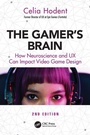
The Gamer's Brain
How Neuroscience and UX Can Impact Video Game Design
2nd Edition
Will be published approx. on 29. January 2026
Book
Hardback
340 pages
978-1-032-05857-3 (ISBN)
Description
Making a successful video game is hard. Even games that are well-received at launch may fail to engage players in the long term due to issues with the user experience (UX) that they are delivering. That's why makers of successful video games like Fortnite and Assassin's Creed invest both time and money perfecting their UX strategy. These top video game creators know that a bad user experience can ruin the prospects for any game, regardless of its budget, scope, or ambition.
The game UX accounts for the whole experience players have with a video game, from first hearing about it to navigating menus and progressing in the game. UX as a discipline offers guidelines to assist developers in creating the optimal experience they want to deliver, including shipping higher quality games (whether indie, triple-A, or "serious") and meeting business goals -- all while staying true to design vision and artistic intent. Yet, UX is more than a discipline, it's a mindset that places players at the center of the game development process, no matter the type of game (from gamification to hardcore games to the metaverse), the platform (PC, consoles, mobile, or VR), or the technology (including AI and blockchain).
At its core, UX is about understanding the gamer's brain: understanding human capabilities and limitations to anticipate how a game will be perceived, the emotions it will elicit, how players will interact with it, and how engaging the experience will be. This book is designed to equip readers of all levels, from student to professional, with cognitive science knowledge and user experience guidelines and methodologies. These insights will help readers identify the ingredients for successful and engaging video games, empowering them to develop their own unique game recipe more efficiently, while providing a better experience for their audience all the while minding for inclusion, accessibility, and ethics.
The game UX accounts for the whole experience players have with a video game, from first hearing about it to navigating menus and progressing in the game. UX as a discipline offers guidelines to assist developers in creating the optimal experience they want to deliver, including shipping higher quality games (whether indie, triple-A, or "serious") and meeting business goals -- all while staying true to design vision and artistic intent. Yet, UX is more than a discipline, it's a mindset that places players at the center of the game development process, no matter the type of game (from gamification to hardcore games to the metaverse), the platform (PC, consoles, mobile, or VR), or the technology (including AI and blockchain).
At its core, UX is about understanding the gamer's brain: understanding human capabilities and limitations to anticipate how a game will be perceived, the emotions it will elicit, how players will interact with it, and how engaging the experience will be. This book is designed to equip readers of all levels, from student to professional, with cognitive science knowledge and user experience guidelines and methodologies. These insights will help readers identify the ingredients for successful and engaging video games, empowering them to develop their own unique game recipe more efficiently, while providing a better experience for their audience all the while minding for inclusion, accessibility, and ethics.
Reviews / Votes
Praise for the First Edition..."The beauty of this book is that it is two things at the same time:
1. An amazingly complete introduction to psychology, using examples from video games to make the concepts clear and memorable.
2. An amazingly complete introduction to video game design, using psychology to help design more compelling games.
So whether you are a game designer, a player, or someone wishing to understand psychology, this is the book for you."
-Don Norman, Director, the Design Lab at the University of California, San Diego Author of The Design of Everyday Things
"By blending up-to-date brain science with game-relevant UX design principles, this book doesn't just give great tips about how to make better games, it gives designers the mental tools to get better at thinking about games. Read this, and suddenly you'll know what you're talking about."
-Jesse Schell, Game Designer, author of The Art of Game Design
"This book is an invaluable asset for game developers, whether you work in game design, user experience, or programming. With a lucid overview of the current best knowledge from cognitive psychology, Hodent provides guidelines and approaches to improve the game experience for players that are based on actual science."
-Raph Koster, Game Designer, author of A Theory of Fun for Game Design
More details
Edition
2nd edition
Language
English
Place of publication
London
United Kingdom
Publishing group
Taylor & Francis Ltd
Target group
College/higher education
Professional and scholarly
Postgraduate and Professional Reference
Illustrations
66 Farbfotos bzw. farbige Rasterbilder, 66 farbige Abbildungen
66 Halftones, color; 66 Illustrations, color
Dimensions
Height: 240 mm
Width: 170 mm
Weight
770 gr
ISBN-13
978-1-032-05857-3 (9781032058573)
Copyright in bibliographic data and cover images is held by Nielsen Book Services Limited or by the publishers or by their respective licensors: all rights reserved.
Schweitzer Classification
Other editions
Additional editions
Book
03/2026
2nd Edition
CRC Press
€65.00
Available immediately
E-Book
01/2026
2nd Edition
CRC Press
€68.49
Available for download
E-Book
01/2026
2nd Edition
CRC Press
€68.49
Available for download
Previous edition

Book
08/2017
1st Edition
CRC Press
€223.04
Shipment within 10-20 days
Person
Celia Hodent, PhD in psychology, is recognized as a leader in the application of user experience and cognitive science in the game industry. With over 17 years of experience in game studios (Ubisoft, LucasArts, & director of UX at Epic Games), she has contributed in advancing the topics of UX strategy, inclusion, and ethics in games. Author of several critically acclaimed books on games and psychology, Celia is the founder of the Game UX Summit & the Ethical Games initiative. She works today as an independent consultant and is an international public speaker.
Content
1. Why you should care about the gamer's brain, PART 1: UNDERSTANDING THE BRAIN, 2. Overview about the brain, 3. Perception, 4. Memory, 5. Attention, 6. Motivation, 7. Emotion, 8. Learning principles, 9. Understanding the brain: Takeaway, PART 2: A UX MINDSET FOR VIDEO GAMES, 10. Game User Experience: Overview, 11. Usability, 12. Engageability, 13. Design thinking, 14. Game User Research, 15. Game Analytics, 16. UX strategy, 17. Ethics, 18. UX Across Various Products: From VR to AI to "Gamification", 19. To conclude