

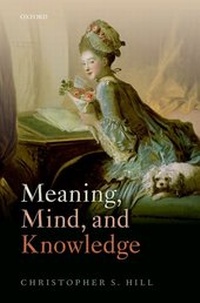
Meaning, Mind, and Knowledge
Published on 6. March 2014
Book
Hardback
342 pages
978-0-19-966582-2 (ISBN)
Description
In this collection of essays, most of which are of recent vintage, and seven of which appear here for the first time, Christopher S. Hill addresses a large assortment of philosophical issues. Part I presents a deflationary theory of truth, argues that semantic properties like reference and correspondence with fact can also be characterized in deflationary terms, and offers an account of the value of these 'thin' properties, tracing it to their ability to track more substantial properties that are informational or epistemic in character. Part II defends the view that conscious experiences are type-identical with brain states. It addresses a large array of objections to this identity thesis, including objections based on the alleged multiple realizability of experiences, and objections based on Cartesian intuitions about the modeal separability of mind and matter. In the end, however, it maintains that theories of experience based on type-identity should give way to representationalist accounts. Part III presents a representationalist solution to the mind-body problem. It argues that all awareness, including awareness of qualia, is governed by a Kantian appearance/reality distinction--a distinction between the ways objects and properties are represented as being, and the ways they are in themselves. It also presents theories of pain and visual qualia that kick them out of the mind and assign them to locations in body and the external world. Part IV defends reliabilist theories of epistemic justification, deploys such theories in answering Cartesian skepticism, responds critically to Hawthorne's lottery problem and related proposals about the role of knowledge in conversation and practical reasoning, presents a new account of the sources of modeal knowledge, and proposes an account of logical and mathematical beliefs that represents them as immunune to empirical revision.
Reviews / Votes
The essays in this volume are the products of forty years of careful and creative philosophical thought. These wonderful essays enrich our understanding of central philosophical topics such as truth, meaning, experience, and knowledge. And they are an excellent gateway to Hills philosophical vision. * Anil Gupta, University of Pittsburgh * In addition to collecting deservedly influential papers by Hill on truth, reference, type materialism, imaginability, pain, skepticism, and knowledge, this book contains new papers on a range of topics, including conceptual representation, phenomenal consciousness, visual experience, modal knowledge, and the a priori.In each of these new contributions, Hill proposes fresh and well motivated solutions to large-scale philosophical problems. * Brian McLaughlin, Rutgers University * There is much to admire and much to be learned in the fascinating essays in this collection. Alongside his exciting new work on perception, concepts, and modality, Christopher HIll has compiled many of his major earlier essays, adding postscripts to place them in perspective. Taken together, these essays provide penetrating and insightful analyses of perception, concepts, knowledge, truth, and the mind-body problem. * Susanna Siegel, Harvard University *More details
Language
English
Place of publication
Oxford
United Kingdom
Target group
College/higher education
Professional and scholarly
Dimensions
Height: 240 mm
Width: 162 mm
Thickness: 29 mm
Weight
674 gr
ISBN-13
978-0-19-966582-2 (9780199665822)
Copyright in bibliographic data and cover images is held by Nielsen Book Services Limited or by the publishers or by their respective licensors: all rights reserved.
Schweitzer Classification
Other editions
Additional editions
Christopher S. Hill
Meaning, Mind, and Knowledge
E-Book
03/2014
1st Edition
OUP eBook
€31.99
Available for download
Person
Christopher S. Hill has taught at a number of institutions, including the University of Arkansas, the University of Michigan, Massachusetts Institute of Technology, and the University of Pittsburgh. He is presently Professor of Philosophy at Brown University. He has published three previous books, and was the editor of Philosophical Topics for twenty years.
Content
PART I: MEANING; PART II: A TYPE MATERIALIST THEORY OF EXPERIENCE; PART III: A REPRESENTATIONALIST THEORY OF EXPERIENCE; PART IV: KNOWLEDGE