

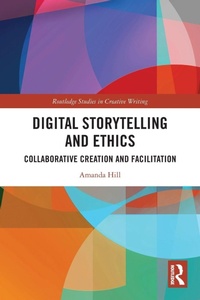
Digital Storytelling and Ethics
Collaborative Creation and Facilitation
1st Edition
Published on 19. December 2024
Book
Paperback/Softback
158 pages
978-1-032-06125-2 (ISBN)
Description
Digital Storytelling and Ethics: Collaborative Creation and Facilitation provides a method for analyzing digital storytelling practices that focuses on the rhetorical, dialogic, co-productive, creative storymaking space rather than the finished stories or the technologies.
Looking through a new media lens, Amanda Hill situates the digital storytelling genre and writing practice as a co-creative media process created between writers, storytellers, educators/facilitators, institutions, and the audience, and discusses the inter-relationships within the collaborative writing workshop as well as in those found in the dissemination of the final digital stories. Digital Storytelling and Ethics provides a reflexive look at the responsibility of the facilitator in co-creative digital storytelling writing spaces and makes use of diverse international case studies as examples.
Hill shows that writing educators/facilitators should interpret their roles within the collaborative creation process. This will ensure that responsible facilitation practices based in witnessing guide the storytelling process and create an environment that treats participants as subjects with the ability to respond to the world. This innovative book is an essential read for collaborative digital writers and facilitators.
Looking through a new media lens, Amanda Hill situates the digital storytelling genre and writing practice as a co-creative media process created between writers, storytellers, educators/facilitators, institutions, and the audience, and discusses the inter-relationships within the collaborative writing workshop as well as in those found in the dissemination of the final digital stories. Digital Storytelling and Ethics provides a reflexive look at the responsibility of the facilitator in co-creative digital storytelling writing spaces and makes use of diverse international case studies as examples.
Hill shows that writing educators/facilitators should interpret their roles within the collaborative creation process. This will ensure that responsible facilitation practices based in witnessing guide the storytelling process and create an environment that treats participants as subjects with the ability to respond to the world. This innovative book is an essential read for collaborative digital writers and facilitators.
More details
Series
Language
English
Place of publication
London
United Kingdom
Publishing group
Taylor & Francis Ltd
Target group
College/higher education
Professional and scholarly
Adult education
Academic, Adult education, and Postgraduate
Illustrations
3 s/w Abbildungen, 3 s/w Zeichnungen
3 Line drawings, black and white; 3 Illustrations, black and white
Dimensions
Height: 234 mm
Width: 156 mm
Thickness: 10 mm
Weight
272 gr
ISBN-13
978-1-032-06125-2 (9781032061252)
Copyright in bibliographic data and cover images is held by Nielsen Book Services Limited or by the publishers or by their respective licensors: all rights reserved.
Schweitzer Classification
Other editions
Additional editions
E-Book
06/2023
1st Edition
Routledge
€59.49
Available for download
E-Book
06/2023
1st Edition
Routledge
€59.49
Available for download
Book
06/2023
1st Edition
Routledge
€216.00
Shipment within 10-20 days
Person
Amanda Hill is an Associate Professor of Communication Studies at St. Mary's University specializing in storytelling and media production. She holds a PhD in Texts and Technology from the University of Central Florida.
Content
Foreword
Acknowledgements
Chapter 1: Introduction: Collaborative Storymaking and Ethical Facilitation
Chapter 2: Contextualizing Personal Narratives: The Digital Storytelling Process
Chapter 3: The Politics of Storytelling: Stakeholders in Collaborative Media Creation
Chapter 4: Navigating Authenticity: Challenges and Considerations in Writing Personal Narratives
Chapter 5: Who's Listening? The Audience as Stakeholder
Chapter 6: Ethical Collaboration: The Responsible Facilitator in Theory
Chapter 7: Ethical Collaboration: The Responsible Facilitator in Practice
Chapter 8: Epilogue: Where Do We Go from Here?
Index
Acknowledgements
Chapter 1: Introduction: Collaborative Storymaking and Ethical Facilitation
Chapter 2: Contextualizing Personal Narratives: The Digital Storytelling Process
Chapter 3: The Politics of Storytelling: Stakeholders in Collaborative Media Creation
Chapter 4: Navigating Authenticity: Challenges and Considerations in Writing Personal Narratives
Chapter 5: Who's Listening? The Audience as Stakeholder
Chapter 6: Ethical Collaboration: The Responsible Facilitator in Theory
Chapter 7: Ethical Collaboration: The Responsible Facilitator in Practice
Chapter 8: Epilogue: Where Do We Go from Here?
Index