

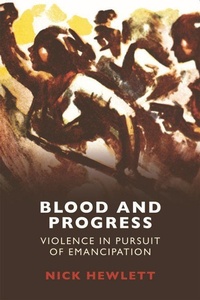
Blood and Progress
Violence in Pursuit of Emancipation
Published on 30. September 2016
Book
Paperback/Softback
208 pages
978-1-4744-1060-1 (ISBN)
Description
From ending the feudal order to struggling against colonial rule; from revolts against slavery to the Bolshevik, Chinese and Cuban revolutions; and from ending foreign occupations to civil wars to overthrow dictators, violent means are seen to justify the non-violent ends. 'Necessary violence' was taken for granted by revolutionaries inspired by Marx, Lenin, Mao and Castro, and countless others. Nick Hewlett places the objectives of non-violence and peace centre-stage to give you a new understanding of violence in revolt. He argues that making the goal of a wholly peaceful society explicit makes an important difference to how we approach and understand violence in pursuit of emancipation.
Reviews / Votes
'Nick Hewlett's Blood and Progress constitutes an engaging meditation on the paradox of violence for the sake of peace. [It] is part of a growing literature which acknowledges the regrettable necessity of constrained violence in some cases for progressive social change... The dominant view that positive social change necessarily stems from non-violent struggle does a disservice to the reality of history. Blood and Progress is not only an important corrective to such a view but also an informed guide on the way forward.' - Guy Lancaster, Political Studies ReviewMore details
Language
English
Place of publication
Edinburgh
United Kingdom
Target group
College/higher education
Product notice
Paperback (trade)
Unsewn / adhesive bound
Dimensions
Height: 231 mm
Width: 152 mm
Thickness: 13 mm
Weight
340 gr
ISBN-13
978-1-4744-1060-1 (9781474410601)
Copyright in bibliographic data and cover images is held by Nielsen Book Services Limited or by the publishers or by their respective licensors: all rights reserved.
Schweitzer Classification
Other editions
Additional editions
E-Book
08/2016
1st Edition
Edinburgh University Press
€24.49
Available for download
E-Book
08/2016
1st Edition
Edinburgh University Press
€0.00
Available for download
Person
Nick Hewlett is Professor of French Studies at the University of Warwick.
Content
AcknowledgementsIntroduction
1. Non-violence as an imperative goalUtopiasModernity, liberalism and non-violence The Post-war period in the West Elias, Pinker and the 'civilizing thesis'Feminism, feminization and maternalismModern medicine
2. Capitalism, communism and violenceThe other side of modernity Communism and violenceUS violence abroad since 1945Structural violenceLate capitalism and its futures
3. Castro, humanism and revolutionHistory will absolve meCuba's history of violenceCastro's ethics of violenceInfluences on Castro's thoughtCuba and the USA With and beyond Castro
4. Marx, Engels and the place of violence in historyEngels's theory of GewaltLenin and the October RevolutionThe structural violence of modernity(Re-)interpreting and complementing Marx and Engels's ethics of violenceBalibar's critique of Marx on violence
5. Terror and terrorismDefining TerrorismTerrorism from above, terrorism from below The Middle East Islamic State of Iraq and the Levant (ISIS)
ConclusionsReferences and bibliographyIndex
1. Non-violence as an imperative goalUtopiasModernity, liberalism and non-violence The Post-war period in the West Elias, Pinker and the 'civilizing thesis'Feminism, feminization and maternalismModern medicine
2. Capitalism, communism and violenceThe other side of modernity Communism and violenceUS violence abroad since 1945Structural violenceLate capitalism and its futures
3. Castro, humanism and revolutionHistory will absolve meCuba's history of violenceCastro's ethics of violenceInfluences on Castro's thoughtCuba and the USA With and beyond Castro
4. Marx, Engels and the place of violence in historyEngels's theory of GewaltLenin and the October RevolutionThe structural violence of modernity(Re-)interpreting and complementing Marx and Engels's ethics of violenceBalibar's critique of Marx on violence
5. Terror and terrorismDefining TerrorismTerrorism from above, terrorism from below The Middle East Islamic State of Iraq and the Levant (ISIS)
ConclusionsReferences and bibliographyIndex