

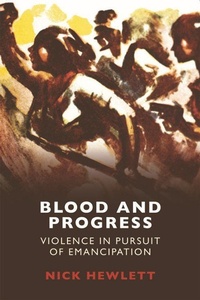
Blood and Progress
Violence in Pursuit of Emancipation
Published on 20. September 2016
Book
Hardback
208 pages
978-1-4744-1059-5 (ISBN)
Description
How do we decide when violence in pursuit of emancipation is legitimate and what form - if any - should it take?
Every day, we hear about war, state repression, uprisings, suicide bombing, gang warfare, slavery and domestic abuse. Is it realistic to think of a future that is free from violence? And can we justify the paradox of violence in pursuit of a peaceful future? Nick Hewlett places the goal of a wholly peaceful society centre-stage to give us a new understanding of violence in pursuit of peace.
Hewlett brings together the modern history of capitalist violence and communist violence; political thought on insurgent violence; a passionate defence of the idea of peace and non-violence; and the political economy of contemporary capitalism. He explores topics ranging from the prospects for peace and non-violence to Fidel Castro's ethics of guerrilla warfare, and from the brutality of US foreign policy and the violence of historical communism to the meaning of terrorism today.
Strongly argued and supported by a wealth of facts, Blood and Progress is suffused with the profound belief that we need to go beyond the inequalities and injustices of the current age and towards societies characterised by equality, deep democracy and peace.
Every day, we hear about war, state repression, uprisings, suicide bombing, gang warfare, slavery and domestic abuse. Is it realistic to think of a future that is free from violence? And can we justify the paradox of violence in pursuit of a peaceful future? Nick Hewlett places the goal of a wholly peaceful society centre-stage to give us a new understanding of violence in pursuit of peace.
Hewlett brings together the modern history of capitalist violence and communist violence; political thought on insurgent violence; a passionate defence of the idea of peace and non-violence; and the political economy of contemporary capitalism. He explores topics ranging from the prospects for peace and non-violence to Fidel Castro's ethics of guerrilla warfare, and from the brutality of US foreign policy and the violence of historical communism to the meaning of terrorism today.
Strongly argued and supported by a wealth of facts, Blood and Progress is suffused with the profound belief that we need to go beyond the inequalities and injustices of the current age and towards societies characterised by equality, deep democracy and peace.
More details
Language
English
Place of publication
Edinburgh
United Kingdom
Target group
College/higher education
Product notice
sewn/stitched
Cloth over boards
Dimensions
Height: 236 mm
Width: 157 mm
Thickness: 18 mm
Weight
476 gr
ISBN-13
978-1-4744-1059-5 (9781474410595)
Copyright in bibliographic data and cover images is held by Nielsen Book Services Limited or by the publishers or by their respective licensors: all rights reserved.
Schweitzer Classification
Other editions
Additional editions
E-Book
08/2016
1st Edition
Edinburgh University Press
€0.00
Available for download
Person
Nick Hewlett is Professor of French Studies at the University of Warwick.
Content
AcknowledgementsIntroduction
1. Non-violence as an imperative goalUtopiasModernity, liberalism and non-violence The Post-war period in the West Elias, Pinker and the 'civilizing thesis'Feminism, feminization and maternalismModern medicine
2. Capitalism, communism and violenceThe other side of modernity Communism and violenceUS violence abroad since 1945Structural violenceLate capitalism and its futures
3. Castro, humanism and revolutionHistory will absolve meCuba's history of violenceCastro's ethics of violenceInfluences on Castro's thoughtCuba and the USA With and beyond Castro
4. Marx, Engels and the place of violence in historyEngels's theory of GewaltLenin and the October RevolutionThe structural violence of modernity(Re-)interpreting and complementing Marx and Engels's ethics of violenceBalibar's critique of Marx on violence
5. Terror and terrorismDefining TerrorismTerrorism from above, terrorism from below The Middle East Islamic State of Iraq and the Levant (ISIS)
ConclusionsReferences and bibliographyIndex
1. Non-violence as an imperative goalUtopiasModernity, liberalism and non-violence The Post-war period in the West Elias, Pinker and the 'civilizing thesis'Feminism, feminization and maternalismModern medicine
2. Capitalism, communism and violenceThe other side of modernity Communism and violenceUS violence abroad since 1945Structural violenceLate capitalism and its futures
3. Castro, humanism and revolutionHistory will absolve meCuba's history of violenceCastro's ethics of violenceInfluences on Castro's thoughtCuba and the USA With and beyond Castro
4. Marx, Engels and the place of violence in historyEngels's theory of GewaltLenin and the October RevolutionThe structural violence of modernity(Re-)interpreting and complementing Marx and Engels's ethics of violenceBalibar's critique of Marx on violence
5. Terror and terrorismDefining TerrorismTerrorism from above, terrorism from below The Middle East Islamic State of Iraq and the Levant (ISIS)
ConclusionsReferences and bibliographyIndex