

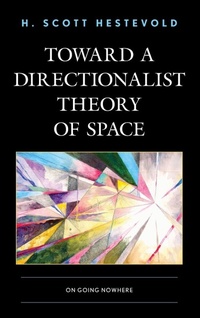
Toward a Directionalist Theory of Space
On Going Nowhere
Published on 2. July 2020
Book
Hardback
220 pages
978-1-4985-7996-4 (ISBN)
Description
In Toward a Directionalist Theory of Space: On Going Nowhere, H. Scott Hestevold formulates a new relationalist theory of space by appealing to the view that the universe is directioned and that there thereby exist spatial relations that Leibniz overlooked-directional relations such that specific directional relations would obtain between any two objects. This directionalist/relationalist theory would allow the reduction of space-implying claims to claims about objects and the directional relations they exhibit, and it would also preserve absolutist intuitions that motivate standard arguments for substantivalist space:intuitions involving, for example, absolute motion and the possibility that all objects are moving uniformly.
Extending the directionalist/relationalist theory of space to the Special Composition Question, Hestevold addresses the problem of when discrete objects compose a whole. He also uses the directionalist/relationalist theory to formulate reductivist theories of boundaries and holes-theories that may allow one to resist the view that boundaries and holes are ontologically parasitic entities. Finally, he explores directionalism/relationalism vis-a-vis spacetime, addressing questions such as whether the findings of modern physics provide adequate evidence that substantivalist spacetime exists; what problems underlie the dispute between spacetime substantivalists and relationalists; and in light of evidence for substantivalist spacetime, what ontological benefit follows from an endorsement of spacetime directional relations?
Extending the directionalist/relationalist theory of space to the Special Composition Question, Hestevold addresses the problem of when discrete objects compose a whole. He also uses the directionalist/relationalist theory to formulate reductivist theories of boundaries and holes-theories that may allow one to resist the view that boundaries and holes are ontologically parasitic entities. Finally, he explores directionalism/relationalism vis-a-vis spacetime, addressing questions such as whether the findings of modern physics provide adequate evidence that substantivalist spacetime exists; what problems underlie the dispute between spacetime substantivalists and relationalists; and in light of evidence for substantivalist spacetime, what ontological benefit follows from an endorsement of spacetime directional relations?
Reviews / Votes
"Hestevold's book is a sophisticated, well-informed, and original treatment of thorny issues in analytic metaphysics. He grounds his discussion of space and directionality in the classic debate between Newton and Leibniz, but deftly takes it into the contemporary relativistic understanding of spacetime, with much to say about composition, persistence, continuity, and dependent particulars along the way. " -- Steven D. Hales, Bloomsburg UniversityMore details
Series
Language
English
Place of publication
United States
Publishing group
Bloomsbury Publishing Plc
Target group
Professional and scholarly
Product notice
sewn/stitched
Cloth over boards
With dust jacket
Illustrations
11 BW Illustrations
Dimensions
Height: 235 mm
Width: 157 mm
Thickness: 18 mm
Weight
515 gr
ISBN-13
978-1-4985-7996-4 (9781498579964)
Copyright in bibliographic data and cover images is held by Nielsen Book Services Limited or by the publishers or by their respective licensors: all rights reserved.
Schweitzer Classification
Other editions
Additional editions
E-Book
07/2020
1st Edition
Lexington Books
€35.49
Available for download
Person
H. Scott Hestevold is professor emeritus of philosophy at The University of Alabama.
Content
PrefaceChapter 1: The Map to Nowhere and Beyond
Chapter 2: Spatial Directionalism
Chapter 3: A Directionalist Theory of Space
Chapter 4: Defending Spacelessness
Chapter 5: The Special Composition Question Revisited
Chapter 6: Is the Road to Nowhere Without Boundaries and Holes?
Chapter 7: Is Modern Physics a Roadblock to Going Nowhere?
Bibliography
Chapter 2: Spatial Directionalism
Chapter 3: A Directionalist Theory of Space
Chapter 4: Defending Spacelessness
Chapter 5: The Special Composition Question Revisited
Chapter 6: Is the Road to Nowhere Without Boundaries and Holes?
Chapter 7: Is Modern Physics a Roadblock to Going Nowhere?
Bibliography