

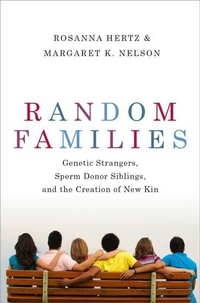
Random Families
Genetic Strangers, Sperm Donor Siblings, and the Creation of New Kin
Published on 20. December 2018
Book
Hardback
312 pages
978-0-19-088827-5 (ISBN)
Description
The ready availability of donated sperm and eggs has made possible an entirely new form of family. Children of the same donor and their families, with the help of the internet, can now locate each other and make contact. Sometimes this network of families form meaningful connections that blossom into longstanding groups, and close friendships. This book is about unprecedented families that have grown up at the intersection of new reproductive technologies, social media and the human desire for belonging.
Random Families asks: Do shared genes make you a family? What do couples do when they discover that their children shares half their DNA with a dozen or more other offspring from the same sperm donor? What do kids find in common with their donor siblings? What becomes of these chance networks once parents and donor siblings find one another?
Based on over 350 interviews with children (ages 10-28) and their parents from all over the U.S., Random Families chronicles the chain of choices that couples and single mothers make from what donor to use to how to participate (or not) in donor sibling networks. Children reveal their understanding of a donor, the donor's spot on the family tree and the meaning of their donor siblings. Through rich first-person accounts of network membership, the book illustrates how these extraordinary relationships--woven from bits of online information and shared genetic ties-- are transformed into new possibilities for kinship.
Random Families offers down-to-earth stories from real families to highlight just how truly distinctive these contemporary new forms of family are.
Random Families asks: Do shared genes make you a family? What do couples do when they discover that their children shares half their DNA with a dozen or more other offspring from the same sperm donor? What do kids find in common with their donor siblings? What becomes of these chance networks once parents and donor siblings find one another?
Based on over 350 interviews with children (ages 10-28) and their parents from all over the U.S., Random Families chronicles the chain of choices that couples and single mothers make from what donor to use to how to participate (or not) in donor sibling networks. Children reveal their understanding of a donor, the donor's spot on the family tree and the meaning of their donor siblings. Through rich first-person accounts of network membership, the book illustrates how these extraordinary relationships--woven from bits of online information and shared genetic ties-- are transformed into new possibilities for kinship.
Random Families offers down-to-earth stories from real families to highlight just how truly distinctive these contemporary new forms of family are.
Reviews / Votes
Random Families is an impressive book...provides lessons for academics in a variety of disciplines, for those working in the field, and for those who recognize themselves in the book's stories. Ultimately, the book challenges us to think about families in new ways. * Naomi Cahn, George Washington Law School, Society * Rosanna Hertz and Margaret Nelson provide an important and significant expansion of the field [of donor kinship]. At the core of the book is a sociological investigation and analysis of whether and how strangers become relatives, and what happens to the meaning of family as these strangers who share genes manage their new relationships. Random Families is an impressive book Ultimately, this is not a neatly tied package of family connections but instead an analysis, an attempt to create a narrative to describe these otherwise unscripted relationships (p. 198) that are so different from other kinship-based bonds. * , Society * add[s] substantially to the literature on Americans' changing families, family values, and behaviors. This clearly written and organized text ... [is] a groundbreaking and illuminating study ... Highly recommended. * W. Feigelman, CHOICE * Hertz and Nelson's approach is a welcome addition to the scholarship on searching for genetic relations among donor-conceived people and their parents . . . Random Families is an intellectually honest account of the complexity, and diversity, of same-donor networks . . . What becomes of these [donor network] possibilities remains to be seen, but for bringing them to light, Random Families deserves recognition. * Science *More details
Language
English
Place of publication
New York
United States
Target group
Professional and scholarly
Product notice
sewn/stitched
Cloth over boards
Illustrations
1 line drawing ; 6 halftones
Dimensions
Height: 241 mm
Width: 161 mm
Thickness: 30 mm
Weight
549 gr
ISBN-13
978-0-19-088827-5 (9780190888275)
Copyright in bibliographic data and cover images is held by Nielsen Book Services Limited or by the publishers or by their respective licensors: all rights reserved.
Schweitzer Classification
Other editions
Additional editions
Rosanna Hertz | Margaret K. Nelson
Random Families
Genetic Strangers, Sperm Donor Siblings, and the Creation of New Kin
Book
09/2020
Oxford University Press Inc
€31.10
Shipment within 15-20 days
Rosanna Hertz | Margaret K. Nelson
Random Families
Genetic Strangers, Sperm Donor Siblings, and the Creation of New Kin
E-Book
11/2018
1st Edition
OUP eBook
€9.99
Available for download
Rosanna Hertz | Margaret K. Nelson
Random Families
Genetic Strangers, Sperm Donor Siblings, and the Creation of New Kin
E-Book
11/2018
1st Edition
OUP eBook
€9.99
Available for download
Persons
Rosanna Hertz is the 1919 50th Reunion Professor of Sociology and Women's and Gender Studies at Wellesley College. She authored Single by Chance, Mothers by Choice, a path-breaking study of women who choose parenthood without marriage. Her first major book was More Equal than Others: Women and Men in Dual-Career Marriages.
Margaret K. Nelson is the A. Barton Hepburn Professor of Sociology Emerita at Middlebury College. Her books include Working Hard and Making Do: Surviving in Small Town America (with Joan Smith), and Parenting Out of Control: Anxious Parents in Uncertain Times.
Margaret K. Nelson is the A. Barton Hepburn Professor of Sociology Emerita at Middlebury College. Her books include Working Hard and Making Do: Surviving in Small Town America (with Joan Smith), and Parenting Out of Control: Anxious Parents in Uncertain Times.
Author
Classes of 1919-1950 Reunion Professor of Sociology and Women's and Gender StudiesClasses of 1919-1950 Reunion Professor of Sociology and Women's and Gender Studies, Wellesley College
A. Barton Hepburn Professor of Sociology EmeritaA. Barton Hepburn Professor of Sociology Emerita, Middlebury College
Content
Introduction: Unprecedented Relationships
Part I: Making Sense of the Donor and Donor Siblings
Chapter 1. Choosing Donors
Chapter 2. Inventing the Donor / Inventing the Self
Chapter 3. Parents Make Contact with Genetic Strangers
Chapter 4. The Surprise of donor siblings
Part II: Networks of Donor Siblings
Chapter 5. Michael's Clan: The Arrival of the Father
Chapter 6. 7008 Builders: We are Family
Chapter 7. The Tourists: Just Related Strangers
Chapter 8. Connected Soul Mates: Emotional Ties
Chapter 9. The Social Capitalists: Joining The Preschoolers Group
Chapter 10. Donor Sibling Networks: Continuity and Change
Conclusion: Choice in Donor Sibling Networks
Appendix A: Respondents
Appendix B: Interviews, Virtual Ethnography And Language In The Book
Endnotes
Bibliography
Part I: Making Sense of the Donor and Donor Siblings
Chapter 1. Choosing Donors
Chapter 2. Inventing the Donor / Inventing the Self
Chapter 3. Parents Make Contact with Genetic Strangers
Chapter 4. The Surprise of donor siblings
Part II: Networks of Donor Siblings
Chapter 5. Michael's Clan: The Arrival of the Father
Chapter 6. 7008 Builders: We are Family
Chapter 7. The Tourists: Just Related Strangers
Chapter 8. Connected Soul Mates: Emotional Ties
Chapter 9. The Social Capitalists: Joining The Preschoolers Group
Chapter 10. Donor Sibling Networks: Continuity and Change
Conclusion: Choice in Donor Sibling Networks
Appendix A: Respondents
Appendix B: Interviews, Virtual Ethnography And Language In The Book
Endnotes
Bibliography