

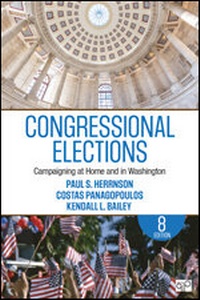
Congressional Elections
Campaigning at Home and in Washington
8th Edition
Published on 7. May 2020
Book
Paperback/Softback
408 pages
978-1-5443-2308-4 (ISBN)
Description
"It is the gold standard for texts on congressional campaigns and elections."
- Bruce A. Larson, Gettysburg College
In Congressional Elections: Campaigning at Home and in Washington authors Paul Herrnson and Costas Panagopoulos combine top-notch research with real-world politics as they argues that successful candidates run two campaigns: one for votes, the other for resources. Using campaign finance data, original survey research, and hundreds of interviews with candidates and political insiders, Herrnson and Panagopoulos look at how this dual strategy affects who wins and how it ultimately shapes the entire electoral system. The Eighth Edition considers the impact of the Internet and social media on campaigning in the 2018 elections; the growing influence of interest groups; and the influence of new voting methods on candidate, party, and voter mobilization tactics.
- Bruce A. Larson, Gettysburg College
In Congressional Elections: Campaigning at Home and in Washington authors Paul Herrnson and Costas Panagopoulos combine top-notch research with real-world politics as they argues that successful candidates run two campaigns: one for votes, the other for resources. Using campaign finance data, original survey research, and hundreds of interviews with candidates and political insiders, Herrnson and Panagopoulos look at how this dual strategy affects who wins and how it ultimately shapes the entire electoral system. The Eighth Edition considers the impact of the Internet and social media on campaigning in the 2018 elections; the growing influence of interest groups; and the influence of new voting methods on candidate, party, and voter mobilization tactics.
Reviews / Votes
"It is, in my view, the best of the congressional elections texts." -- John Dinan "In a few words: comprehensive, well-written, and timely. Herrnson was among the first to detect the role of the party-in-the-campaign centered in Washington, D.C., and the intervening years have proved him right." -- John White "This book is an excellent, engaging read in which students can learn a lot about the myths and realities of how congressional elections operate." -- Ken MoffettMore details
Edition
8th Revised edition
Language
English
Place of publication
Washington
United States
Publishing group
SAGE Publications Inc
Target group
College/higher education
Edition type
Revised edition
Dimensions
Height: 229 mm
Width: 152 mm
Weight
436 gr
ISBN-13
978-1-5443-2308-4 (9781544323084)
Copyright in bibliographic data and cover images is held by Nielsen Book Services Limited or by the publishers or by their respective licensors: all rights reserved.
Schweitzer Classification
Other editions
Previous edition
Book
01/2016
7th Edition
SAGE Publications Inc
€77.03
Article exhausted; check for reprint
Persons
Paul S. Herrnson is director of the Center for American Politics and Citizenship and professor of government and politics at the University of Maryland. He is the author of Congressional Elections: Campaigning at Home and in Washington, 4th ed. (2004) and Party Campaigning in the 1980s (1988) and coauthor of The Financiers of Congressional Elections (2003). He is coeditor of several volumes, including War Stories from Capitol Hill (2003), Responsible Partisanship? The Evolution of American Political Parties Since 1950 (2003), Multiparty Politics in America, 2nd ed. (2002), and Playing Hardball: Campaigning for the U.S. Congress (2000). He has served as an American Political Science Association congressional fellow and has received several teaching awards, including an Excellence in Teaching Award from the University of Maryland.
Costas Panagopoulos is a visiting professor of Political Science and a fellow at the Center for the Study of American Politics at Yale University for the 2015-2016 academic year. He is also Professor of Political Science and Director of the Center for Electoral Politics and Democracy and the graduate program in Elections and Campaign Management at Fordham University. A leading expert on campaigns and elections, voting behavior, media and public opinion, campaign strategy and campaign finance, Dr. Panagopoulos has published numerous book and dozens of articles, including A Citizens' Guide to U.S. Elections: Empowering Democracy in America (coauthored with Aaron Weinschenk, Routledge, 2016). He has also been part of the Decision Desk team at NBC News since the 2006 election cycle. In 1992, while a student at Harvard University, Dr. Panagopoulos was a candidate for the Massachusetts State Legislature.
Costas Panagopoulos is a visiting professor of Political Science and a fellow at the Center for the Study of American Politics at Yale University for the 2015-2016 academic year. He is also Professor of Political Science and Director of the Center for Electoral Politics and Democracy and the graduate program in Elections and Campaign Management at Fordham University. A leading expert on campaigns and elections, voting behavior, media and public opinion, campaign strategy and campaign finance, Dr. Panagopoulos has published numerous book and dozens of articles, including A Citizens' Guide to U.S. Elections: Empowering Democracy in America (coauthored with Aaron Weinschenk, Routledge, 2016). He has also been part of the Decision Desk team at NBC News since the 2006 election cycle. In 1992, while a student at Harvard University, Dr. Panagopoulos was a candidate for the Massachusetts State Legislature.
Content
Tables and Figures
Preface
Authorship and Acknowledgments
Introduction
Chapter 1 The Strategic Context
The Candidate-Centered Campaign
The Institutional Framework
Political Culture
Campaign Technology
The Political Setting
Recent Congressional Elections
Chapter 2 Candidates and Nominations
Strategic Ambition
Passing the Primary Test
Nominations, Elections, and Representation
The Senate
Chapter 3 The Anatomy of a Campaign
Campaign Organizations
Campaign Budgets
Senate Campaigns
Chapter 4 The Parties Campaign
National Agenda-Setting
National, Congressional, and Senatorial Campaign Committees
Strategy, Decision-Making, and Targeting
Campaign Contributions and Coordinated Expenditures
Campaign Services
Outside Campaigns
The Impact of Party Campaigning
Chapter 5 The Interests Campaign
Organizing for Electoral Influence
Strategy, Decision-Making, and Targeting
PAC Contributions
Campaign Services
Outside Campaigns
The Impact of Interest Group Activity
Chapter 6 The Campaign for Resources
Inequalities in Resources
House Incumbents
House Challengers
Candidates for House Open Seats
Senate Campaigns
Single-Candidate Super PACs and 501(c) Organizations
Female Candidates, Political Movements, and Campaign Fundraising
Chapter 7 Campaign Strategy
Voting Behavior
Voters and Campaign Strategy
Gauging Public Opinion
Voter Targeting
The Message
Chapter 8 Campaign Communications
Television Advertising
Radio Advertising
Newspaper Advertising
Direct Mail and Newsletters
Telephone Calls
Digital Advertising
Free Media
Attracting Coverage
Fieldwork
The Importance of Different Communications Techniques
Outside Campaigns
Chapter 9 Candidates, Campaigns, and Electoral Success
House Incumbent Campaigns
House Challenger Campaigns
House Open-Seat Campaigns
Senate Campaigns
Claiming Credit and Placing Blame
Chapter 10 Elections and Governance
The Permanent Campaign
A Decentralized Congress
Political Parties as Centralizing Agents
Responsiveness, Responsibility, and Public Policy
Chapter 11 Campaign Reform
The Case for Reform
Obstacles to Reform
The BCRA and the DISCLOSE Act
The NVRA and the HAVA
Some Ideas for Reform
Notes
Name Index
Index
Preface
Authorship and Acknowledgments
Introduction
Chapter 1 The Strategic Context
The Candidate-Centered Campaign
The Institutional Framework
Political Culture
Campaign Technology
The Political Setting
Recent Congressional Elections
Chapter 2 Candidates and Nominations
Strategic Ambition
Passing the Primary Test
Nominations, Elections, and Representation
The Senate
Chapter 3 The Anatomy of a Campaign
Campaign Organizations
Campaign Budgets
Senate Campaigns
Chapter 4 The Parties Campaign
National Agenda-Setting
National, Congressional, and Senatorial Campaign Committees
Strategy, Decision-Making, and Targeting
Campaign Contributions and Coordinated Expenditures
Campaign Services
Outside Campaigns
The Impact of Party Campaigning
Chapter 5 The Interests Campaign
Organizing for Electoral Influence
Strategy, Decision-Making, and Targeting
PAC Contributions
Campaign Services
Outside Campaigns
The Impact of Interest Group Activity
Chapter 6 The Campaign for Resources
Inequalities in Resources
House Incumbents
House Challengers
Candidates for House Open Seats
Senate Campaigns
Single-Candidate Super PACs and 501(c) Organizations
Female Candidates, Political Movements, and Campaign Fundraising
Chapter 7 Campaign Strategy
Voting Behavior
Voters and Campaign Strategy
Gauging Public Opinion
Voter Targeting
The Message
Chapter 8 Campaign Communications
Television Advertising
Radio Advertising
Newspaper Advertising
Direct Mail and Newsletters
Telephone Calls
Digital Advertising
Free Media
Attracting Coverage
Fieldwork
The Importance of Different Communications Techniques
Outside Campaigns
Chapter 9 Candidates, Campaigns, and Electoral Success
House Incumbent Campaigns
House Challenger Campaigns
House Open-Seat Campaigns
Senate Campaigns
Claiming Credit and Placing Blame
Chapter 10 Elections and Governance
The Permanent Campaign
A Decentralized Congress
Political Parties as Centralizing Agents
Responsiveness, Responsibility, and Public Policy
Chapter 11 Campaign Reform
The Case for Reform
Obstacles to Reform
The BCRA and the DISCLOSE Act
The NVRA and the HAVA
Some Ideas for Reform
Notes
Name Index
Index