

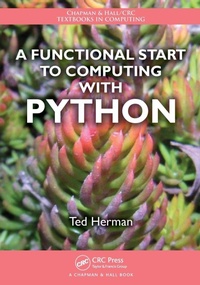
A Functional Start to Computing with Python
1st Edition
Published on 26. July 2013
Book
Paperback/Softback
429 pages
978-1-4665-0455-4 (ISBN)
Description
A Functional Start to Computing with Python enables students to quickly learn computing without having to use loops, variables, and object abstractions at the start. Requiring no prior programming experience, the book draws on Python's flexible data types and operations as well as its capacity for defining new functions. Along with the specifics of Python, the text covers important concepts of computing, including software engineering motivation, algorithms behind syntax rules, advanced functional programming ideas, and, briefly, finite state machines.
Taking a student-friendly, interactive approach to teach computing, the book addresses more difficult concepts and abstractions later in the text. The author presents ample explanations of data types, operators, and expressions. He also describes comprehensions-the powerful specifications of lists and dictionaries-before introducing loops and variables. This approach helps students better understand assignment syntax and iteration by giving them a mental model of sophisticated data first.
Web ResourceThe book's supplementary website at http://functionalfirstpython.com/ provides many ancillaries, including:
Interactive flashcards on Python language elements
Links to extra support for each chapter
Unit testing and programming exercises
An interactive Python stepper tool
Chapter-by-chapter points
Material for lectures
Taking a student-friendly, interactive approach to teach computing, the book addresses more difficult concepts and abstractions later in the text. The author presents ample explanations of data types, operators, and expressions. He also describes comprehensions-the powerful specifications of lists and dictionaries-before introducing loops and variables. This approach helps students better understand assignment syntax and iteration by giving them a mental model of sophisticated data first.
Web ResourceThe book's supplementary website at http://functionalfirstpython.com/ provides many ancillaries, including:
Interactive flashcards on Python language elements
Links to extra support for each chapter
Unit testing and programming exercises
An interactive Python stepper tool
Chapter-by-chapter points
Material for lectures
More details
Series
Language
English
Place of publication
Bosa Roca
United States
Publishing group
Taylor & Francis Inc
Target group
College/higher education
Undergraduate students in computer science (CS1 courses); professionals interested in Python programming.
Illustrations
1 s/w Tabelle, 52 s/w Abbildungen
1 Tables, black and white; 52 Illustrations, black and white
Dimensions
Height: 254 mm
Width: 178 mm
Thickness: 23 mm
Weight
804 gr
ISBN-13
978-1-4665-0455-4 (9781466504554)
Copyright in bibliographic data and cover images is held by Nielsen Book Services Limited or by the publishers or by their respective licensors: all rights reserved.
Schweitzer Classification
Other editions
Additional editions
Ted Herman
A Functional Start to Computing with Python
Book
07/2017
1st Edition
CRC Press
€297.12
Shipment within 10-20 days
Ted Herman
A Functional Start to Computing with Python
E-Book
07/2013
1st Edition
Chapman & Hall/CRC
€121.99
Available for download
Ted Herman
A Functional Start to Computing with Python
E-Book
07/2013
1st Edition
Chapman & Hall/CRC
€121.99
Available for download
Person
Ted Herman
Content
Motivation and Background: Inspirations of Computing. Preview of Computing with Python. General Landscape of Computing Languages. Python Setup. Functional-Style Python: Types. Operators. Expressions. Printing. Functions I. Functions II. Conditional Logic. Slice, Split, Join. Comprehensions. Functional Patterns. Imperative-Style Python: Names for Data. Functions and Variables. Mutation. Modules. Repetition. Documentation. Debugging. Accumulation Loop Patterns. Search Loop Patterns. Drawing. Input and Output. Network Programs. Objects, Classes, and Inheritance. Randomness, Time, and System Modules. Graphical User Interfaces. Appendices. Index.