

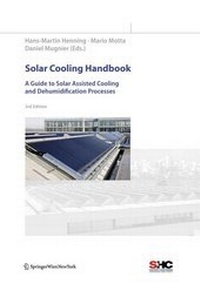
Solar Cooling Handbook
A Guide to Solar Assisted Cooling and Dehumidification Processes
3rd Edition
Published on 1. June 2013
Book
Hardback
270 pages
978-3-7091-0841-3 (ISBN)
Description
Our energy system faces a fundamental transformation and renewable energies will play a dominant role in the future energy supply. One of the promising solutions is the use of solar thermal energy in buildings, for cooling, heating and domestic hot water preparation. Solar thermal systems for providing heat and cold to industrial processes show a high potential, too. In the last decade, the application of solar driven cooling systems achieved a significant progress. Steps forward have been taken in the design of system concepts to specific needs and in more reliable and efficient operation of the installed plants. New systems are available on the market and cover a broad range of cooling capacities and driving temperatures. This handbook provides an overview on the various solutions to convert solar heat into useful cooling, reports about experiences made with realized installations and gives support in the design process. Its use will strongly contribute to achieve high quality solar cooling systems which provide significant energy savings and fulfil the user's requirements in a safe and reliable way.
More details
Edition
3rd ed. 2013
Language
English
Place of publication
Vienna
Austria
Target group
Professional and scholarly
Professional/practitioner
Edition type
Revised edition
Illustrations
250 farbige Abbildungen
250 colour illustrations
Dimensions
Height: 297 mm
Width: 210 mm
ISBN-13
978-3-7091-0841-3 (9783709108413)
Copyright in bibliographic data and cover images is held by Nielsen Book Services Limited or by the publishers or by their respective licensors: all rights reserved.
Schweitzer Classification
Other editions
Previous edition
Book
08/2007
2nd Edition
Springer
€53.45
Article exhausted; check for reprint
Persons
Dr. Hans-Martin Henning studied physics and has been working in the field of research and development since almost 20 years . Key topics of his work cover energy efficiency in buildings, solar energy systems with a particular focus on solar refrigeration and air-conditioning and materials and cycles for heat transformation, mainly based on adsorption technology. He is deputy director of the Fraunhofer Institute for Solar Energy Systems ISE in Freiburg/GERMANY. At this institute he is also responsible director of the division "Thermal Systems and Buildings". Dr. Mario Motta, is Mechanical Engineer, took his Master on "Energy Systems and the Environment" at Strathclyde University in Glasgow (UK) and a PhD on Thermodynamics at the University of Genoa (I) in 2002. He worked with a Marie Curie Individual fellowship for a post-doc position at the Fraunhofer Institute for Solar Energy Systems in Freiburg between 2002 and 2004. Since then he works at the Department of Energy of Politecnico di Milano, where he is Associate Professor and lecturer of HVAC systems for low energy houses and Engineering of Solar Thermal Processes. Solar assisted air-conditioning and refrigeration are among his main research interests from 2000. Dr Daniel Mugnier studied physics and energetics at the Ecole des Mines (diploma of Engineering + PhD) and works since almost 10 years in the field of Solar thermal technology (large DHW systems and solar air conditioning). He is working both inthe field of engineering and R&D. Key topics of his work cover solar thermal energy systems with a particular focus on solar heating and cooling. He is R&D manager in the French Engineering company TECSOL
Content
Part 1 Introduction.- Meteorological data and Heating and cooling loads calculation.- Components of solar thermal systems.- Heat driven cooling technologies: Closed cycles.- Heat driven cooling technologies: Open cycle systems.- Solar cooling systems characterization.- Energy and Economic figures for solar cooling Part 2 Overall system design, sizing, design tools.- Solar thermal system design issues.- Pre-engineered Systems: Built Examples and Experiences.- Experiences from installed custom made systems.- Experience on DEC Systems.- Trends and new development.- Summary & outlook.