

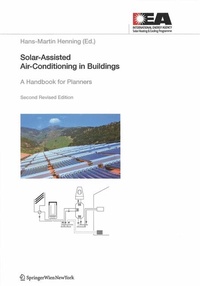
Solar-Assisted Air-Conditioning in Buildings
A Handbook for Planners
2nd Edition
Published on 1. August 2007
Book
Hardback
XIV, 150 pages
978-3-211-73095-9 (ISBN)
Description
This second edition of a hugely important work on this subject still plugs a gap in the literature. It is a source of crucial support to the planner in the design of solar assisted air-conditioning systems, which use solar collectors as a heat source. Air conditioning contributes significantly to the energy consumption of buildings in many countries and a promising possibility for energy reduction is the use of solar thermal energy in solar-assisted air conditioning systems. However, until today only a few systems have been installed world-wide and design and operation experiences are fairly poor.
More details
Edition
2nd revised edition
Language
English
Place of publication
Vienna
Austria
Publishing group
Springer Wien
Target group
Professional and scholarly
Professional/practitioner
Edition type
Revised edition
Illustrations
126 s/w Abbildungen
126 black & white illustrations
Dimensions
Height: 29.7 cm
Width: 21 cm
Weight
1020 gr
ISBN-13
978-3-211-73095-9 (9783211730959)
DOI
10.1007/978-3-211-75266-1
Schweitzer Classification
Other editions
New editions
H.-M. Henning | Mario Motta
Solar Cooling Handbook
A Guide to Solar Assisted Cooling and Dehumidification Processes
Book
06/2013
3rd Edition
Springer
€64.15
The article will not be published
Previous edition
Book
12/2003
Springer
€42.80
Article exhausted; check for reprint
Person
Dr. Hans-Martin Henning, Thermal Systems and Components Fraunhofer Institute for Solar Energy Systems (ISE)
Content
Editor's notes.- Authors, contributors.- Introduction.- COMPONENTS: The load sub-system - air-conditioning equipment: All-air systems; Water systems; Air-water systems.- The cold production sub-system: Chillers; Desiccant cooling systems; Other components of air-conditioning systems.- The heat production sub-system: Solar collectors and back-up heat source; Storage systems.- SYSTEMS: System configurations: examples, control and operation: Solar-assisted and solar thermally autonomous systems; Characterisation of solar-thermally driven cooling systems.- Design approaches: Rules of thumb; Comparison of solar collectors; Gross heat production of the collector; Correlation between solar gains and cooling (heating) loads; SACE method; TASK 25 design tool; Simulation programs.- Performance figures: Energy performance; Economic performance; Environmental benefits.- Design examples: The SARANTIS cosmetics factory at Inofita Viotias, Greece; An office building in Guadeloupe; The IHK desiccant cooling system in Freiburg, Germany.- Summary.- References.- Appendices: Example load parameters; Performance example parameters; The IEA Solar Heating & Cooling Programme; Task 25 Solar-Assisted Air-Conditioning of Buildings