

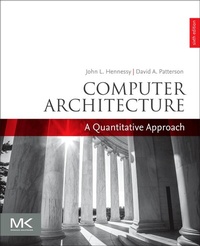
Computer Architecture
A Quantitative Approach
6th Edition
Published on 15. December 2017
Book
Paperback/Softback
936 pages
978-0-12-811905-1 (ISBN)
Description
Computer Architecture: A Quantitative Approach, Sixth Edition has been considered essential reading by instructors, students and practitioners of computer design for over 20 years. The sixth edition of this classic textbook from Hennessy and Patterson, winners of the 2017 ACM A.M. Turing Award recognizing contributions of lasting and major technical importance to the computing field, is fully revised with the latest developments in processor and system architecture. The text now features examples from the RISC-V (RISC Five) instruction set architecture, a modern RISC instruction set developed and designed to be a free and openly adoptable standard. It also includes a new chapter on domain-specific architectures and an updated chapter on warehouse-scale computing that features the first public information on Google's newest WSC.
True to its original mission of demystifying computer architecture, this edition continues the longstanding tradition of focusing on areas where the most exciting computing innovation is happening, while always keeping an emphasis on good engineering design.
True to its original mission of demystifying computer architecture, this edition continues the longstanding tradition of focusing on areas where the most exciting computing innovation is happening, while always keeping an emphasis on good engineering design.
Reviews / Votes
"What has made this book an enduring classic is that each edition is not an update, but an extensive revision that presents the most current information and unparalleled insight into this fascinating and fast changing field. For me, after over twenty years in this profession, it is also another opportunity to experience that student-grade admiration for two remarkable teachers." --From the Foreword by Luiz Andre Barroso, Google, Inc.More details
Series
Edition
6th edition
Language
English
Place of publication
San Francisco
United States
Publishing group
Elsevier Science & Technology
Target group
Professional and scholarly
College/higher education
Graduate students and professional computer architects, computer system designers, compiler and system software developers, programmers, application developers
Illustrations
45 illustrations
Dimensions
Height: 235 mm
Width: 191 mm
Weight
2030 gr
ISBN-13
978-0-12-811905-1 (9780128119051)
Copyright in bibliographic data and cover images is held by Nielsen Book Services Limited or by the publishers or by their respective licensors: all rights reserved.
Schweitzer Classification
Other editions
New editions
John L. Hennessy | David A. Patterson | Christos Kozyrakis
Computer Architecture
A Quantitative Approach
Book
11/2025
7th Edition
Morgan Kaufmann
€104.50
Available immediately
Additional editions
E-Book
11/2017
6th Edition
Morgan Kaufmann
€73.99
Available for download
Previous edition
Book
10/2011
5th Edition
Morgan Kaufmann
€80.47
Article exhausted; check for reprint
Persons
ACM named John L. Hennessy a recipient of the 2017 ACM A.M. Turing Award for pioneering a systematic, quantitative approach to the design and evaluation of computer architectures with enduring impact on the microprocessor industry. John L. Hennessy is a Professor of Electrical Engineering and Computer Science at Stanford University, where he has been a member of the faculty since 1977 and was, from 2000 to 2016, its tenth President. Prof. Hennessy is a Fellow of the IEEE and ACM; a member of the National Academy of Engineering, the National Academy of Science, and the American Philosophical Society; and a Fellow of the American Academy of Arts and Sciences. Among his many awards are the 2001 Eckert-Mauchly Award for his contributions to RISC technology, the 2001 Seymour Cray Computer Engineering Award, and the 2000 John von Neumann Award, which he shared with David Patterson. He has also received seven honorary doctorates. David Patterson is the Pardee Professor of Computer Science, Emeritus at the University of California at Berkeley, which he joined after graduating from UCLA in 1977.His teaching has been honored by the Distinguished Teaching Award from the University of California, the Karlstrom Award from ACM, and the Mulligan Education Medal and Undergraduate Teaching Award from IEEE. Prof. Patterson received the IEEE Technical Achievement Award and the ACM Eckert-Mauchly Award for contributions to RISC, and he shared the IEEE Johnson Information Storage Award for contributions to RAID. He also shared the IEEE John von Neumann Medal and the C & C Prize with John Hennessy. Like his co-author, Prof. Patterson is a Fellow of the American Academy of Arts and Sciences, the Computer History Museum, ACM, and IEEE, and he was elected to the National Academy of Engineering, the National Academy of Sciences, and the Silicon Valley Engineering Hall of Fame. He served on the Information Technology Advisory Committee to the U.S. President, as chair of the CS division in the Berkeley EECS department, as chair of the Computing Research Association, and as President of ACM. This record led to Distinguished Service Awards from ACM, CRA, and SIGARCH.
Content
Printed Text
1. Fundamentals of Quantitative Design and Analysis
2. Memory Hierarchy Design
3. Instruction-Level Parallelism and Its Exploitation
4. Data-Level Parallelism in Vector, SIMD, and GPU Architectures
5. Multiprocessors and Thread-Level Parallelism
6. The Warehouse-Scale Computer
7. Domain Specific Architectures
A. Instruction Set Principles
B. Review of Memory Hierarchy
C. Pipelining: Basic and Intermediate Concepts
Online
D. Storage Systems
E. Embedded Systems
F. Interconnection Networks
G. Vector Processors
H. Hardware and Software for VLIW and EPIC
I. Large-Scale Multiprocessors and Scientific Applications
J. Computer Arithmetic
K. Survey of Instruction Set Architectures
L. Advanced Concepts on Address Translation
M. Historical Perspectives and References
1. Fundamentals of Quantitative Design and Analysis
2. Memory Hierarchy Design
3. Instruction-Level Parallelism and Its Exploitation
4. Data-Level Parallelism in Vector, SIMD, and GPU Architectures
5. Multiprocessors and Thread-Level Parallelism
6. The Warehouse-Scale Computer
7. Domain Specific Architectures
A. Instruction Set Principles
B. Review of Memory Hierarchy
C. Pipelining: Basic and Intermediate Concepts
Online
D. Storage Systems
E. Embedded Systems
F. Interconnection Networks
G. Vector Processors
H. Hardware and Software for VLIW and EPIC
I. Large-Scale Multiprocessors and Scientific Applications
J. Computer Arithmetic
K. Survey of Instruction Set Architectures
L. Advanced Concepts on Address Translation
M. Historical Perspectives and References